

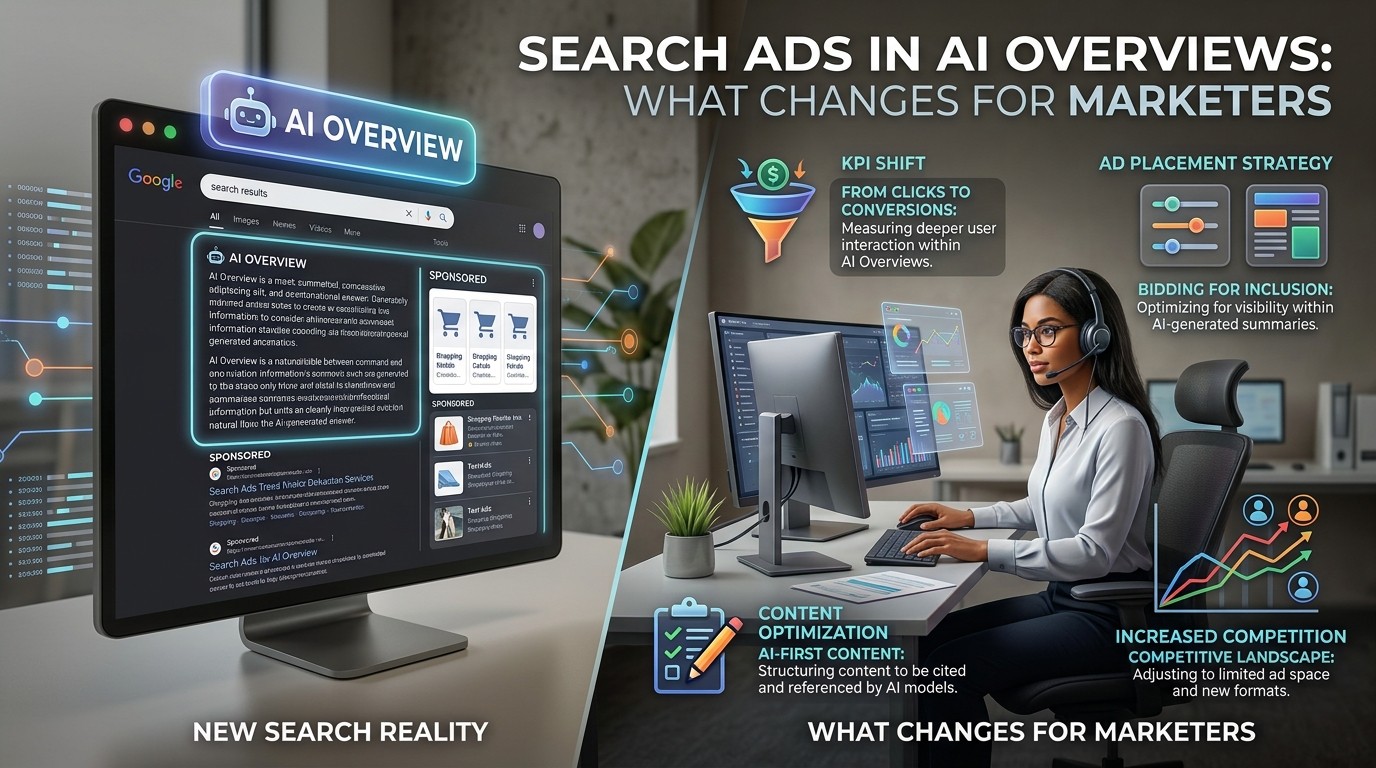
Search Ads in AI Overviews are changing how marketers approach intent, relevance, creative, measurement, and visibility as Google reshapes the search journey around AI-powered answers.
For years, Google Search advertising was built around a relatively predictable journey. A user typed a query, Google matched that query against eligible ads, the advertiser competed in an auction, and the user saw a familiar list of organic results and sponsored placements.
That model has not disappeared, but the environment around it is changing quickly.
Google’s AI-powered search experiences can now answer complex questions, summarize information, connect users with sources, and help people explore topics through longer and more conversational interactions. At the same time, Google has introduced advertising placements connected to these AI experiences.
For marketers, this means Search Ads in AI Overviews should not be treated as a minor visual adjustment to the existing search page.
They represent a change in context.
The user may no longer see an advertisement as an isolated message positioned above ten blue links. Instead, an ad may appear in an environment where Google has already interpreted the user’s question and generated an AI-powered response around it.
That creates both opportunity and pressure.
Search Ads in AI Overviews can give advertisers access to users during earlier and more complex moments of discovery. However, the advertiser must compete not only for relevance to the user’s query but also for relevance to the context of the AI-generated response.
Google’s current documentation says ads can appear above, below, or within AI Overviews. Ads shown within AI Overviews are currently available in English across a defined group of countries and can be served from existing Search, Shopping, and Performance Max campaigns. Google also states that both the user query and the content of the AI Overview can be considered when determining whether an ad is relevant.
That single development changes the strategic conversation.
The key question is no longer simply, “What keyword am I bidding on?”
It increasingly becomes:
“What does the user need, what does Google understand about that need, and how can my business become a useful next step?”
This article explains what Search Ads in AI Overviews mean for marketers, how the placements work, what changes for keyword strategy and creative, how measurement is evolving, and how businesses can prepare for the next stage of AI-driven search advertising.
What Are AI Overviews?
AI Overviews are AI-generated summaries that appear within Google Search when Google’s systems determine that a generative response can be useful for the query. Google describes them as a way for people to quickly understand information and explore the wider web.
They are particularly relevant to complex searches.
A traditional search might ask:
“best laptop for graphic design”
An AI-oriented query might ask:
“I am a freelance designer who travels frequently. I need a lightweight laptop with a strong display, enough RAM for Adobe applications, and good battery life. What should I look for?”
The second query provides considerably more intent.
It contains a problem, a user profile, constraints, priorities, and a decision framework.
This is exactly the kind of environment in which Search Ads in AI Overviews become interesting.
The search engine is not simply matching words.
It is interpreting the user’s broader need.
Google says AI Overviews commonly appear for queries where there may not be one simple answer or where information from multiple sources can help the user.
That means advertisers can encounter users before those users have reduced their need to a conventional transactional keyword.
Instead of waiting for “buy laptop online,” a marketer may have an opportunity around a complex research journey that eventually leads toward a purchase.
This does not mean every informational query suddenly becomes commercial.
Rather, Google’s systems can identify commercial intent within a broader journey.
That is one of the most important changes marketers need to understand.
Why Search Ads in AI Overviews Matter
Search advertising has historically been strongest when intent is obvious.
Queries containing terms such as “buy,” “price,” “near me,” “quote,” “discount,” or a specific product model can provide strong commercial signals.
But consumers do not always start there.
People research before they buy.
They compare before they commit.
They ask questions before they know which product or service is appropriate.
They often begin with uncertainty.
Search Ads in AI Overviews can potentially reach users during this uncertainty because the AI Overview itself can reveal the user’s underlying needs and the direction of the research journey.
Google gives an important example. A user may search a non-commercial question such as why a pool is green and how to clean it. The resulting AI Overview may discuss testing water, removing debris, or vacuuming the pool. Google says that understanding the query together with the AI Overview can reveal commercial intent and create an opportunity for relevant ads such as pool vacuum products.
That example demonstrates the core concept.
The commercial opportunity does not necessarily come from the literal wording of the query.
It can emerge from the problem the user is trying to solve.
This is why Search Ads in AI Overviews require marketers to think beyond keyword lists.
How Ads Appear Around AI Overviews
Google currently distinguishes between ads appearing above or below an AI Overview and ads appearing within the AI Overview itself.
Ads can show above or below AI Overviews in markets where AI Overviews are available. Google says existing text, Shopping, local, and app ads from eligible campaigns can participate in those placements.
Ads within the AI Overview are a more specific experience.
Google says the user’s query and the AI Overview content are both considered when determining eligibility and relevance. Text and Shopping ads from existing Search, Shopping, and Performance Max campaigns can currently be eligible to show within AI Overviews.
This distinction matters because marketers may mentally categorize all AI-related Search placements as one thing.
They are not.
An ad above an AI Overview competes in a conventional ad environment with a new page layout.
An ad inside an AI Overview exists within a generated answer that has already framed the topic.
That contextual difference can influence user expectations.
It can also influence which creative message feels relevant.
Search Ads in AI Overviews therefore create an environment where context becomes a more visible part of advertising relevance.
Search Ads in AI Overviews Do Not Use a Separate Campaign Type

A common misconception is that advertisers need to build a special campaign specifically designed for AI Overviews.
Google’s current documentation says ads in AI Overviews can be served from existing Search, Shopping, and Performance Max campaigns. Advertisers cannot directly target AI Overview placements as an independent placement.
That changes the implementation question.
Instead of asking:
“How do I create an AI Overview campaign?”
marketers should ask:
“Is my existing advertising infrastructure prepared to participate in AI-driven search experiences?”
That includes:
- conversion tracking
- keyword and intent strategy
- ad assets
- landing pages
- product data
- bidding
- business goals
- brand controls
This also means that Search Ads in AI Overviews should be approached as an extension of a broader Search strategy rather than an isolated media channel.
The Shift From Exact Queries to Complex Intent
Traditional keyword strategy tends to organize the world around phrases.
AI-powered Search is increasingly organized around meanings.
Consider a financial software company.
Traditional queries might include:
“accounting software”
“small business accounting software”
“best accounting software”
Now consider:
“I run a small ecommerce company with three employees and need software that can track expenses, send invoices, connect with my bank, and simplify tax reporting.”
The second search contains significantly richer intent.
A machine-learning system can potentially identify that the user is looking for a particular class of commercial solution even though the query may not contain the exact keywords traditionally used by advertisers.
Search Ads in AI Overviews become relevant because AI-generated context can bridge that gap.
The advertiser does not necessarily need to predict every possible wording.
The advertiser needs to establish the right signals and provide a compelling answer to the user’s underlying need.
What Changes for Keyword Research?
Keyword research is not becoming irrelevant.
It is becoming more strategic.
Marketers should still identify important commercial themes, product categories, customer problems, use cases, comparison queries, and buying signals.
But trying to create a keyword for every semantic variation becomes less important when Google can use AI-powered matching technologies to discover related demand.
This makes Search Ads in AI Overviews more compatible with intent-based keyword planning.
Instead of organizing a campaign around hundreds of microscopic variations, marketers can build around meaningful clusters.
For example:
Product Intent
Queries indicating that the user knows what product they want.
Problem Intent
Queries describing a problem that a product or service can solve.
Comparison Intent
Queries comparing solutions, features, brands, or approaches.
Use-Case Intent
Queries explaining how or where the product will be used.
Decision Intent
Queries expressing price, availability, location, reviews, or purchase requirements.
Search Ads in AI Overviews can potentially benefit from this broader intent framework because AI-generated responses often expose the context behind a user’s question.
Why Human Intent Mapping Still Matters
AI does not remove the need for customer research.
It increases the value of customer research.
The better a marketer understands why people search, the better the business can prepare its ads, landing pages, products, and conversion paths.
Ask:
What problem starts the journey?
What makes the user frustrated?
What information reduces uncertainty?
What objections prevent action?
What benefits matter most?
What signals indicate purchase readiness?
These questions reveal intent.
Search Ads in AI Overviews can then become another place where the business participates in that intent ecosystem.
The mistake is assuming that automation replaces customer psychology.
It does not.
Automation can process signals at enormous scale.
Humans still need to determine what those signals mean for the business.
Creative Changes: Ads Need to Feel Like the Next Step
The psychology of an ad inside or around an AI-generated answer is different from the psychology of an isolated ad.
The user may already have received a partial answer.
They may have learned several facts.
They may have seen recommendations or options.
They may now be asking:
“What should I do next?”
Search Ads in AI Overviews need to fit that transition.
Suppose a user asks:
“What should I look for when buying a beginner hiking backpack?”
The AI Overview may explain capacity, weight, rain protection, comfort, and fit.
A generic advertisement saying “Premium Backpacks Available” is weak.
An advertisement offering “Lightweight Hiking Backpacks With Adjustable Fit and Rain Protection” feels more connected to what the user just learned.
The difference is contextual relevance.
The advertiser is not simply matching the query.
The advertiser is participating in the decision process.
Search Ads in AI Overviews and the Psychology of Trust
AI-generated environments introduce another important factor: trust.
Users may assume that an AI-generated answer has already filtered information for them.
That makes the next commercial message more scrutinized.
The ad must feel credible.
That means marketers should avoid vague claims, exaggerated promises, and unsupported superlatives.
Specificity is more persuasive.
Proof is more persuasive.
Transparent pricing can be persuasive.
Clear product benefits can be persuasive.
A trustworthy landing page is essential.
Search Ads in AI Overviews should therefore reinforce rather than undermine the user’s confidence.
If the AI Overview says a user should consider durability, and the ad immediately communicates a specific durability benefit supported by product evidence, the message feels coherent.
If the ad suddenly makes an unrelated claim, the transition feels disruptive.
That is a psychological mismatch.
The Importance of Landing Pages
Landing pages become even more important when search experiences become more contextual.
Imagine someone receives an AI-generated explanation about how to choose a home security camera.
The overview discusses:
- night vision
- motion detection
- storage
- installation
- privacy
- mobile alerts
If the user clicks an ad and lands on a generic electronics category page with hundreds of unrelated products, the experience breaks.
Search Ads in AI Overviews should ideally lead into a page that continues the decision journey.
This could be:
- a focused product page
- a comparison page
- a category page
- a buying guide
- a solution page
- a service page
- a relevant consultation page
The landing page should answer the question created by the ad.
This is why website architecture increasingly matters for paid search.
AI Max and Broader Search Automation
Google’s AI-powered Search strategy is not limited to AI Overviews.
Google has also expanded AI Max for Search campaigns, which provides capabilities for broader search-term matching, text customization, and Final URL expansion. Google says AI Max can use broad match and keywordless technology to identify additional relevant queries and can adapt creative and destination pages based on context.
For Search Ads in AI Overviews, this is strategically significant.
Google’s own best-practice guidance for ads in AI Overviews recommends AI-powered targeting solutions such as broad match and keywordless targeting through AI Max for Search and other eligible campaign types, combined with smart bidding and strong creative.
This means AI Overview participation is increasingly connected to the broader automation stack.
Advertisers should not think about AI Overviews separately from their campaign’s matching and optimization architecture.
AI Max for Search Is Becoming More Important
The evolution of Google Ads makes AI Max increasingly relevant to Search marketers.
Google announced that AI Max for Search was moving out of beta in 2026 and that certain legacy Search features would transition toward AI Max. Google later updated the Dynamic Search Ads sunset timeline, saying DSA sunset and auto-upgrade would begin in February 2027, while certain other legacy configurations would be upgraded starting in September 2026.
This tells marketers something important.
Google is moving toward a more integrated AI-driven Search architecture.
Search Ads in AI Overviews are part of that larger transformation.
The future Search campaign is less likely to be defined solely by manually constructed keyword lists and individually written messages.
Instead, it will increasingly depend on:
- high-quality signals
- AI-powered matching
- strong creative foundations
- valuable website content
- reliable conversion data
- clear business objectives
Product Feeds Are Becoming More Valuable
The evolution becomes even more significant for ecommerce advertisers.
Google announced AI Max capabilities for Shopping campaigns in 2026 and described how Merchant Center product information can help AI understand product context and support conversational shopping experiences.
That gives structured product information a more strategic role.
Product data can communicate:
- what the product is
- what it is made from
- who it is for
- what features it has
- which variations exist
- what it costs
- whether it is available
For ecommerce marketers, Product Feeds for AI should therefore be treated as part of a broader information strategy.
The feed is not merely an inventory file.
It is a machine-readable explanation of the product.
Search Ads in AI Overviews can potentially benefit when the broader advertising ecosystem has access to accurate and detailed product information.
AI Product Promotion and Conversational Commerce

The meaning of AI Product Promotion is also expanding.
Traditional product advertising focused on explicit product searches.
Conversational commerce introduces more problem-oriented discovery.
A consumer might say:
“I need a comfortable office chair for working eight hours a day, but my home office is very small.”
This is not merely a product-name search.
It is a decision request.
The marketer needs product information that connects with:
- space
- comfort
- ergonomics
- work duration
- user needs
Google’s 2026 advertising roadmap shows increasing movement toward conversational and AI-powered ad formats, including new formats being tested in Search and Shopping.
Search Ads in AI Overviews sit within this much larger change in consumer behavior.
People increasingly expect search systems to help them decide, not merely retrieve pages.
Google AI Overview Context Can Change Ad Relevance
One of the most important technical details is that Google says ads shown within AI Overviews can be evaluated against both the user’s query and the content of the Google AI Overview.
This has a major implication for marketers.
The query alone may not explain the entire commercial opportunity.
The AI-generated response can reveal what the user is learning, considering, comparing, or trying to accomplish.
Search Ads in AI Overviews can therefore exist within a richer contextual environment than ordinary keyword matching suggests.
For example, a user may ask a broad question about renovating a kitchen.
The AI Overview might discuss cabinet materials, countertop options, installation complexity, and budget.
An advertiser selling cabinet hardware may become relevant even if the original query did not explicitly mention cabinet hardware.
The commercial context emerged through the answer.
This is a fundamental change in advertising opportunity.
Search Ads in AI Overviews and the Discovery-to-Decision Journey
Traditional funnel models often divide the journey into:
Awareness.
Consideration.
Decision.
AI-powered Search makes these stages more fluid.
A user can move between them inside a single conversational journey.
Search Ads in AI Overviews can potentially appear during that transition.
That creates opportunities for advertisers to position products and services as the natural next step.
The best advertisers will therefore think about content and advertising together.
Educational content can establish expertise.
Comparison content can reduce uncertainty.
Product pages can support evaluation.
Ads can provide the action.
The journey becomes an interconnected experience.
Measurement Is One of the Biggest Challenges
One of the biggest issues marketers should understand is reporting.
Google currently states that Google Ads does not offer segmented reporting specifically showing when an ad served within an AI Overview. Google says reporting remains focused on actionable information and that it is continuing to evaluate how reporting should evolve for this experience.
This means marketers cannot simply open a standard report and expect a clean “AI Overview” performance line.
Search Ads in AI Overviews therefore need to be evaluated using broader performance indicators.
Look at:
- conversions
- conversion value
- CPA
- ROAS
- qualified leads
- revenue
- customer acquisition cost
- search-term quality
- landing-page engagement
The absence of granular placement reporting does not mean measurement should stop.
It means marketers need to interpret performance carefully.
Why CTR Alone Is Not Enough
Click-through rate is often tempting because it is easy to understand.
But a higher CTR can come from lower-quality traffic.
Imagine a campaign receives significantly more clicks after broadening its reach.
That sounds positive.
But if conversion rates collapse, revenue does not increase, and customer quality declines, the additional traffic may not be valuable.
Search Ads in AI Overviews should therefore be evaluated against meaningful business objectives.
For ecommerce:
Did revenue increase?
Did profitable orders increase?
Did average order value remain healthy?
For lead generation:
Did qualified leads increase?
Did sales opportunities increase?
For B2B:
Did pipeline value increase?
Did closed revenue improve?
AI-powered discovery can create more interactions.
The challenge is separating interaction growth from business growth.
Conversion Tracking Becomes More Important
Automation depends on feedback.
If conversion data is wrong, the system receives the wrong feedback.
For ecommerce, purchase values should be accurate.
For lead generation, important downstream stages should be represented whenever possible.
For subscription businesses, a low-quality signup should not automatically be treated as equal to a valuable long-term customer.
Search Ads in AI Overviews operate within Google’s broader machine-learning ecosystem, so advertisers should carefully audit:
- primary conversion actions
- duplicate conversions
- value assignments
- imported offline conversions
- attribution
- lead qualification
- revenue tracking
The goal is to make the optimization signal reflect actual business success.
Search Ads in AI Overviews and Brand Protection
Broader context can be valuable, but brands still need boundaries.
A premium business may not want every contextual association.
A regulated company may have strict advertising requirements.
A local business may only serve specific geographic areas.
An enterprise may have competitor-related policies.
Google says ads in AI Overviews currently do not appear for several sensitive verticals, including categories such as adult, alcohol, gambling, finance, healthcare, and politics, among others.
This is an important reminder that AI search advertising is not a universal one-size-fits-all system.
Marketers need to understand both platform eligibility and their own brand requirements.
Search Ads in AI Overviews and Negative Keywords
Negative keywords can still play a useful role, but marketers should avoid treating them as a substitute for intent analysis.
Suppose a software company sells a paid platform.
It may legitimately want to exclude searches for:
free versions
cracked software
jobs
careers
unrelated tutorials
The goal should be to eliminate clearly unsuitable intent.
However, marketers should avoid excluding every unfamiliar phrase.
AI-driven Search can discover new wording that was not in the original keyword plan.
Search Ads in AI Overviews make this even more relevant because complex user journeys can produce queries that look informational while containing commercial potential.
The right question is:
“Is this the kind of customer we want?”
not:
“Does this phrase look exactly like our keyword?”
Creative Strategy Needs a Strong Human Foundation
AI-generated or dynamically adapted assets do not mean humans should stop writing good advertising.
They mean the human-created foundation matters more.
Your core headlines and descriptions should communicate:
- real benefits
- meaningful differentiators
- strong proof points
- brand positioning
- customer outcomes
- relevant offers
- clear calls to action
Search Ads in AI Overviews can perform within a context-sensitive environment, but the underlying message still needs to be persuasive.
Generic language remains generic even when an AI system delivers it.
Strong positioning gives automation better material to work with.
Google AI Overviews Change How Relevance Is Defined
Traditional ad relevance often focused on the relationship between the query, keyword, ad, and landing page.
AI search introduces another layer:
query → AI interpretation → generated context → ad relevance
This means marketers should think beyond lexical matching.
For example, an AI Overview may explain that a traveler planning a winter trip needs insulation, waterproofing, layering, and packability.
An outdoor brand can create a message that addresses those specific needs.
The advertisement feels relevant not simply because it contains the word “jacket,” but because it responds to the decision context.
That is the opportunity.
Content Strategy Now Influences Paid Search More Directly
The quality of your website increasingly matters to advertising.
Why?
Because your website can contain the detailed information needed to satisfy complex intent.
A product page may explain materials.
A comparison page may explain differences.
A buying guide may explain selection criteria.
A service page may explain the process.
A case study may demonstrate results.
Search Ads in AI Overviews become stronger when the ad and destination page continue a coherent information journey.
This suggests that SEO teams and PPC teams should collaborate more closely.
They do not need identical goals.
They do need aligned information.
AI Search Advertising Is Becoming More Contextual

AI Search Advertising increasingly depends on understanding what the user is trying to accomplish.
That means advertisers should organize their marketing around customer problems.
Suppose a home-improvement company sells insulation.
Customers may search:
“how to keep attic cool”
“why is my upstairs so hot”
“best insulation for summer heat”
“attic insulation cost”
These queries represent different stages of the same broader problem.
Search Ads in AI Overviews can potentially connect to users earlier in the journey because the AI-generated context can expose the underlying need.
This encourages marketers to build more complete solution ecosystems.
Instead of creating only a “Buy Insulation” page, the company may also create:
- cooling guides
- insulation comparisons
- cost explanations
- product information
- installation pages
The advertising system has more relevant destinations to work with.
How Marketers Should Prepare Their Websites
An AI-ready website should be understandable to both users and machines.
Use clear page titles.
Write descriptive product and service copy.
Explain important features.
Use logical navigation.
Build relevant internal links.
Keep information accurate.
Make prices and offers current.
Avoid contradictory statements.
Create dedicated pages for meaningful use cases.
Improve mobile usability.
Ensure pages load reliably.
Search Ads in AI Overviews may introduce users with more complex questions, so the landing experience needs to provide enough depth to satisfy them.
A generic page can waste a highly relevant click.
A Practical Strategy for Advertisers
A useful preparation framework can be divided into six areas.
1. Intent Mapping
Identify customer problems, use cases, questions, comparisons, and purchase signals.
2. Campaign Structure
Maintain meaningful commercial themes rather than chasing endless keyword variations.
3. Creative
Build strong, specific messages that communicate real value.
4. Website
Create landing pages that directly answer important user needs.
5. Measurement
Ensure conversions, values, and business outcomes are tracked accurately.
6. Experimentation
Test changes carefully instead of changing the whole account simultaneously.
Search Ads in AI Overviews require this type of system-level thinking.
What Google Recommends
Google’s own best-practice guidance for ads in AI Overviews recommends using AI-powered targeting solutions such as broad match or keywordless targeting technologies, combined with smart bidding and high-quality creative. Google explains that AI Overviews can surface complex queries that advertisers may not have explicitly targeted with keywords.
This is an important recommendation.
It suggests Google expects advertisers to move beyond highly restrictive keyword coverage when appropriate.
The logic is straightforward.
AI Overview queries can be complex.
Manual targeting may miss many of them.
AI-powered matching can potentially expand coverage.
Smart bidding can help determine which eligible opportunities are more valuable.
Creative can improve the relevance of the resulting advertisement.
Search Ads in AI Overviews therefore work as part of a connected optimization framework.
What Marketers Should Not Assume
There are several dangerous assumptions to avoid.
“Every AI Overview Has Ads”
Not necessarily.
Google determines when ads can show based on query, intent, eligibility, and relevance.
“I Can Target AI Overviews Directly”
Google currently says advertisers cannot directly target AI Overview placements.
“I Can See Every AI Overview Impression in a Report”
Google currently does not provide segmented placement reporting specifically for ads shown within AI Overviews.
“More AI Means Better Performance Automatically”
No.
Business results still depend on relevance, economics, data quality, creative, landing pages, and conversion signals.
“Keywords Are Dead”
No.
Keywords remain strategic signals, but the system can use broader contextual matching.
Search Ads in AI Overviews require a more sophisticated interpretation of all five assumptions.
The Competitive Advantage Will Shift
Historically, competitive advantage in Search could come from:
- better keyword research
- better bidding
- better ad copy
- higher Quality Score
- stronger landing pages
- stronger offers
Those factors still matter.
But AI-powered Search increases the value of information quality.
A business with detailed product information, accurate conversion data, strong pages, clear positioning, and useful content gives Google’s systems more context.
A business with vague pages, incomplete product information, poor tracking, and generic creative gives the system less useful information.
Search Ads in AI Overviews can therefore reward businesses that invest in their entire digital information infrastructure.
Search Ads in AI Overviews and Ecommerce
Ecommerce businesses should pay especially close attention because product discovery is changing.
A shopper may not know the exact product name.
They may describe a need.
For example:
“I want a lightweight carry-on that fits under the seat and still has enough space for a weekend trip.”
That is an intent-rich query.
A retailer with detailed product attributes, strong product pages, accurate Merchant Center information, and useful creative is better positioned to participate.
Search Ads in AI Overviews are part of an ecosystem that increasingly connects discovery and commerce.
Google’s 2026 announcements show continued investment in AI-powered Shopping experiences, including new ad formats designed around conversational product discovery.
Search Ads in AI Overviews and B2B Marketing
B2B marketers face an especially interesting opportunity.
B2B buyers rarely move directly from awareness to a demo request.
They research.
They compare.
They assess risks.
They look for case studies.
They investigate integrations.
They estimate costs.
AI-generated Search experiences can support these exploratory stages.
A buyer may ask:
“What should a 100-person company look for in customer support software?”
The AI Overview may explain ticketing, automation, analytics, integrations, and pricing considerations.
A B2B advertiser can position its solution around one or more of those decision factors.
Search Ads in AI Overviews can therefore potentially participate before the traditional “request demo” keyword appears.
This does not mean every informational query should be monetized.
The better strategy is to identify where educational intent naturally leads into commercial evaluation.
Search Ads in AI Overviews and Local Businesses
Local businesses can also benefit from context-rich intent.
Imagine someone asking:
“What should I check before hiring a plumber to repair a leaking water heater?”
The AI Overview may explain licensing, emergency availability, pricing, warranties, and safety considerations.
A local plumbing company that clearly communicates these differentiators can become a more relevant next step.
The same principle applies to:
- dentists
- home contractors
- legal services
- repair businesses
- consultants
- moving companies
- travel providers
The ad needs to answer the user’s next question.
That is the common thread.
What the Future Could Look Like
Google’s advertising roadmap increasingly points toward a Search environment where ads feel more integrated with AI-assisted discovery.
Google has announced testing of new ad formats built with Gemini, including conversational and discovery-oriented experiences. The company has also described efforts to create ads that can “answer and inspire” within AI Search.
That suggests a future in which the classic ad unit becomes less isolated.
Instead of simply displaying:
Headline
Description
URL
the advertising experience may help the user evaluate a product, compare options, ask follow-up questions, or move directly toward an action.
Search Ads in AI Overviews are an early manifestation of this broader transformation.
The exact formats will continue evolving.
The underlying direction is already visible.
How AI Changes the Role of the PPC Specialist

The role of a PPC specialist is also changing.
Less time may be required for repetitive keyword expansion.
More time can be spent on:
- intent research
- customer psychology
- creative strategy
- website architecture
- measurement
- experimentation
- profitability analysis
- brand controls
- data quality
Search Ads in AI Overviews reward professionals who understand why a campaign produces value rather than only how to configure settings.
That makes strategic thinking more important.
A Human-in-the-Loop Model
The most realistic future is not:
Human versus AI.
It is:
Human strategy + machine scale.
Humans decide:
Who should we target?
What do we want to be known for?
What promises can we responsibly make?
What outcomes matter?
Where should we never appear?
Machines help:
Interpret queries.
Find related intent.
Adapt creative.
Select pages.
Optimize bids.
Scale across opportunities.
Search Ads in AI Overviews fit naturally into this model.
Final Checklist for Marketers
Before relying heavily on AI-powered Search experiences, check the fundamentals.
Campaign
Have clear business objectives.
Have meaningful intent themes.
Use appropriate bidding.
Review search-term quality.
Creative
Communicate specific benefits.
Use strong differentiators.
Maintain brand voice.
Review generated messaging.
Website
Create relevant landing pages.
Explain products and services clearly.
Support comparison and research behavior.
Keep information accurate.
Data
Track conversions correctly.
Import valuable downstream outcomes.
Use meaningful conversion values.
Audit duplicate actions.
Ecommerce
Keep product information current.
Maintain high-quality Merchant Center data.
Use descriptive product attributes.
Make availability and pricing accurate.
Governance
Review brand controls.
Understand eligibility limitations.
Monitor sensitive categories.
Use exclusions thoughtfully.
Testing
Establish a baseline.
Change one major variable at a time where possible.
Measure business outcomes.
Document what works.
Search Ads in AI Overviews are easier to manage when these foundations are strong.
Final Perspective
The most important change is not the physical position of an advertisement on the Search page.
It is the context surrounding that advertisement.
The user may arrive with a complicated question.
Google may interpret that question.
An AI Overview may explain the problem.
The user may discover new considerations.
Then an advertisement may appear as a possible next step.
Search Ads in AI Overviews place marketers closer to that decision-making moment.
That creates opportunity, but it also creates a higher standard for relevance.
A poor ad can feel intrusive.
A useful ad can feel like a logical continuation of the user’s journey.
The difference comes down to understanding intent.
Conclusion
Search Ads in AI Overviews are changing paid search by placing advertising within a richer, AI-interpreted context where user queries and generated answers can influence relevance. For marketers, this means moving beyond exact keyword thinking toward intent, context, creative quality, landing-page relevance, and reliable measurement. Search Ads in AI Overviews do not require a separate campaign type, but they do require stronger foundations across campaigns, websites, product data, and conversion tracking. Google’s broader AI Max and conversational advertising developments show that Search is moving toward increasingly adaptive experiences. Marketers that understand customer needs and build useful next steps will be better prepared for this evolving search environment.
Frequently Asked Question (FAQ)
1. What are Search Ads in AI Overviews?
Search Ads in AI Overviews are advertisements that can appear above, below, or within Google’s AI Overview experience in eligible circumstances. Google says ads shown within AI Overviews can consider both the user’s query and the content of the AI-generated overview when determining relevance.
2. Do Search Ads in AI Overviews require a separate campaign?
No. Google says existing Search, Shopping, and Performance Max campaigns can be eligible to serve ads within AI Overviews. Advertisers currently cannot create a separate campaign targeting only AI Overview placement.
3. Can advertisers directly target AI Overview placements?
No. Google currently states that advertisers cannot directly target ad placements inside AI Overviews. Eligibility is determined through Google’s existing systems and signals.
4. Are all AI Overviews monetized with advertisements?
No. Google determines whether ads can serve based on factors including commercial intent, ad quality, relevance, and other eligibility conditions. Ads are not guaranteed to appear in every AI Overview.
5. How should marketers approach keywords for AI Overviews?
Marketers should continue using keyword research to understand important commercial themes, but they should also focus on broader intent, customer problems, use cases, and decision factors. Google’s guidance recommends AI-powered targeting solutions for reaching relevant complex searches.
6. Can AI Max help advertisers reach AI Overview opportunities?
Yes. Google specifically recommends AI-powered targeting solutions such as broad match and keywordless targeting technology available through AI Max for Search and other eligible campaign types when relevant to reaching complex queries associated with AI Overviews.
7. Can marketers see exactly how many clicks came from ads inside AI Overviews?
Google currently says Google Ads does not provide segmented reporting specifically identifying when an ad served within an AI Overview. The company says it continues to evaluate how reporting should evolve.
8. Why are landing pages important for AI-powered Search?
Users may arrive from complex research journeys, so the landing page needs to continue the context created by the search and advertisement. Relevant pages can reduce friction and help users move from information to action.
9. Are Search Ads in AI Overviews important for ecommerce?
Yes. Ecommerce marketers can benefit from richer product information and conversational shopping behavior. Google’s AI Max expansion into Shopping uses Merchant Center information to help systems understand product context and support more AI-driven discovery.
10. What is the biggest change marketers should prepare for?
The biggest change is the movement from simple keyword-to-ad matching toward intent and contextual relevance. Marketers should strengthen customer research, creative, product information, landing pages, conversion signals, and experimentation so advertising can participate effectively in AI-driven search journeys.



Leave a Reply