

Google AI Overviews is changing how people discover information, compare options, evaluate brands, and move toward commercial decisions, creating a major new consideration for modern search advertisers.
Google Search has never remained static. The interface has changed from ten simple blue links into a complex environment containing shopping results, maps, videos, featured snippets, local packs, images, product listings, knowledge panels, and increasingly sophisticated AI-generated experiences. For advertisers, every major change creates both uncertainty and opportunity.
Google AI Overviews is one of the most significant developments in this transformation because it changes how information can be presented before a user interacts with traditional search results. Instead of asking a question and receiving only a ranked list of webpages, users can receive an AI-generated overview designed to help them understand a topic more quickly, with links to supporting web resources. Google says these AI-generated experiences are designed to help people explore complex questions and discover useful information across the web.
For advertisers, the important question is not simply whether AI exists inside Search. The bigger question is what happens to user attention, commercial intent, ad visibility, click behavior, and conversion journeys when an AI-generated layer sits inside the search experience.
Google AI Overviews can affect discovery before a conventional organic listing is clicked, and Google has also created opportunities for ads to appear above, below, or within these experiences under specific conditions.
That means advertisers need a different mental model.
The future of paid search is not simply about winning a keyword auction. It is increasingly about understanding the question, the context, the user journey, the information presented by Google, and the commercial action the user is ready to take.
This guide explains what advertisers need to know, how Google AI Overviews can influence SEM strategy, how AI-driven advertising connects with landing pages and conversion tracking, what metrics matter, which mistakes to avoid, and how marketers can prepare for a search environment where users ask more complex questions.
What Are Google AI Overviews?
Google AI Overviews are AI-generated summaries that appear in Google Search when Google determines that an AI response can be useful for the searcher. They provide a summary of information and links to supporting web resources, acting as an additional layer between a query and the wider web. Google describes them as a way to help users get the gist of complex topics faster and then explore sources for more information.
Google AI Overviews should not be confused with a single static content box that behaves identically for every query.
The system is dynamic.
It can appear for some questions and not others. The content can vary according to the query, context, available sources, and the systems determining whether the feature adds value. Google explicitly states that AI Overviews are only shown when its systems determine that they are additive to classic Search and that they may use different models and techniques from AI Mode.
This variability matters to advertisers.
A marketer cannot assume that every search containing a target keyword will trigger an AI-generated result. Similarly, the appearance of an AI response does not mean a traditional paid listing becomes irrelevant.
Instead, advertisers should think about Search as a layered environment.
A user may see an AI-generated explanation, traditional organic results, shopping listings, videos, maps, and paid advertisements during the same decision process.
Google AI Overviews therefore adds another interaction point to an already complex search journey.
Why Advertisers Should Care
The primary reason advertisers should pay attention is simple: attention is the scarce resource.
People do not interact with every element of a search page equally. They scan, compare, interpret, skip, refine, and sometimes reformulate their query.
Google AI Overviews can influence what users understand before they decide where to click.
Suppose someone searches for a complicated software solution. The AI response might explain the problem, outline several approaches, mention important considerations, and provide links to supporting sources. The user can then move from general understanding into evaluation.
For advertisers, that creates a different route to commercial intent.
Google says that users interacting with AI-powered Search are asking more complex questions, and that AI features can create new opportunities for brands to meet users during moments of exploration.
Google AI Overviews can therefore influence the journey before the user submits an explicitly transactional query.
That is strategically important.
The customer may not search “buy project management software” immediately.
They may first search:
“How do distributed teams reduce project delays?”
Then:
“What tools help agencies manage client deadlines?”
Then:
“What should I look for when choosing project management software?”
By the time the user reaches the commercial stage, they may already have formed opinions about the category.
Advertisers need to understand the whole progression rather than optimizing only for the final query.
How Google AI Overviews Change the Search Journey
Traditional search often encourages a linear sequence:
Query → Search results → Click → Website → Conversion.
AI-powered Search can create a more layered sequence:
Question → AI-generated context → Supporting sources → Follow-up question → Comparison → Commercial search → Ad or organic interaction → Conversion.
This does not happen identically for every person, but the structure illustrates why modern search strategy must become more journey-oriented.
Google AI Overviews can reduce the amount of effort required to understand a subject. A person can receive a synthesized starting point rather than manually opening several pages just to establish basic context.
That changes the psychological state of the searcher.
They may reach your page with more knowledge.
They may be more selective.
They may ask more detailed questions.
They may already know which features matter.
They may compare your company with competitors more critically.
For advertisers, that means landing pages and ad messages need to meet a more informed audience.
Ads Above and Below AI Overviews
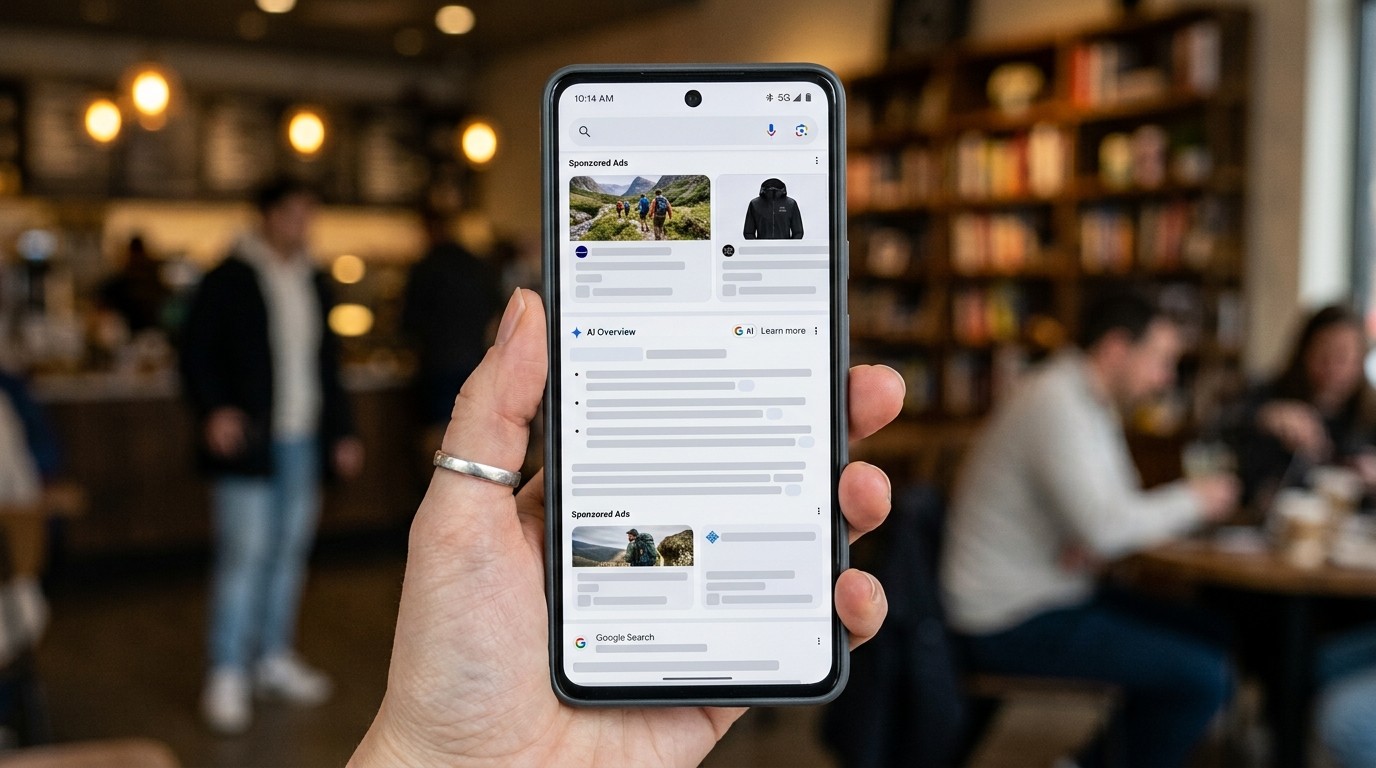
Google states that ads are eligible to appear above or below AI-generated overviews in Search. Existing text, shopping, local, and app ads from eligible campaign types can participate according to the applicable auction and ad-ranking systems. Google says this availability extends across markets where AI Overviews are available.
This is important because advertisers do not necessarily need a separate campaign simply to participate in the surrounding paid-search environment.
Google AI Overviews changes the context in which the ad appears.
The user has an additional layer of information between the query and the advertiser.
Imagine someone searching for a product category.
The AI response may explain common options or purchasing considerations.
An advertisement appearing afterward is no longer operating in exactly the same environment as a classic text ad shown beside a conventional results page.
The user may have already gained information from the AI response.
Therefore, ads need to provide a compelling next step.
The best ad may not repeat what the AI response just explained.
Instead, it could communicate a specific advantage, product capability, price-related benefit, proof point, offer, or reason to continue to the advertiser’s site.
This creates an important creative principle:
When the search page becomes more informative, the ad should become more useful.
Ads Inside AI Overviews
Google has also introduced advertising opportunities within AI Overviews under specific conditions. According to Google Ads documentation, ads can appear inside AI Overviews when relevant criteria are met, including commercial intent and relevance between the query, the AI-generated content, and the advertisement.
This is a particularly important shift.
Google AI Overviews can interpret not only the user’s query but also the content of the generated response when determining whether certain ads are relevant.
That means the traditional idea of exact keyword-to-ad matching becomes less complete.
Imagine a user searches:
“Why is my lawn turning brown and what should I do?”
The search may trigger an AI-generated response discussing possible causes, testing, watering, and treatment.
The user did not explicitly search for a product.
Yet Google explains that an ad for a relevant product, such as a lawn-care solution, can potentially be appropriate because the query and AI-generated context together reveal commercial intent.
For advertisers, this is a major strategic clue.
Google AI Overviews can create commercial opportunities from journeys that begin as informational searches.
Why Intent Matters More Than Ever
Search intent has always mattered.
But AI-driven experiences can make intent more contextual.
A short keyword may hide multiple meanings.
A longer question often contains clues about the user’s problem, urgency, knowledge level, and desired outcome.
Advertisers therefore need to understand not only what users type, but why they type it.
Consider these searches:
“best CRM”
“CRM for a ten-person sales team”
“how to automate follow-up after sales calls”
“CRM that integrates with accounting software”
Each search can represent a different stage of decision-making.
Google AI Overviews may help users move between those stages more quickly.
That means campaign strategy should account for progression.
An advertiser who only optimizes around bottom-funnel keywords may miss opportunities to influence users earlier.
An advertiser who targets everything without regard to commercial value may waste budget.
The strategic objective is controlled expansion.
Use automation to discover relevant demand, but measure the resulting quality.
Google AI Overviews and AI Max for Search
Google’s advertising ecosystem is increasingly designed around AI-powered matching and optimization. One important example is AI Max for Search, which Google describes as a suite of Search campaign optimization capabilities that can expand search term matching and improve creative relevance.
This relationship matters because advertisers may increasingly encounter searches that do not look exactly like their original keyword lists.
Google AI Overviews can surface or influence complex search journeys, while AI-powered advertising tools can help match ads to broader forms of intent.
The combination points toward a more flexible SEM model.
Historically, an advertiser might spend significant effort creating tightly segmented campaigns for every conceivable keyword variation.
Modern systems can automate more of that discovery.
But automation is not a replacement for strategy.
Advertisers still need to determine which products are profitable, which customers are valuable, which messages are appropriate, which searches are irrelevant, and what the campaign should optimize toward.
AI expands reach.
Human strategy determines whether that reach is valuable.
Search Keywords Still Matter
The rise of AI does not make keyword research obsolete.
Keywords still provide useful evidence about customer language, commercial categories, product terminology, competitor comparisons, and intent.
The difference is that keywords should be treated as signals rather than the entire definition of targeting.
Google AI Overviews can help users phrase their questions differently over time. Someone who begins with a broad problem may later use more specific terminology learned from the search experience.
Advertisers should monitor those patterns.
Look at search terms.
Look for repeated questions.
Analyze modifiers.
Identify phrases indicating urgency.
Study comparison language.
Track feature-specific queries.
Watch for terminology that customers use but your business does not.
Those insights can improve ad copy, landing pages, SEO content, sales scripts, and product messaging.
Search data becomes customer research.
The Importance of Landing Pages
A more intelligent search page creates a higher expectation for what happens next.
If a user receives useful information from an AI-generated result, the landing page must offer a clear reason to continue.
A generic homepage is rarely enough for a highly specific query.
Suppose someone searches:
“How can an ecommerce brand reduce abandoned carts without adding discounts?”
A page titled “Our Ecommerce Platform” may not satisfy that intent.
A stronger landing page might directly explain strategies, show the relevant capability, demonstrate evidence, and offer a logical next step.
Google AI Overviews increases the importance of this alignment because users may arrive with more context than before.
The advertiser should continue the conversation.
The landing page should answer:
What problem does this solve?
How does it work?
Why should I trust you?
What makes the solution different?
What evidence supports the claim?
What should I do next?
That is where advertising turns into conversion architecture.
The Psychology of the Post-AI Searcher
One major psychological shift is that users may feel more informed before clicking.
An informed customer behaves differently from a confused customer.
They may spend less time discovering basic definitions.
They may spend more time evaluating differences.
They may ask harder questions.
They may become more sensitive to exaggerated claims.
They may compare several providers.
They may expect evidence immediately.
Google AI Overviews can therefore raise the quality threshold for advertising.
Generic statements like “best solution,” “leading platform,” or “number one provider” may become less persuasive when users can quickly compare options.
Advertisers need stronger proof.
That can include transparent pricing, customer examples, product demonstrations, independent reviews, guarantees where appropriate, implementation detail, technical specifications, and clear differentiation.
A sophisticated search experience requires sophisticated persuasion.
Google AI Overviews and Brand Visibility
Visibility in modern Search should not be measured only by whether an advertiser occupied a traditional ad position.
The broader question is:
Where does the brand appear in the user’s discovery journey?
A brand may be encountered through an advertisement, an organic result, a supporting link, a shopping module, a video, or an AI-generated summary.
Google’s Search guidance states that AI features continue to rely on the foundations of Search, including technical eligibility and helpful, reliable, people-first content. There are no separate special technical requirements specifically required for appearing as a supporting link in AI Overviews.
For businesses, that reinforces an important principle.
Paid search and organic authority should not be treated as isolated projects.
Your advertising strategy, website content, reputation, and customer experience all influence what happens after discovery.
Organic SEO Still Matters
Some advertisers may assume that AI-generated answers make organic SEO less important.
Google’s own guidance says the opposite.
Google explains that the best practices for SEO remain relevant because its generative AI experiences are rooted in core Search ranking and quality systems. Its newer guidance emphasizes technical accessibility, valuable original content, and helpful information for users.
That creates a useful strategic relationship.
Paid campaigns generate intent data.
Organic content addresses questions.
Landing pages convert commercial demand.
Brand authority reinforces trust.
Google AI Overviews can sit across this ecosystem.
The strongest organizations therefore build consistent messaging across paid and organic channels.
From Keywords to Questions

One of the most practical changes advertisers can make is to expand keyword research into question research.
Ask:
What problem is the customer trying to solve?
What happens immediately before they search?
What happens after they receive the answer?
What objections emerge?
What comparisons are they likely to make?
Which questions suggest purchase intent?
Which questions signal education only?
Google AI Overviews can make this question-based thinking even more valuable because complex questions are one of the areas where AI-generated search experiences can be particularly useful.
Question-based campaign research also produces better creative.
Instead of saying:
“We offer advanced analytics.”
You can address the actual problem:
“See which campaigns generate qualified revenue, not just clicks.”
The second statement speaks to an outcome.
Mapping the Customer Funnel
Advertisers need to recognize that search does not always move neatly from awareness to conversion.
Users can move backward.
They can compare alternatives.
They can change their priorities.
They can discover a new problem.
They can become more sophisticated after reading information.
This is why Optimizing Funnel Stages should be connected to Search strategy rather than treated purely as a separate conversion tactic.
At the awareness stage, users may need explanation.
During consideration, they may need comparisons.
At decision stage, they may need proof, pricing, implementation details, and reduced risk.
Google AI Overviews can influence users across these stages by making research faster and more interactive.
The advertiser should adapt messaging accordingly.
AI Search Advertising Becomes More Contextual
The emergence of Google AI Overviews is closely connected to the broader evolution of AI Search Advertising.
Search advertising increasingly depends on context rather than isolated strings.
A user can describe a problem without using your preferred product terminology.
The system can still identify potential relevance when the commercial signal is strong enough.
That is valuable because customers do not always speak like marketers.
They use natural language.
They describe symptoms.
They explain desired outcomes.
They ask for comparisons.
They tell Google what they are trying to accomplish.
Advertisers that understand customer language can take advantage of this shift.
The best campaign assets provide enough semantic variety for automated systems to find relevant combinations without sacrificing brand clarity.
Creative Strategy for AI-Driven Search
Creative assets should now function as a strategic message library.
Build different types of assets:
Benefit-focused.
Problem-focused.
Outcome-focused.
Trust-focused.
Comparison-focused.
Feature-focused.
Risk-reduction focused.
Offer-focused.
Each asset should contribute something meaningful.
Repeating essentially the same statement in slightly different words gives the system less strategic diversity.
Google’s advertising guidance recommends investing in high-quality creative and using AI-powered targeting solutions alongside smart bidding when advertisers want to take advantage of new search opportunities.
Google AI Overviews therefore increases the value of a strong creative system.
The advertiser needs messages that can make sense in multiple contexts.
A person who has just read a detailed AI-generated explanation may respond differently from someone who typed a short transactional query.
Creative should reflect that possibility.
Trust Becomes a Performance Variable
Search advertising has always depended on trust, but AI-generated experiences may make credibility even more important.
When Google provides a synthesized response, users may quickly move from broad understanding toward brand comparison.
At that point, trust becomes part of the conversion equation.
Reviews matter.
Testimonials matter.
Site quality matters.
Transparent information matters.
Brand consistency matters.
Customer support matters.
Third-party evidence matters.
For businesses recovering from damaged reputation, Brand Trust Recovery should not be treated as a public-relations exercise disconnected from paid search.
Advertising can bring more people to the brand.
If trust is weak, increased traffic can expose that weakness faster.
The better strategy is to make the entire customer journey credible.
Measurement Is Changing
Advertisers should not assume that traditional metrics tell the complete story.
Clicks remain useful.
CTR remains useful.
CPC remains useful.
Conversion rate remains useful.
But the strategic interpretation of these metrics needs to evolve.
Google itself has warned against evaluating AI-powered Search only through clicks and highlighted the importance of looking at broader indicators such as sales, signups, engaged audiences, and business interactions.
Google AI Overviews may change how users discover and evaluate businesses before they click.
Therefore, a campaign could produce fewer clicks but higher-value users.
Another campaign could produce more clicks from weak commercial intent.
The second campaign might look better in a superficial dashboard while being worse for the company.
Search Console and Generative AI Visibility
Organic marketers also have a new measurement opportunity.
Google introduced a Generative AI performance report in Search Console in 2026, with visibility data for generative AI features such as AI Overviews and AI Mode. Google says the report is currently being rolled out to a subset of sites while it undergoes testing and expansion.
This is significant because measurement is becoming more granular.
Marketers can begin examining where their content receives visibility in generative AI experiences rather than assuming all Search exposure behaves the same way.
For advertisers, this creates an opportunity to combine paid and organic intelligence.
Ask:
Which topics create visibility?
Which pages attract engagement?
Which queries have commercial intent?
Which content supports buying decisions?
Which pages deserve stronger paid support?
That integrated view is more powerful than isolated channel reporting.
What Advertisers Should Monitor
A modern Google AI Overviews strategy should track several layers.
| Measurement Area | What to Watch |
|---|---|
| Search visibility | Impression trends and market presence |
| Engagement | CTR, engagement quality, landing-page behavior |
| Intent quality | Search-term relevance and commercial intent |
| Conversion | Purchases, qualified leads, demos, signups |
| Business value | Revenue, pipeline, customer quality |
| Brand impact | Trust, branded demand, repeat visits |
| Content impact | Organic visibility and AI-feature exposure |
The exact metrics will vary by business.
An ecommerce brand may prioritize revenue and margin.
A B2B company may prioritize qualified pipeline.
A local service company may prioritize booked calls.
A subscription company may prioritize retained customers.
The principle remains the same.
Optimize for the outcome that actually matters.
Common Advertising Mistakes
Mistake 1: Assuming AI Overviews Replace Ads
They do not.
Google explicitly provides opportunities for ads above, below, and in certain cases within AI Overviews.
The environment changes, but paid search remains strategically relevant.
Mistake 2: Treating Every AI Search as Informational
Some AI-driven searches begin with information but move toward commerce.
Advertisers should understand the full journey.
Mistake 3: Using Generic Landing Pages
More contextual search experiences make poor landing-page alignment more visible.
Mistake 4: Optimizing for Clicks Alone
Clicks do not necessarily represent business value.
Mistake 5: Ignoring Creative Diversity
Automation performs better when it has meaningful message options.
Mistake 6: Forgetting Brand Safety
More automation means advertisers should maintain clear controls around unsuitable queries, destinations, and messaging.
Mistake 7: Assuming AI Understands Your Business Automatically
Machine learning systems rely on signals.
Poor conversion tracking, weak assets, unclear landing pages, and inconsistent data can produce poor outcomes.
The Role of Broad Match and Automated Targeting
Google recommends AI-powered targeting approaches such as broad match and keywordless targeting technologies because AI Overviews can generate opportunities from complex queries that advertisers may not explicitly target.
This is an important strategic point.
If the advertiser only targets exact phrases they already know, they may miss emerging forms of demand.
Broader targeting can help uncover new opportunities.
But broad does not mean careless.
Strong conversion tracking remains critical.
Smart bidding remains important.
Negative keywords remain relevant.
Brand settings remain relevant.
Search-term analysis remains relevant.
The correct approach is controlled exploration.
Smart Bidding in the AI Era
Smart Bidding uses machine learning to set bids at the auction level based on the goal selected by the advertiser. Google describes Smart Bidding strategies as using Google AI to optimize for conversions or conversion value.
That matters in an AI-driven Search environment because opportunities can become more varied.
Different users can arrive through different search paths.
Different contexts can produce different probabilities of conversion.
Manual bidding may struggle to react to all of these signals individually.
Automated bidding can evaluate many signals simultaneously.
But again, the output depends on the input.
If the conversion goal is poor, automation can optimize efficiently toward the wrong result.
Conversion Tracking Is the Foundation

Before expanding automation, audit conversion tracking.
Make sure important actions are measured.
Separate primary outcomes from secondary interactions.
Use accurate values where possible.
Connect marketing activity to downstream business outcomes.
For lead generation, measure qualified opportunities rather than relying exclusively on forms.
For ecommerce, consider transaction value and profitability.
For subscriptions, consider customer quality and retention.
Google AI Overviews may bring new categories of searchers into the funnel.
The measurement system should be capable of identifying which ones matter.
The Relationship Between Content and Paid Search
Content strategy and paid search can reinforce each other.
Advertisers can use paid search data to identify customer questions.
Content teams can turn those questions into detailed resources.
SEO can capture organic demand.
Paid media can accelerate important commercial topics.
Landing pages can convert high-intent traffic.
Google AI Overviews can surface pages that provide useful context and supporting evidence.
Google’s current documentation repeatedly emphasizes original, helpful, reliable content rather than special optimization tricks for AI-generated Search features.
That means advertisers should invest in substance.
The best response to AI search is not more shallow content.
It is more useful content.
Building an AI-Ready Landing Page
An AI-ready landing page should be easy to understand.
Start with a clear answer.
Explain the core benefit.
Demonstrate the solution.
Address objections.
Provide evidence.
Show the next step.
Use headings that reflect customer questions.
Explain important terminology.
Make product differences obvious.
Include relevant proof.
Avoid hiding crucial information behind unnecessary friction.
Google AI Overviews may help users arrive with a clearer understanding of what they need.
Your landing page should reward that understanding.
How Small Businesses Can Adapt
Small businesses often worry that AI-powered advertising favors large companies with massive budgets.
That is not necessarily true.
Smaller businesses can compete through specificity.
A local provider can dominate a specific service niche.
A specialist consultancy can focus on a narrow customer problem.
An ecommerce brand can develop strong product differentiation.
A software company can create high-quality educational content around a specific workflow.
Google AI Overviews may actually make expertise more valuable because users increasingly ask detailed questions.
The business that understands a niche deeply can create better answers, stronger trust, and more relevant advertising.
How Enterprise Advertisers Should Adapt
Enterprise advertisers face a different challenge: scale.
Large companies need governance.
They may have thousands of products, multiple countries, several brands, complex legal requirements, and large agency structures.
Google AI Overviews increases the need for consistency.
Campaign teams should establish:
Approved messaging.
Conversion definitions.
Brand exclusions.
Search controls.
Landing-page standards.
Measurement governance.
Creative guidelines.
Market-specific flexibility.
Automation should operate within those boundaries.
The objective is not to eliminate control.
The objective is to make control strategic rather than manual.
Preparing for More Conversational Search
People are increasingly comfortable asking complete questions.
That means advertisers need to understand natural language.
Search research should include conversational phrasing.
Instead of only studying:
“CRM software”
Also consider:
“What CRM should a ten-person sales team use?”
“How can a small sales team automate follow-up?”
“What is the easiest CRM to implement without technical staff?”
The precise queries will vary by market, but the strategy is universal.
Think like the customer.
Write down the questions they ask before purchasing.
Build advertising and content around those questions.
Google AI Overviews can make this approach even more important because conversational and complex searches are central to the AI-powered evolution of Search.
Google AI Overviews and Competitive Research
Advertisers should also use AI-generated Search experiences as a competitive intelligence signal.
Search important category questions.
Look at which brands appear in supporting information.
Study which topics receive detailed treatment.
Examine what users may learn before reaching your site.
Ask whether competitors are addressing objections that your website ignores.
Look for recurring differentiators.
Identify knowledge gaps.
This should not become a copy-and-paste exercise.
The purpose is to discover where the market’s information architecture is weak.
Then build something better.
Managing the Risk of Reduced Click Dependence
One concern surrounding Google AI Overviews is whether users may receive enough information without clicking.
The answer is not binary.
Google says that AI-generated results provide links to supporting web resources and has reported that clicks from AI Overviews pages can be higher quality, with users more likely to spend more time on sites after clicking.
That means advertisers and publishers should not simply assume that fewer traditional clicks automatically equal lower-value traffic.
The quality of the visitor matters.
A smaller number of better-informed users can be more valuable than a larger audience with weak intent.
This is another reason to measure revenue and engagement instead of obsessing over volume alone.
A Practical 30-Day Action Plan
Days 1–7: Audit
Review Search campaigns.
Review conversion tracking.
Identify major customer questions.
Analyze search terms.
Review landing-page relevance.
Map the current customer funnel.
Document brand controls.
Days 8–14: Build
Develop stronger creative assets.
Create question-based content themes.
Improve landing pages.
Define primary and secondary conversions.
Create clearer audience and product priorities.
Days 15–21: Test
Introduce appropriate AI-powered targeting.
Test broader relevant demand carefully.
Review search-term quality.
Monitor conversion quality.
Compare performance against baseline results.
Days 22–30: Optimize
Remove irrelevant demand.
Strengthen successful creative.
Improve weak landing experiences.
Review qualified conversion performance.
Allocate more budget toward profitable intent.
Document lessons for the next testing cycle.
The goal of the first month is not perfect automation.
It is learning.
A Strategic Framework for Advertisers

Use this framework:
1. Understand the Question
Identify what the user is trying to accomplish.
2. Understand the Context
Determine what information may influence the next decision.
3. Match the Message
Create a relevant advertising proposition.
4. Match the Destination
Send the user to the most useful page.
5. Match the Conversion
Track the action that represents real business value.
6. Improve the Feedback Loop
Use results to refine targeting, creative, content, and offers.
Google AI Overviews makes this framework particularly valuable because the search experience can contain more contextual information before the click.
The Future of SEM
The future of SEM will likely involve less obsession with individual keyword strings and more attention to intent systems.
Automation will continue expanding.
Search will become more conversational.
AI-generated answers will continue evolving.
Users will ask more complicated questions.
Advertising will become more context-aware.
Measurement will move closer to business value.
Creative systems will become more adaptive.
For marketers, this means the profession becomes less about operating a dashboard and more about designing a growth system.
The best SEM professionals will understand:
Customer psychology.
Search behavior.
Business economics.
Conversion architecture.
Content.
Analytics.
Creative.
Automation.
Brand strategy.
That combination creates resilience.
Final Takeaways for Advertisers
Google AI Overviews is not a reason to abandon Search advertising.
It is a reason to rethink how Search advertising works.
The most important lessons are clear.
AI-generated responses can change how users discover and evaluate information.
Ads can appear around AI Overviews, and eligible ads can also appear within them under specific conditions.
Complex informational searches can create new commercial opportunities.
Broader intent matching can uncover demand that traditional keyword lists miss.
Creative quality is becoming more important.
Landing-page relevance is becoming more important.
Conversion quality is becoming more important.
Brand trust is becoming more important.
Organic SEO remains foundational.
Measurement should move beyond clicks toward real business outcomes.
Most importantly, advertisers should not view AI as something happening outside their strategy.
It is becoming part of the search environment itself.
Conclusion
Google AI Overviews is changing the relationship between search queries, information, advertising, and customer decisions. Advertisers now need to think beyond traditional keyword targeting and understand the broader intent behind increasingly complex searches. The strongest strategy combines AI-powered targeting, high-quality creative, useful landing pages, reliable conversion tracking, strong brand trust, and business-focused measurement. Rather than fearing AI-generated Search experiences, marketers should use them as a reason to improve relevance and customer value. Search is becoming more contextual, conversational, and intelligent, and advertisers who adapt their strategy around real user needs will be better positioned to compete in the next generation of SEM.
Frequently Asked Questions (FAQ)
1. What are Google AI Overviews?
Google AI Overviews are AI-generated responses that can appear in Google Search to summarize information and provide links to supporting web resources. Google says they are intended to help users understand complex questions and explore information more efficiently.
2. Do Google AI Overviews replace traditional Search results?
No. AI-generated summaries exist alongside traditional Search results and other Search features. Google says AI Overviews appear when its systems determine that the AI experience is useful and additive to classic Search.
3. Can advertisements appear in Google AI Overviews?
Yes. Google states that eligible advertisements can appear above or below AI Overviews, while certain text and shopping ads can also appear within AI Overviews when relevance and other conditions are met.
4. Do advertisers need a special campaign for Google AI Overviews?
Not necessarily. Google says existing eligible Search, Shopping, Performance Max, and other campaign inventory can participate in relevant AI Overview placements according to the applicable systems and campaign eligibility.
5. How do Google AI Overviews affect keyword targeting?
They increase the importance of intent and context. Users may ask longer, more conversational questions, so advertisers can benefit from broader relevant targeting rather than relying exclusively on narrowly defined keyword variations.
6. Is SEO still important because of Google AI Overviews?
Yes. Google explicitly states that its foundational SEO guidance remains relevant for AI features. Websites still need to meet Search technical requirements and provide helpful, reliable, people-first content.
7. Should businesses optimize specifically for AI Overviews?
Google says there are no additional special technical requirements specifically for appearing as a supporting link in AI Overviews. The recommended approach is to follow strong foundational SEO practices and create valuable content for people.
8. What should advertisers measure?
Advertisers should measure relevant impressions, clicks, conversion rates, qualified leads, purchases, revenue, customer quality, pipeline, and other business outcomes. Google has encouraged marketers to evaluate the broader value of visits rather than focusing only on clicks.
9. How can advertisers prepare for AI-powered Search?
Start with reliable conversion tracking, clear campaign goals, strong creative assets, relevant landing pages, broader intent research, controlled automation, and strong brand governance. Treat AI as an optimization layer rather than a substitute for marketing strategy.
10. Is the future of SEM completely automated?
No. Automation will handle more targeting, bidding, matching, and optimization, but humans remain essential for business objectives, positioning, customer psychology, creative direction, brand safety, offer strategy, and interpreting market changes. The strongest model combines machine-scale optimization with human strategic judgment.



Leave a Reply