

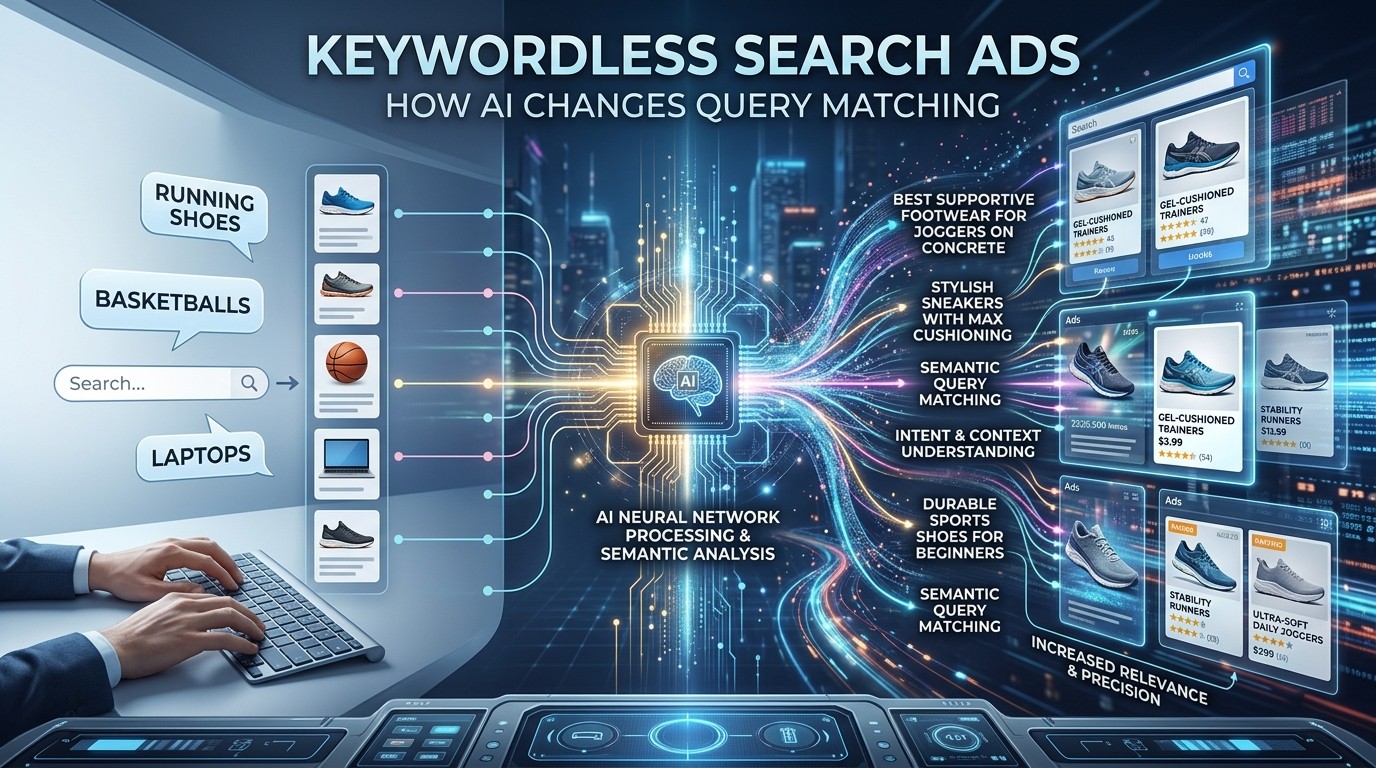
Keywordless Search Ads are changing paid search from manually predefined queries toward AI-driven intent matching, where context, landing pages, creative signals, and conversion data influence which searches trigger ads.
Search advertising used to feel like a keyword engineering exercise. Marketers researched phrases, grouped them into tightly themed ad groups, wrote ads around those phrases, selected match types, added negatives, and then watched the Search Terms report for opportunities.
That model still matters, but it is no longer the entire story.
Modern Google Search campaigns increasingly use artificial intelligence to interpret what a person wants rather than relying only on whether a query resembles a manually entered keyword. Google’s current AI Max for Search campaign framework explicitly combines broad match and keywordless technology to discover relevant searches that advertisers might otherwise miss.
This shift creates an important question: what actually happens when there is no traditional keyword standing between a user’s query and your ad?
The answer is more sophisticated than “AI guesses the keyword.”
Keywordless Search Ads rely on a broader collection of business and campaign signals. Google can evaluate existing keywords, ads, landing pages, URLs, geographic intent, brand settings, and conversion signals to decide whether a search appears relevant enough to enter the auction.
That changes how marketers should think about paid search.
Instead of asking only, “Which keyword should I bid on?” the more strategic question becomes, “Have I given the system enough reliable information to understand who I want, what I sell, why it matters, and which searches are valuable?”
This guide explains that transition in detail, including how AI changes query matching, how keywordless targeting differs from traditional matching, what happens inside the auction, how creative and landing-page relevance influence delivery, and how marketers can maintain control while allowing automation to discover new demand.
What Are Keywordless Search Ads?
Keywordless Search Ads are ads that can be matched to relevant user searches without requiring the advertiser to maintain a traditional keyword for every query opportunity.
The important distinction is that “keywordless” does not mean “contextless.”
Keywordless Search Ads still require context. That context can come from campaign structure, website content, landing pages, existing keywords, ad assets, audience and geographic signals, business goals, conversion history, and automated bidding systems.
Google describes AI Max for Search as a continuous optimization layer for existing Search campaigns. Its search-term matching feature can use broad match, asset-based technology, and keywordless technology to expand campaign reach and identify relevant queries.
Keywordless Search Ads therefore represent a shift in the source of targeting intelligence.
Traditional search targeting starts with a marketer-defined keyword and expands outward.
AI-led matching can start with a richer understanding of the advertiser’s business and work toward a query that appears commercially relevant.
That sounds subtle, but it changes campaign construction considerably.
A keyword list might contain:
- emergency plumber
- emergency plumbing service
- plumber near me
- 24 hour plumber
A keywordless system may encounter a search such as:
“water heater stopped working late at night who can fix it nearby”
The query does not need to share a clean lexical pattern with every manually selected keyword. The system can instead evaluate the underlying intent, the advertiser’s landing page, campaign signals, and expected conversion value.
That is where Keywordless Search Ads become especially powerful.
They can help advertisers respond to the way people actually search, which is increasingly conversational, fragmented, mobile-driven, and unpredictable.
Why Search Query Behavior Is Changing
People rarely search like marketers expect.
Marketers think in categories. Consumers think in situations.
A marketer might classify a product as “running shoes.”
A consumer might search:
“best shoes for sore feet after walking all day”
Another person might search:
“lightweight shoes for standing at work”
Another might search:
“comfortable sneakers that don’t hurt my heel”
All three searches can express commercial intent without using the same product terminology.
Keywordless Search Ads become useful because modern query interpretation can move beyond simple word overlap.
Google’s broad match documentation states that broad match can identify related queries and use additional signals to assess relevance and intent.
AI increases the importance of this principle.
Instead of treating language as a rigid list of strings, search systems increasingly interpret relationships between concepts.
That means the difference between “keyword matching” and “intent matching” becomes more important.
From words to meaning
A search engine can distinguish between:
“how to repair a leaking tap”
and
“best plumber for leaking tap”
The words overlap, but the commercial intent differs.
The first may indicate informational intent.
The second may indicate transactional intent.
Keywordless Search Ads need systems capable of identifying those distinctions because broad semantic relevance alone does not guarantee business relevance.
The objective is not to match everything related to a topic.
The objective is to discover searches that have a reasonable relationship with the advertiser’s offer and performance goal.
How Keywordless Search Ads Actually Work
The simplest way to understand Keywordless Search Ads is to think of them as an AI decision process rather than a single match type.
A simplified journey looks like this:
User enters a search
↓
Google interprets the query and context
↓
Eligible campaigns are evaluated
↓
AI compares business and campaign signals
↓
Potentially relevant ad/landing-page combinations are identified
↓
Smart Bidding assesses auction value
↓
Eligible ad competes in the auction
↓
The system learns from the resulting interaction and conversion data
The real system is considerably more complex, but this model helps explain the strategic shift.
Signal 1: Existing campaign information
Keywordless Search Ads can learn from information already present in the campaign.
That may include existing keywords, ad copy, URLs, landing-page content, and other campaign-level controls.
Google says AI Max search-term matching can learn from current keywords, creatives, and URLs when identifying relevant queries.
This means your old keyword research does not necessarily become useless.
Instead, it can become contextual input.
Signal 2: Website relevance
Your website can become part of your targeting intelligence.
If your landing page clearly explains:
- who the product is for
- what problem it solves
- features
- pricing
- locations served
- product categories
- use cases
- differentiators
the system has more information with which to understand potential query relevance.
This makes content quality increasingly important to paid search.
Signal 3: Conversion history
A campaign that receives high-quality conversion data can help automated systems distinguish valuable traffic from superficial traffic.
For example, two searches might both produce clicks.
But one group could produce qualified leads while another creates low-value inquiries.
The system can use performance signals to optimize toward the business outcome rather than click volume alone.
This is one reason Keywordless Search Ads are closely connected to Smart Bidding.
Keywordless Matching vs. Traditional Keyword Matching
Traditional keyword management gives advertisers a very visible targeting mechanism.
You choose:
Exact match.
Phrase match.
Broad match.
You then create negative keywords and evaluate search terms.
Keywordless Search Ads move some of that interpretation into Google’s AI systems.
| Traditional Approach | AI-Led Keywordless Approach |
|---|---|
| Starts with predefined keywords | Starts with broader business context |
| Strong manual control | Greater automated discovery |
| Query expansion is constrained by chosen inputs | Query discovery can extend beyond explicit keywords |
| Keyword lists require maintenance | Less dependence on exhaustive lists |
| Marketer interprets variations | AI interprets intent and contextual signals |
| More predictable lexical relationships | More semantic and contextual matching |
| Manual expansion often drives scale | AI can identify incremental opportunities |
Neither approach means advertisers should abandon strategy.
In fact, Keywordless Search Ads can make strategic discipline more important.
When targeting becomes more automated, your inputs become more influential.
Bad information can produce bad automation.
Great information can give AI a stronger foundation for finding valuable demand.
Google’s current documentation also notes that AI-based relevance can help prioritize the most relevant ad groups when a query could match multiple groups.
That means campaign organization still matters even when manual keyword expansion matters less.
The Role of Search Intent in Keywordless Search Ads
Intent is the real currency of modern search advertising.
Consider four searches:
“what is CRM software”
“CRM software comparison”
“best CRM for small business”
“buy CRM software for 20 employees”
These searches are related, but they indicate different stages of decision-making.
Keywordless Search Ads work best when campaigns provide enough contextual information for AI to recognize those differences.
Informational intent
The person wants knowledge.
Examples:
“how does inventory software work”
“what is automated payroll”
“how does email authentication work”
Commercial investigation
The person is comparing options.
Examples:
“best payroll software”
“CRM software pricing comparison”
“top accounting tools for startups”
Transactional intent
The person is preparing to act.
Examples:
“buy payroll software”
“book accounting consultation”
“CRM demo for small business”
Local intent
The person wants a nearby provider.
Examples:
“dentist open now”
“emergency electrician near me”
“pizza delivery nearby”
AI matching needs to interpret these subtle distinctions because advertisers do not necessarily want every search containing the same conceptual topic.
This is why intent-focused landing pages and conversion signals are so important.
Why Keyword Research Is Not Dead
One of the most common misunderstandings about Keywordless Search Ads is that keyword research no longer matters.
It does.
The role simply changes.
Keyword research can help you understand:
- customer vocabulary
- pain points
- product categories
- buying language
- competitors
- objections
- use cases
- high-value intent
- irrelevant searches
- emerging demand
Those insights can influence website architecture, ad messaging, landing-page content, exclusions, campaign segmentation, and measurement.
The difference is that marketers no longer need to assume they can manually predict every profitable query.
Instead, research becomes strategic intelligence.
For example, suppose you sell accounting software.
Your research might reveal important concepts such as:
“accounting software for contractors”
“construction bookkeeping”
“1099 accounting”
“job costing”
“invoice automation”
You may build campaign and landing-page context around those themes without requiring hundreds of tiny keyword variants.
That is a much more scalable approach to Keywordless Search Ads.
How AI Changes Query Matching
The biggest change is that query matching becomes probabilistic and contextual.
A traditional mental model asks:
“Does this query match my keyword?”
An AI-driven model asks something closer to:
“Does this query indicate a user whose intent is sufficiently relevant to this campaign, offer, landing page, and performance objective?”
That is a fundamentally different question.
Keywordless Search Ads can therefore discover unusual queries that a human researcher would not necessarily place into a keyword list.
This is particularly valuable for long-tail search.
Long-tail searches often have:
- lower volume
- higher specificity
- stronger situational context
- unusual phrasing
- more combinations than marketers can manually enumerate
A human can research thousands of phrases.
An automated system can evaluate enormous numbers of potential query variations.
The goal is not replacing human judgment entirely.
The goal is allowing human strategy and machine-scale discovery to work together.
AI Mobile Marketing and the Expansion of Search Context
Search behavior is becoming increasingly fragmented across devices and moments.
AI Mobile Marketing reflects a broader reality: people search while commuting, comparing products in stores, asking voice assistants questions, checking prices quickly, or researching a problem immediately after encountering it.
Mobile users often provide less context in each individual search.
A person might type:
“best running shoes”
from a desktop while researching.
Later, on a phone:
“wide toe box near me”
Later:
“asics vs brooks”
Later:
“running shoe store open now”
Each query can represent a different stage of the same buying journey.
Keywordless Search Ads can potentially connect these moments more intelligently when campaign and conversion signals provide enough context.
This is also why Mobile-First Marketing increasingly overlaps with search advertising strategy. Mobile users expect fast answers, relevant landing pages, simple navigation, and minimal friction.
An ad can win the auction and still lose the customer if the mobile landing experience is poor.
Creative Relevance Matters More Than Ever
Targeting is only half of the equation.
The other half is the message.
Google’s AI Max framework includes text customization that can create customized ad assets based on signals from existing ads, landing pages, keywords, and website content.
This creates a direct relationship between targeting intelligence and creative intelligence.
Suppose the system identifies a search around:
“affordable CRM for nonprofit organizations”
A generic headline such as:
“Powerful CRM Software”
may be technically relevant but psychologically weak.
A more contextually aligned message could emphasize:
“CRM Built for Nonprofit Teams”
The advertiser’s core positioning stays intact, but the message becomes closer to the searcher’s situation.
This is where AI Ad Creative enters the broader marketing equation.
The strongest results are unlikely to come from blindly generating endless variations. They come from giving AI strong source material: clear positioning, accurate benefits, product facts, audience language, and brand constraints.
Landing Pages Become Targeting Assets
One of the most important implications of Keywordless Search Ads is that the landing page is no longer simply the destination after the click.
It can also become part of the relevance signal.
Google’s AI Max documentation says Final URL expansion can select more relevant URLs from a website when those pages are likely to improve performance and are relevant to the query and ad-group theme.
That has significant implications.
Imagine an ecommerce website with pages for:
Running Shoes
Trail Running Shoes
Road Running Shoes
Marathon Shoes
Stability Shoes
Walking Shoes
If every ad sends users to the homepage, the system has less contextual precision.
A well-structured website gives AI more useful choices.
This means SEO and paid search can increasingly reinforce one another.
Strong information architecture creates clearer topical relationships.
Clear product pages create better relevance signals.
Detailed landing pages provide more usable context.
Conversion-focused UX improves the probability that traffic becomes valuable business outcomes.
Keywordless Search Ads and Search Ads in AI Overviews
Search Ads in AI Overviews itself is changing beyond the traditional blue-link results page.
Google’s current guidance explains that ads can appear in AI Overviews and that matching in these contexts relies on Google’s understanding of user intent using not only the query but also the content of the AI Overview.
That is strategically important.
The user’s journey may become:
Search query
→ AI-generated overview
→ deeper exploration
→ follow-up question
→ commercial interaction
The original query can be broad while the resulting AI Overview adds context.
For advertisers, Keywordless Search Ads can help bridge the gap between a broad natural-language search and a highly specific commercial intent that emerges from the context.
Google specifically identifies broad match and keywordless targeting through AI Max as mechanisms for matching relevant ads in AI Overview experiences.
This suggests a future in which advertisers should think less about isolated keyword strings and more about the complete information ecosystem surrounding user intent.
How Negative Keywords Preserve Control
Automation does not eliminate the need for boundaries.
In fact, Keywordless Search Ads make exclusions especially important.
Suppose you sell premium software.
AI might identify hundreds of semantically relevant searches, but some could be poor business matches:
“free software”
“open source”
“jobs”
“training course”
“meaning”
“definition”
Those searches may be related to your business category without representing your target customer.
Negative keywords can help establish boundaries.
In keywordless and AI-driven environments, exclusions function like guardrails.
They tell the system:
“This category of demand should not receive our advertising.”
Google also highlights negative keywords, URL exclusions, brand exclusions, and related controls as ways advertisers can constrain keywordless targeting.
The strategic balance is therefore:
AI discovers.
Humans define boundaries.
Data evaluates outcomes.
AI optimizes.
That is a much healthier mental model than either extreme of “AI controls everything” or “manual keywords control everything.”
Smart Bidding and Keywordless Search Ads
Query discovery without intelligent bidding would create a serious problem.
Imagine an AI discovering 10,000 potentially relevant queries.
Do you want to bid equally on all of them?
Obviously not.
Some users are highly likely to convert.
Some are weak prospects.
Some are valuable only in certain locations.
Some may have strong order values.
Others may generate cheap but low-quality traffic.
Smart Bidding helps connect query opportunity with auction-level decisions.
Google recommends using Smart Bidding alongside AI-powered search-term matching, because the system can determine which auctions are more aligned with campaign performance goals.
This changes the optimization objective.
The question becomes less:
“How do I get more searches?”
and more:
“How do I let the system find more relevant searches while competing intelligently for the ones most likely to produce valuable outcomes?”
Keywordless Search Ads become far more powerful when the conversion signal is reliable.
Poor conversion tracking can teach automation the wrong lesson.
Conversion Tracking Is the Foundation
AI cannot optimize correctly toward information that is incomplete, duplicated, misleading, or irrelevant.
Suppose your account counts:
Page views
Button clicks
Email opens
Form submissions
Purchases
as equivalent conversions.
That may confuse the optimization system.
Instead, marketers should distinguish between micro and macro outcomes.
A SaaS company might track:
Demo request
Qualified demo
Trial activation
Paid subscription
A retailer might track:
Product view
Add to cart
Checkout
Purchase
A lead-generation company might track:
Form submission
Qualified lead
Sales opportunity
Closed deal
The more accurately your conversion structure reflects business value, the more useful automated targeting and bidding can become.
For Keywordless Search Ads, this is especially important because query discovery can extend beyond the exact phrases you manually predicted.
Your conversion system becomes part of how the campaign learns which newly discovered demand is actually worth pursuing.
Building Campaigns for an AI-Driven Search Environment
Campaign structure should not become chaotic simply because targeting becomes automated.
Keep campaigns organized around meaningful business distinctions.
Good segmentation can include:
Product category
Business objective
Geography
Customer type
Profitability
Sales cycle
Offer
Language
Brand versus non-brand
You generally do not need separate campaigns for every tiny keyword variation.
Instead, ask whether the difference changes:
Budget
Bid strategy
Landing page
Creative
Geographic targeting
Conversion goal
Business economics
If it does, segmentation may make sense.
If it does not, excessive fragmentation can make your data thinner and optimization less efficient.
This is one of the strongest strategic advantages of Keywordless Search Ads: your structure can become more business-oriented instead of query-oriented.
A Practical Keywordless Search Ads Setup
A strong implementation can follow a structured process.
Step 1: Define the commercial objective
Decide what success means.
Revenue?
Qualified leads?
Bookings?
Subscriptions?
Profit?
Do not start with targeting settings.
Start with the outcome.
Step 2: Build strong landing-page context
Make sure your website clearly communicates your:
Product
Audience
Use cases
Benefits
Features
Pricing
Locations
Proof
Differentiators
Objections
Step 3: Preserve strategic keyword intelligence
Keep high-value keyword themes where useful.
Use them to communicate category and intent to the system rather than trying to create infinite variations.
Step 4: Create strong creative assets
Provide clear headlines, benefits, value propositions, calls to action, and proof points.
Keywordless Search Ads should not depend on weak generic messaging.
Step 5: Implement conversion tracking
Track meaningful outcomes and remove misleading conversion actions from primary optimization where appropriate.
Step 6: Add negative keywords
Protect budget from known irrelevant intent.
Step 7: Establish brand controls
AI Max includes brand inclusions and exclusions for advertisers that need additional control over brand association.
Step 8: Test before scaling
Google provides AI Max experiments so advertisers can test the approach before applying it broadly across campaigns.
Testing is especially useful when internal stakeholders are concerned about losing traditional keyword-level control.
What Should You Monitor?
Automation does not mean “launch and forget.”
The Search Terms report remains critical.
Look for:
High-converting new queries
Irrelevant themes
Unexpected customer language
Expensive low-value traffic
Strong geographic patterns
New product demand
Searches requiring exclusions
Queries exposing new landing-page opportunities
Google says the AI Max Search Terms report can identify incremental terms and show whether those were associated with broad-match expansion or keywordless matching.
This is valuable because the report becomes more than a policing mechanism.
It becomes market research.
Imagine discovering that customers repeatedly search for a use case you never mentioned on your website.
That could influence:
SEO content
Landing pages
Product positioning
Ad messaging
Sales scripts
Email campaigns
Product development
The advertising platform can therefore reveal demand intelligence beyond advertising.
Common Mistakes With Keywordless Search Ads
Mistake 1: Treating automation as a substitute for strategy
Turning on AI does not create a positioning strategy.
Your offer still needs differentiation.
Mistake 2: Sending everything to the homepage
A broad homepage creates weaker contextual precision than specialized landing pages.
Mistake 3: Poor conversion tracking
Automation optimizes according to the data it receives.
Bad signals create bad outcomes.
Mistake 4: No exclusions
AI can discover relevant concepts that are not commercially useful.
Use negative keywords and other controls where needed.
Mistake 5: Fragmenting campaigns excessively
Creating tiny campaigns for every phrase can prevent the system from collecting useful performance data.
Mistake 6: Using generic ads
More sophisticated matching increases the value of relevance.
The ad still needs to persuade.
Mistake 7: Judging success only by CTR
A high click-through rate is not automatically a business win.
Evaluate:
Conversion rate
Cost per qualified lead
Revenue
ROAS
Customer acquisition cost
Lead quality
Profitability
Lifetime value
Mistake 8: Making decisions too quickly
AI systems need meaningful data.
Evaluate trends instead of reacting emotionally to isolated search terms or short-term fluctuations.
The Human Psychology Behind AI Query Matching
The technology matters, but psychology matters more.
Users do not wake up wanting keywords.
They wake up wanting outcomes.
Someone searching:
“best accounting software”
is not emotionally attached to the phrase itself.
They may be worried about:
Making mistakes
Losing money
Wasting time
Compliance
Growing complexity
Hiring another employee
That means an effective advertisement should address the underlying concern.
Keywordless Search Ads can help expose more of these natural-language expressions of intent.
The marketer’s job is then to interpret what those expressions mean psychologically.
Ask:
What fear is behind the search?
What desire is behind it?
What uncertainty is stopping action?
What outcome does the customer want?
What proof would reduce perceived risk?
What friction prevents conversion?
AI can improve matching, but persuasion still depends heavily on understanding humans.
Mobile Behavior Makes Query Matching Even Harder
Mobile searches often happen in moments of urgency.
A user may search while:
Standing in a store
Driving to an appointment
Comparing two products
Talking to a colleague
Waiting for a flight
Dealing with a problem
Looking for a local business
These situations produce shorter, less polished queries.
Keywordless Search Ads can be valuable because AI can interpret messy language rather than expecting users to behave like keyword researchers.
This is particularly important for local businesses.
“car battery replacement open now”
may be far more commercially meaningful than a polished phrase such as:
“automotive battery replacement service.”
The customer does not care whether the terminology is technically elegant.
They care whether someone can solve the problem immediately.
That is the environment AI query matching is designed to understand.
Keywordless Search Ads and the Future of Search Advertising
The long-term trend is clear: search advertising is moving toward greater automation.
Google’s AI Max is not a separate campaign type; it is an optimization layer for existing Search campaigns, combining features such as improved search-term matching and asset optimization.
Google also says that AI Max search-term matching can combine broad match and keywordless technology to identify incremental opportunities.
This does not mean the keyword disappears overnight.
Instead, its role becomes smaller relative to the total amount of information available to the system.
The future search marketer will likely spend less time building giant keyword spreadsheets and more time working on:
Customer research
Offer strategy
Landing-page architecture
Creative systems
Conversion measurement
Exclusions
Business economics
Experimentation
Data quality
This is not the death of paid search expertise.
It is a change in where expertise creates leverage.
A Better Mental Model for Advertisers
Think of your account as an information system.
You provide:
Business context
Products
Audiences
Landing pages
Creative assets
Conversion goals
Brand rules
Geographic targeting
Negative keywords
Budget
Bidding objectives
The AI interprets these signals and attempts to find valuable opportunities.
You then inspect:
Queries
Conversions
Costs
Revenue
Lead quality
Customer behavior
You feed those insights back into the system.
That creates a loop:
Strategy → Signals → AI Discovery → Auction → Conversion → Measurement → Refinement
Keywordless Search Ads become effective when every stage of that loop is coherent.
If your landing page says one thing, your ad says another, your conversion tracking measures something irrelevant, and your negatives are incomplete, AI cannot magically make the system perfect.
But when strategy and data are aligned, automated discovery can significantly expand the surface area of your campaigns.
How Marketers Should Adapt Their Skills
The skill set of a search advertiser is evolving.
Old-school strengths such as keyword research, match-type knowledge, search-term analysis, and negative-keyword management remain valuable.
But new strengths are becoming equally important.
Customer language analysis
Understand how different customer segments describe their problems.
Landing-page strategy
Make your website easy for humans and AI systems to understand.
Conversion architecture
Define which actions actually create business value.
Creative strategy
Develop strong source messaging that automation can adapt intelligently.
Data interpretation
Separate profitable demand from attractive-looking vanity metrics.
Experiment design
Test automated targeting against controlled baselines.
Business economics
Know your acceptable customer acquisition cost, margin, average order value, lead value, and lifetime value.
The best Keywordless Search Ads strategy therefore combines marketing fundamentals with machine-assisted execution.
A Simple Decision Framework
Before expanding automation, ask five questions:
| Question | What Good Looks Like |
|---|---|
| Is the offer clear? | Customers immediately understand the value |
| Is the website relevant? | Landing pages closely match major customer intents |
| Is tracking accurate? | Primary conversions represent real business value |
| Are boundaries defined? | Negative keywords and brand controls prevent obvious waste |
| Is testing available? | You can compare performance rather than guessing |
When all five are reasonably strong, automation has a healthier foundation.
When several are weak, adding more AI may simply accelerate inefficient spending.
Why Keywordless Search Ads Can Increase Discovery
The strongest argument for Keywordless Search Ads is not convenience.
It is discovery.
Humans are limited in how many query combinations they can anticipate.
AI systems can process significantly more variations.
That matters because customer demand is not static.
People invent new language.
Products change.
Competitors change.
Cultural language changes.
Features create new use cases.
Economic conditions alter priorities.
Mobile behavior changes.
Search interfaces evolve.
A rigid keyword list can become outdated while the underlying customer need remains.
Keywordless Search Ads offer a mechanism for adapting to that complexity.
They are particularly useful when businesses have broad product catalogs, changing demand, complex customer journeys, or large numbers of possible long-tail searches.
The Strategic Balance: Automation vs. Control
Some advertisers fear that automation means giving Google unlimited authority.
That does not have to be the case.
Modern AI-driven Search includes several controls intended to help advertisers manage where and how automation operates. Google documents controls such as location of interest, brand inclusions and exclusions, URL inclusions and exclusions, negative keywords, and ad-group-level search-term matching settings.
The right approach is controlled automation.
Let AI handle:
Query discovery
Semantic interpretation
Large-scale pattern recognition
Creative variation
Auction-level optimization
But let humans control:
Business strategy
Brand positioning
Offer economics
Compliance
Exclusions
Customer definitions
Conversion goals
Risk tolerance
This division creates a stronger partnership between humans and machines.
Conclusion
Keywordless Search Ads represent a major change in how paid search can connect advertisers with customer intent. Instead of depending entirely on manually predicted keyword variations, modern AI can evaluate broader signals such as queries, keywords, website content, creative assets, landing pages, and conversion performance to discover relevant opportunities. The winning strategy is not to abandon keyword knowledge, but to elevate it into business context and customer intelligence. Strong conversion tracking, clear landing pages, persuasive creative, thoughtful exclusions, and disciplined experimentation become more important as automation expands. Ultimately, Keywordless Search Ads reward marketers who give AI better information while maintaining strong human control over strategy, relevance, and profitability.
Frequently Asked Questions (FAQ)
1. What are Keywordless Search Ads?
Keywordless Search Ads are search advertisements that can become eligible for relevant user queries without requiring a manually specified keyword for every search variation. AI evaluates broader campaign and business signals to identify potential relevance.
2. Are Keywordless Search Ads replacing keywords completely?
No. Keywordless targeting does not mean traditional keyword knowledge has become irrelevant. Existing keywords can still provide useful business and contextual information, while AI expands query discovery beyond manually predicted variations.
3. How do Keywordless Search Ads find relevant queries?
They can use signals such as existing keywords, ad assets, landing-page content, URLs, geographic intent, brand settings, and conversion-related information. Google says AI Max search-term matching uses broad match and keywordless technology to expand opportunities.
4. Do Keywordless Search Ads work with Smart Bidding?
Yes. Google recommends pairing AI-powered search-term matching with Smart Bidding so the system can identify relevant opportunities while optimizing auction participation toward performance goals.
5. Can advertisers control Keywordless Search Ads?
Yes. Advertisers can use controls such as negative keywords, brand controls, URL exclusions, location settings, and campaign or ad-group settings to establish boundaries around automated targeting.
6. Are Keywordless Search Ads useful for small businesses?
They can be, especially when a small business has clear conversion tracking, focused landing pages, a strong offer, and enough campaign data for automation to learn. Smaller budgets still require careful monitoring and strong exclusions.
7. Do Keywordless Search Ads make keyword research unnecessary?
No. Keyword research remains valuable for understanding customer language, market demand, product categories, pain points, and commercial intent. The difference is that research becomes strategic context rather than an attempt to predict every possible search phrase.
8. How do AI Overviews affect Keywordless Search Ads?
Google says ads appearing in AI Overviews can be matched using an understanding of the user’s intent that considers both the query and the content of the AI Overview. Google identifies broad match and keywordless technology as mechanisms for relevant ad matching in these experiences.
9. What is the biggest risk with Keywordless Search Ads?
The biggest risk is poor input quality. Weak conversion tracking, unclear landing pages, irrelevant campaigns, overly broad business definitions, and missing exclusions can cause automation to pursue traffic that looks relevant but produces little business value.
10. What should marketers focus on most as search becomes more AI-driven?
Focus on customer intent, offer clarity, conversion quality, landing-page relevance, persuasive creative, search-term analysis, exclusions, and business profitability. AI can expand discovery, but strategic direction still comes from the marketer.



Leave a Reply