

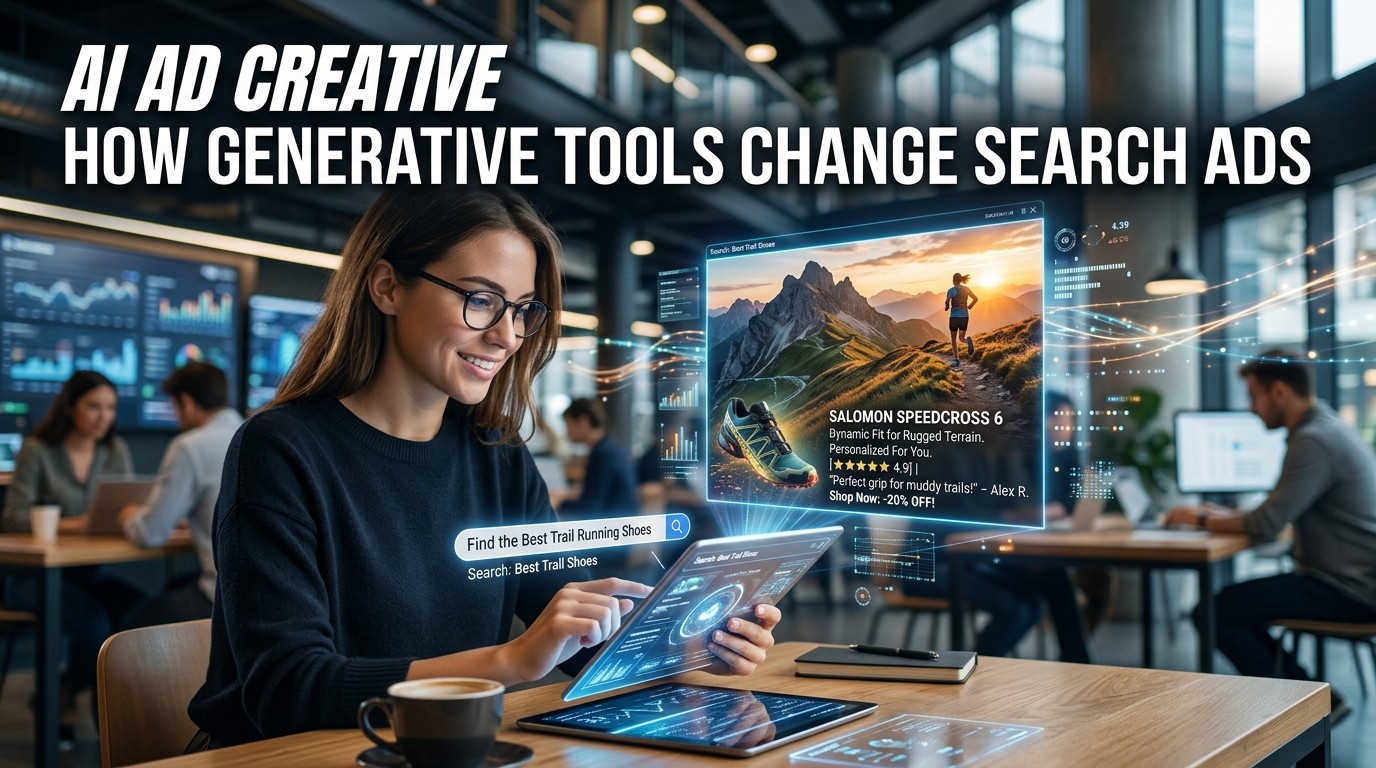
AI Ad Creative is transforming search advertising by generating context-aware messages faster, expanding experimentation, improving relevance, and changing how marketers build scalable performance campaigns.
Search advertising has always involved a difficult balancing act.
Marketers need to understand what people are searching for, write persuasive messages, maintain brand consistency, test variations, respond to changing demand, and keep every piece of the experience aligned with the landing page.
Historically, much of that work happened manually.
A marketer researched keywords, created ad groups, wrote multiple headlines and descriptions, reviewed search terms, identified new opportunities, rejected irrelevant traffic, and continuously produced new variations.
Generative artificial intelligence changes the economics of that process.
AI Ad Creative does not simply mean asking a chatbot to write ten headlines. It represents a broader shift toward using machine intelligence to create, adapt, test, and personalize advertising messages around different forms of user intent.
Google’s current Search advertising guidance describes text customization as a feature that can use generative AI together with advertiser-provided assets, landing-page content, existing ads, keywords, and other context to produce additional headlines and descriptions. Google also states that generated assets are designed to be relevant to the advertiser’s offering and are checked for accuracy.
That matters because the hardest part of search advertising is not producing words.
It is producing the right words for the right person at the right moment.
A searcher looking for an inexpensive accounting platform may need a different message from someone comparing enterprise finance software. A first-time buyer needs different reassurance from an experienced customer. A mobile user searching in a hurry may respond to a different message than someone conducting a long desktop research session.
AI Ad Creative can help advertisers respond to this complexity at a scale that would be difficult to reproduce entirely through manual work.
Yet automation does not automatically create better advertising.
The quality of the result depends on the quality of the strategy, inputs, product information, landing pages, brand guidelines, conversion data, and human oversight behind the system.
This guide explains how generative tools are changing search ads, how the technology works, what marketers should automate, what they should protect, how psychology influences generated messaging, and how businesses can build a responsible and high-performance creative system.
What Is AI Ad Creative?
AI Ad Creative refers to advertising assets, variations, concepts, or customized messages produced or adapted with artificial intelligence.
In search advertising, that can involve generating:
- Headlines
- Descriptions
- Calls to action
- Benefit statements
- Product-specific messages
- Query-relevant variations
- Promotional angles
- Value propositions
- Messaging combinations
The important difference between older automation and modern generative systems is flexibility.
Older rule-based automation generally followed predefined patterns.
Generative systems can synthesize information and create new language based on context.
For example, imagine an advertiser selling project-management software.
A conventional campaign might contain headlines such as:
“Project Management Software”
“Manage Projects Better”
“Powerful Team Collaboration”
A generative system may recognize a search focused on remote teams and produce a more contextual message such as:
“Keep Remote Projects On Track”
That message does not necessarily introduce a new product.
It reframes an existing value proposition around the searcher’s situation.
This is the central promise of AI Ad Creative.
The goal is not merely to make advertising cheaper to produce. The goal is to increase the number of relevant messages an advertiser can potentially test and serve.
Google’s current documentation explains that text customization can combine advertiser-provided assets with additional generated headlines and descriptions, while grounding generated content in the domain, landing pages, existing ads, and ad-group keywords.
That approach moves search advertising closer to dynamic communication rather than fixed copy.
Why Generative AI Is a Major Change for Search Ads
Search advertising has a fundamental constraint: the advertiser usually does not know exactly how every future customer will phrase a query.
A business may research hundreds of important keywords.
Customers can still produce thousands or millions of variations.
Someone might search:
“best bookkeeping tool for freelancers”
while another person searches:
“simple accounting app for one person business”
A third might ask:
“how can I automate invoices and expenses”
All three can express overlapping commercial needs.
AI Ad Creative allows marketers to move beyond the assumption that one static message should represent every version of demand.
Instead, advertisers can create a larger messaging library.
That library can include different benefits, use cases, emotional triggers, proof points, objections, and calls to action.
The system can then determine which combinations are more relevant to specific contexts.
This creates three major advantages.
Greater creative scale
Human marketers have finite time.
Generative systems can produce large numbers of candidate messages quickly.
Faster iteration
When product positioning changes, teams can create updated variations without rewriting an entire account manually.
More contextual relevance
Generated messaging can potentially adapt to different user situations instead of forcing everyone to see the same generic proposition.
These advantages explain why AI Ad Creative is becoming more important in paid search.
But there is another reason.
Search itself is becoming more conversational.
People increasingly search with natural language, fragmented questions, descriptive problems, and highly specific situations.
The more complicated the language becomes, the more valuable contextual creative can become.
How AI Ad Creative Works

To understand the technology, imagine a search campaign as an information ecosystem.
The system can receive information from:
The business website.
The landing page.
Existing headlines.
Existing descriptions.
Keywords.
Product categories.
Ad-group themes.
Search queries.
Audience signals.
Conversion performance.
Brand requirements.
Geographic context.
AI then analyzes available information and creates candidate messaging.
Google describes text customization as using a combination of extractive techniques and generative AI. It can draw from page titles, descriptions, meta information, landing-page content, existing ads, and other relevant campaign inputs to generate assets that fit specific search contexts.
That means AI Ad Creative is not necessarily inventing advertising from a blank page.
The strongest implementations are grounded in real business information.
That distinction is crucial.
A completely unconstrained generative model might produce something that sounds persuasive but is factually wrong.
A grounded system can instead use real product information and turn it into contextual messaging.
The creative transformation process
A simplified workflow looks like this:
User submits search.
The system interprets the search.
Relevant campaign context is identified.
Potentially relevant landing-page information is evaluated.
Existing assets provide brand and product context.
AI creates candidate messaging.
Quality and policy systems evaluate the candidate.
The ad is assembled.
Performance data feeds future optimization.
This is fundamentally different from asking a writer to create one perfect ad.
The system operates as a continuous creative engine.
The Psychology Behind AI Ad Creative
Technology alone does not make an advertisement persuasive.
Human psychology determines whether someone notices the message, understands it, trusts it, and eventually acts.
AI Ad Creative becomes much more powerful when marketers understand the psychological forces behind search behavior.
A person does not search merely because they want information.
They usually search because something has happened.
They have a problem.
They have a desire.
They have a fear.
They have uncertainty.
They have a deadline.
They are comparing alternatives.
They want reassurance.
The best advertising connects with that underlying psychological state.
Problem recognition
A user may search:
“how to reduce website loading time”
The visible query is technical.
The underlying concern may be:
“My site is losing customers.”
A strong advertisement can connect the technical problem to a business outcome.
Risk reduction
A customer searching:
“best payroll service for small business”
may be worried about compliance errors, missed payments, or administrative complexity.
The advertising message should therefore reduce uncertainty.
Identity
Some searches contain identity signals.
“Accounting software for freelancers”
is not merely a functional request.
The customer may want a tool that feels designed specifically for independent professionals.
AI Ad Creative can help reinterpret the same product around different identity or use-case signals.
Urgency
Search behavior often reveals time pressure.
“24 hour plumber”
“same day delivery”
“open dentist near me”
“emergency laptop repair”
A generic benefit may be less persuasive than immediate availability.
This is why contextual messaging matters.
From Generic Headlines to Intent-Based Messaging
One of the biggest weaknesses in traditional search advertising is generic language.
Consider:
“High-Quality Marketing Software”
It may be technically accurate.
But almost every competitor can say the same thing.
Now imagine the search query is:
“marketing software for ecommerce retention”
A stronger contextual message might emphasize:
“Automate Ecommerce Retention”
The difference is not just wording.
It is relevance.
The advertiser has moved from describing the product to reflecting the user’s reason for searching.
AI Ad Creative makes this kind of contextual transformation more scalable because the system can potentially generate many intent-specific variants.
This does not mean every generated message will be better.
It means the creative search space becomes much larger.
That is a major strategic advantage.
AI Ad Creative and Responsive Search Ads
Responsive Search Ads are already designed around combinations of multiple headlines and descriptions.
Generative AI extends the concept.
Instead of relying only on the assets a marketer manually submits, the system can generate additional variations.
Google explains that text customization can create extra headlines and descriptions that work alongside advertiser-provided assets, and that generated assets are used when predicted to perform better in context.
This creates a hybrid model.
The marketer supplies:
Core positioning.
Brand language.
Product truth.
Unique selling propositions.
Approved offers.
Strategic messaging.
The AI supplies:
Variation.
Contextual adaptation.
Additional combinations.
Potentially overlooked phrasing.
That division is powerful because the human remains responsible for strategic truth while the machine expands creative flexibility.
AI Ad Creative should therefore not be viewed as “AI replaces the copywriter.”
A better model is:
Human strategy + machine-scale variation + performance feedback.
Building the Creative Foundation Before Using AI
Generative tools become much stronger when the underlying advertising foundation is strong.
Before generating hundreds of assets, establish a clear messaging architecture.
Define the product promise
What exactly does the product help customers accomplish?
Avoid vague statements.
Instead of:
“Improve your business.”
Use:
“Automate invoices and reduce manual accounting work.”
Specificity gives AI more useful material.
Define customer segments
Different audiences care about different outcomes.
A startup may care about:
Cost.
Speed.
Simplicity.
A large company may care about:
Security.
Integration.
Control.
Scalability.
Define proof
Advertising claims should have evidence.
Proof can come from:
Customer results.
Reviews.
Certifications.
Product capabilities.
Guarantees.
Demonstrations.
Independent validation.
Define objections
Customers often hesitate because of:
Price.
Complexity.
Trust.
Switching costs.
Setup time.
Compatibility.
Security.
AI Ad Creative can address objections only when marketers understand them first.
AI Mobile Marketing and Search Creative Adaptation
Search advertising can no longer be considered independently from mobile behavior.
People search on smartphones when they are:
Comparing products.
Looking for local services.
Checking prices.
Solving immediate problems.
Reading reviews.
Researching while shopping.
AI Mobile Marketing reflects this broader shift toward intelligent marketing experiences shaped by mobile context, rapid intent changes, and compressed decision windows.
For advertisers, that means creative must communicate quickly.
A mobile searcher may see an advertisement for only a few seconds.
The message therefore needs to answer an immediate psychological question:
“Why should I care?”
Good mobile-oriented creative often emphasizes:
Immediate benefit.
Simple language.
Strong differentiation.
Local availability.
Fast delivery.
Ease of use.
Clear next step.
AI Ad Creative can generate variations aligned with these motivations, but the underlying strategy should come from human understanding of mobile behavior.
Google’s own AI-driven advertising guidance emphasizes the importance of tailoring creative messaging to a user’s unique query context.
Mobile-First Marketing Changes Creative Priorities
Mobile-first experiences make attention more expensive.
There may be limited screen space.
Users may be multitasking.
Connection speed may vary.
The customer may be further down the buying journey than expected.
Mobile-First Marketing therefore requires concise and immediately understandable messaging.
The advertisement should not force users to decode complicated terminology.
This is especially relevant when generative systems create multiple variations.
More variations do not automatically mean better ads.
A poorly controlled AI system could generate:
Longer claims.
Redundant statements.
Overly clever phrases.
Unclear promises.
Weak calls to action.
The marketer must establish guardrails.
AI should optimize the message, not destroy clarity.
AI Ad Creative and Brand Consistency
One of the biggest concerns about generative advertising is brand inconsistency.
Imagine a premium financial brand suddenly sounding casual.
Or a healthcare company using exaggerated language.
Or a luxury retailer using bargain-focused wording.
These mismatches can damage trust.
Brand consistency requires more than repeating a logo or company name.
It includes:
Tone.
Vocabulary.
Emotional positioning.
Promises.
Level of formality.
Claim boundaries.
Product terminology.
Audience perspective.
AI Ad Creative should therefore operate inside a defined brand framework.
A useful brand instruction can specify:
Never make unsupported performance claims.
Never use exaggerated superlatives.
Never imply guaranteed results.
Prefer confident but factual language.
Use customer-friendly terminology.
Emphasize measurable benefits where evidence exists.
Avoid slang.
This turns AI from a free-form writer into a controlled brand assistant.
Creative Quality Is More Important Than Creative Quantity
Generative systems make quantity easy.
That creates a new danger.
More headlines can create the illusion of progress.
A campaign with 200 mediocre variations is not necessarily stronger than one with 20 exceptional assets.
The purpose of generation is not volume for its own sake.
It is useful diversity.
Strong creative diversity means variations differ meaningfully across:
Benefits.
Problems.
Use cases.
Audiences.
Objections.
Proof.
Calls to action.
Emotional framing.
For example, a software company might build a creative matrix around:
Save time.
Reduce cost.
Automate repetitive work.
Improve visibility.
Integrate existing tools.
Scale without hiring.
Then the system can produce multiple expressions of each theme.
This is far more strategic than asking AI to “write more headlines.”
Query Relevance and AI Ad Creative
Search ads succeed when the customer sees a connection between what they searched and what the advertisement promises.
Imagine someone searches:
“CRM for real estate agents”
and sees:
“Business Software for Modern Teams.”
That may be relevant at a category level.
But it does not demonstrate understanding.
Now consider:
“CRM Built for Real Estate Teams.”
The second message immediately signals relevance.
That is the potential advantage of AI Ad Creative when generated messaging is connected to query context.
Google’s current documentation says text customization can synthesize query signals with landing-page content and existing assets to create relevant assets for searches advertisers might not have anticipated.
This can be particularly valuable in long-tail search environments.
The advertiser does not need to manually write a message for every imaginable query.
The AI can potentially adapt a strategic message to individual forms of demand.
Keywordless Search Ads and Creative Expansion
The movement toward broader AI-driven query matching makes creative adaptation even more important.
When campaigns can discover search opportunities beyond tightly predefined keyword structures, static messaging can become a constraint.
Imagine a campaign selling cybersecurity software.
The system may encounter searches related to:
Ransomware prevention.
Phishing protection.
Employee security training.
Cloud protection.
Endpoint monitoring.
Small-business cybersecurity.
The product may solve all of these problems.
A single generic advertisement cannot communicate every benefit equally well.
Keywordless Search Ads can expand the query universe, while contextual creative can help adapt the message to different expressions of intent.
That creates a powerful combination:
Broader discovery.
Better relevance.
More creative diversity.
Potentially stronger user experience.
The key is ensuring that the message remains grounded in what the business actually provides.
Search Ads in AI Overviews and Creative Context
Search Ads in AI Overviews behavior is also changing because users can receive synthesized information directly within search experiences.
Google states that ads can appear in AI Overviews and that ad matching may consider both the user’s query and the content of the AI Overview.
This changes the context surrounding an ad.
Suppose a user searches for:
“best accounting software for freelancers”
An AI-generated result may explain:
Pricing.
Tax tools.
Invoice management.
Expense tracking.
Integrations.
The advertisement may now compete within a richer informational environment.
Creative therefore needs to be highly relevant to the topic the user is exploring.
This makes AI Ad Creative increasingly valuable because generating context-specific messaging becomes harder through manual processes alone.
Advertisers should also recognize that search experiences are becoming less linear.
A user can move from:
Question.
Overview.
Comparison.
Follow-up.
Product evaluation.
Purchase.
Creative needs to meet the user at whatever stage that journey creates.
Generative AI and Emotional Triggers
Effective advertising frequently activates psychological triggers.
Examples include:
Curiosity.
Urgency.
Confidence.
Relief.
Belonging.
Convenience.
Security.
Status.
Loss aversion.
Social proof.
AI can generate language around these concepts.
But marketers should use emotional persuasion responsibly.
Fear-based claims can damage trust.
Artificial urgency can frustrate users.
Unverified social proof can create compliance problems.
Overpromising can generate clicks but harm conversion quality.
Good AI Ad Creative balances persuasion and credibility.
The best message often reduces cognitive effort.
It tells the customer:
This is for you.
This solves your problem.
This is why it is different.
This is what you can do next.
When the customer can process those four ideas quickly, the ad becomes psychologically efficient.
The Role of Landing Pages in AI Creative
Creative and landing pages are becoming increasingly interconnected.
An ad promises something.
The landing page must fulfill it.
For example:
Ad: “Same-Day Laptop Repair”
Landing page: general electronics store homepage.
The user expects speed but sees a broad catalog.
That creates friction.
Now consider:
Ad: “Same-Day Laptop Repair in Your Area”
Landing page: dedicated laptop-repair page with service details, availability, location, pricing, and booking.
The journey is coherent.
Google’s AI Max documentation describes text customization and Final URL Expansion as complementary features, with AI-generated messaging and destination selection working together to improve relevance.
This means marketers should think about creative architecture and landing-page architecture together.
AI Ad Creative is strongest when every major message has a credible destination.
AI Ad Creative for E-commerce
E-commerce advertising provides an especially strong use case.
An online store may have:
Hundreds of products.
Thousands of variations.
Multiple buyer segments.
Seasonal demand.
Different product benefits.
Different pricing tiers.
Generative tools can help create more contextual messaging around those variables.
For example, an outdoor retailer may promote the same jacket to different audiences through different psychological angles.
Traveler:
“Packable Weather Protection.”
Hiker:
“Lightweight Jacket for Changing Conditions.”
Commuter:
“Everyday Rain Protection.”
The product does not change.
The perceived relevance changes.
That is the real value of generative advertising.
AI Ad Creative for B2B Search Campaigns
B2B advertising has a different challenge.
Business buyers often have longer research cycles.
They compare:
Features.
Pricing.
Security.
Integrations.
Implementation.
Support.
ROI.
Procurement requirements.
An AI system can help create different messaging around different decision criteria.
For example:
“ERP Software With Faster Implementation”
“ERP Integration for Growing Teams”
“Inventory Visibility Across Locations”
“Secure Financial Reporting Software”
Each message can address a different concern.
This can help B2B advertisers move beyond generic statements such as:
“Complete Business Management Platform.”
The more specific the business problem, the more useful contextual messaging becomes.
AI Ad Creative for Local Businesses
Local businesses can benefit from highly contextual advertising because search intent is often explicit.
Examples include:
“dentist open today”
“emergency electrician near me”
“same day flower delivery”
“car repair open now”
AI can potentially adapt messages to emphasize urgency, proximity, availability, or service type.
For local advertisers, landing-page relevance is equally important.
The customer wants to know:
Where are you?
Are you open?
Can you help me now?
What does it cost?
How do I contact you?
Creative that answers those concerns quickly can reduce search friction.
How to Control Generative AI
The best AI advertising strategies use guardrails.
Google provides text guidelines that can help advertisers establish restrictions around terms, messaging, and other requirements for generated creative. Google also provides reporting that allows advertisers to inspect AI-generated assets.
This creates a useful governance framework.
Rule 1: Protect factual accuracy
Do not allow AI to invent:
Prices.
Features.
Guarantees.
Certifications.
Statistics.
Awards.
Testimonials.
Rule 2: Define prohibited language
Create a list of words or claims the model should avoid.
Rule 3: Define approved positioning
Provide a messaging hierarchy.
For example:
Primary benefit.
Secondary benefit.
Differentiator.
Proof.
Call to action.
Rule 4: Monitor generated assets
Do not assume every generated asset will be perfect.
Review what is actually serving.
Rule 5: Use human escalation
Sensitive industries or high-risk claims may require more intensive review.
Generative technology should increase speed without removing accountability.
Measuring AI Ad Creative Performance
The correct measurement framework goes beyond click-through rate.
Track:
Impressions.
Clicks.
CTR.
Conversions.
Conversion rate.
Cost per conversion.
Revenue.
ROAS.
Qualified leads.
Customer acquisition cost.
Lead-to-sale rate.
Lifetime value.
The central question is not:
“Did the AI generate more clicks?”
It is:
“Did AI-generated or AI-assisted messaging produce better business outcomes?”
Suppose one variation gets a 9% CTR but a 1% conversion rate.
Another gets a 6% CTR but a 7% conversion rate.
The second may be dramatically more valuable.
This is why performance measurement must extend beyond engagement.
AI Ad Creative should ultimately be judged by business contribution.
Incremental Lift Matters
Another important concept is incremental impact.
Suppose a campaign already performs well with manually written assets.
Turning on AI generation and seeing total conversions increase does not automatically prove that generated assets caused the increase.
Other factors may have changed.
Seasonality.
Budget.
Search demand.
Bid strategy.
Competition.
Landing pages.
Promotions.
To evaluate AI properly, advertisers should use controlled experiments where practical.
Google provides AI Max experiments that can compare treatment campaigns using AI Max features with a control setup.
This is a better approach than relying on intuition.
Test.
Measure.
Compare.
Learn.
Then scale.
AI Ad Creative and the Search Marketing Workflow
Generative advertising does not need to replace the entire creative workflow.
Instead, it can improve each stage.
Research
AI can organize customer language and identify themes.
Ideation
AI can propose angles and benefits.
Drafting
AI can create initial versions.
Adaptation
AI can create contextual variations.
Testing
The platform can test combinations.
Analysis
Marketers can identify winning themes.
Refinement
Human strategy can improve future inputs.
That creates a continuous creative learning loop.
The strongest teams will not simply generate more advertisements.
They will become better at extracting strategic information from advertising performance.
What AI Should Automate
AI is particularly useful for repetitive and high-volume activities.
Examples include:
Creating variations.
Adapting wording.
Generating alternative headlines.
Reframing benefits.
Testing different calls to action.
Expanding use-case messaging.
Organizing creative themes.
Refreshing stale language.
This frees human marketers to focus on higher-value tasks.
Those include:
Positioning.
Offer design.
Customer research.
Brand strategy.
Competitive differentiation.
Business economics.
Regulatory judgment.
Creative direction.
These are difficult to automate because they require broader context.
What Humans Should Still Control
There are areas where human judgment remains critical.
Brand positioning
AI can describe your product.
It should not independently decide what your brand stands for.
Strategic differentiation
A competitor can use the same generative model.
Your advantage comes from what you tell it and how you position the product.
Claims
Claims can carry legal and reputational consequences.
Customer understanding
AI can process data, but human insight is still valuable for interpreting why customers behave in certain ways.
Business priorities
A marketer must determine whether the goal is:
Revenue.
Profit.
Market share.
Lead quality.
Retention.
Brand growth.
AI can optimize toward the objective.
It should not invent the objective.
Common Mistakes When Using Generative Advertising
Generating without strategy
Writing hundreds of ads before defining the value proposition creates noise.
Giving AI weak source material
If your landing page is vague, generated content may also become vague.
Chasing novelty
Creative does not need to sound clever.
It needs to be relevant.
Ignoring customer language
The words customers use can be more persuasive than internal marketing terminology.
Overusing automation
Not every message should be dynamically rewritten.
Some core brand statements should remain stable.
Failing to review
Automated systems still require oversight.
Measuring shallow metrics
Clicks alone do not prove profitability.
Forgetting the landing page
A highly relevant advertisement cannot compensate for a confusing destination.
A Practical AI Ad Creative Framework
A strong implementation can follow seven stages.
Stage 1: Customer intelligence
Collect:
Search queries.
Customer reviews.
Sales-call language.
Support questions.
Competitor positioning.
Website behavior.
Stage 2: Messaging architecture
Identify:
Pain points.
Desired outcomes.
Benefits.
Features.
Proof.
Objections.
Differentiators.
Stage 3: Brand guardrails
Define:
Tone.
Forbidden claims.
Preferred vocabulary.
Legal restrictions.
Message hierarchy.
Stage 4: Generate
Use AI to create:
Headlines.
Descriptions.
Angles.
Variants.
Use-case adaptations.
Stage 5: Validate
Check:
Accuracy.
Relevance.
Clarity.
Brand fit.
Policy compliance.
Stage 6: Test
Compare:
Creative themes.
Benefits.
Calls to action.
Intent-specific messaging.
Stage 7: Learn
Turn performance data into improved strategic inputs.
This is where AI advertising becomes a system instead of a gimmick.
The Future of AI Ad Creative
Generative advertising is likely to become increasingly contextual.
Search engines understand more about:
The query.
The user journey.
The website.
The landing page.
The advertisement.
The available products.
The likely intent.
As these signals become more interconnected, static advertising becomes less efficient as a universal model.
The future is likely to involve a greater separation between:
Strategic inputs.
Creative generation.
Real-time adaptation.
Auction optimization.
Measurement.
The marketer may define the boundaries while AI manages much more of the variation inside those boundaries.
Google already describes AI Max as a broad optimization layer combining search-term matching, text customization, and Final URL Expansion.
That direction suggests advertising platforms are moving toward integrated AI systems rather than isolated automation features.
Why Creative Strategy Becomes More Valuable, Not Less
At first glance, generative AI appears to reduce the importance of copywriting.
In reality, it can increase the importance of creative strategy.
When everyone can generate 100 headlines instantly, headlines themselves become less scarce.
The scarce resource becomes:
Knowing what should be said.
Knowing what customers care about.
Knowing which benefit matters.
Knowing which objections prevent action.
Knowing what differentiates the product.
Knowing how the brand should sound.
Knowing what not to promise.
That is strategic creativity.
AI Ad Creative makes execution cheaper, but strategic judgment becomes more important.
The organizations that benefit most will not necessarily be those that generate the largest number of assets.
They will be those that give AI the strongest strategic foundation.
How to Create Better Inputs for Generative Systems
A useful input framework can include five layers.
Product truth
What does the product actually do?
Customer problem
What problem does it solve?
Desired outcome
What does the customer gain?
Differentiation
Why choose this product instead of another?
Proof
Why should the customer believe you?
For example:
Product truth: automated invoice management.
Problem: manual invoicing consumes staff time.
Outcome: faster billing and fewer repetitive tasks.
Differentiation: designed for growing service businesses.
Proof: documented product capabilities and customer evidence.
The AI can turn those facts into many creative expressions without requiring the marketer to rewrite the underlying strategy repeatedly.
AI Ad Creative and Competitive Advantage
Generative technology is widely accessible.
That means the technology itself is unlikely to remain a durable competitive advantage.
Competitors can generate headlines too.
The competitive advantage comes from better inputs and better learning.
A company that knows:
Why customers buy.
Why customers hesitate.
Which messages convert.
Which claims are credible.
Which segments are most profitable.
Which product benefits matter.
can give an AI system a better foundation than a competitor that simply asks for generic ad copy.
In other words, AI amplifies marketing intelligence.
It does not magically create it.
A Human-Centered Approach to AI Advertising
The most successful use of generative advertising should remain human-centered.
A customer does not care whether a headline was written by:
A human.
An AI.
A hybrid workflow.
They care whether the message helps them make a decision.
That means relevance comes first.
Then clarity.
Then credibility.
Then persuasion.
Then action.
When those factors work together, the source of the words becomes far less important.
The purpose of AI Ad Creative is therefore not to impress marketers with automation.
Its purpose is to improve the customer’s experience of finding and evaluating an offer.
Final Checklist for AI-Powered Search Ads
Before launching an AI-assisted search campaign, ask:
| Area | Question |
|---|---|
| Positioning | Is the core product value clear? |
| Audience | Do we know who the ad is for? |
| Intent | Do we understand the customer’s search motivation? |
| Creative | Are there meaningful message variations? |
| Brand | Are clear tone and claim rules defined? |
| Landing page | Does the destination fulfill the ad promise? |
| Tracking | Are meaningful conversions measured? |
| Governance | Can generated assets be reviewed? |
| Testing | Can we compare AI-assisted performance against a baseline? |
| Optimization | Are we learning from business outcomes rather than clicks alone? |
When these foundations are strong, generative advertising can become a powerful performance layer.
When these foundations are weak, AI simply increases the speed of producing mediocre or misleading content.
Conclusion
AI Ad Creative is changing search advertising from a static copy-production process into a dynamic system built around context, intent, experimentation, and automated adaptation. Generative tools can help advertisers create more variations, respond to complex searches, align messaging with landing pages, and scale creative experimentation beyond what manual teams can reasonably produce. However, the real advantage does not come from generating the largest number of headlines. It comes from combining accurate product information, strong positioning, customer psychology, trustworthy conversion data, brand guardrails, and human judgment with machine-scale execution. As search becomes increasingly AI-driven and conversational, advertisers that build strong creative foundations and continuously learn from performance will be better positioned to turn automation into meaningful commercial results.
Frequently Asked Questions (FAQ)
1. What is AI Ad Creative?
AI Ad Creative refers to advertising assets created, adapted, or personalized with artificial intelligence. In search advertising, this can include generated headlines, descriptions, benefit statements, and query-relevant messaging variations.
2. How does AI Ad Creative differ from traditional ad copywriting?
Traditional ad copywriting generally relies on humans creating and managing a defined set of messages. AI Ad Creative can generate and adapt a much larger number of contextual variations based on campaign, website, landing-page, and query information.
3. Can AI Ad Creative replace human copywriters?
It can automate portions of copy production, but it does not eliminate the need for human strategy. Brand positioning, customer understanding, product differentiation, claim approval, and creative direction still require strong human judgment.
4. Does Google use generative AI for Search ad assets?
Yes. Google’s current Search guidance describes text customization as using extractive techniques and generative AI to create additional headlines and descriptions using relevant advertiser and landing-page context.
5. Is AI Ad Creative useful for small businesses?
It can be useful because small teams often have limited creative resources. Automation can help them produce more variations and adapt messaging without requiring a large in-house advertising team.
6. How can marketers keep AI-generated ads on-brand?
Create clear brand guidelines covering tone, vocabulary, approved claims, prohibited wording, product facts, differentiators, and promotional rules. Google also provides text guidelines and asset reporting for greater control and review.
7. Should every AI-generated ad be accepted?
No. Generated assets should be evaluated for factual accuracy, relevance, brand fit, clarity, policy compliance, and business value. Automation should reduce repetitive work, not eliminate quality control.
8. Does AI Ad Creative improve CTR automatically?
No. Generative technology can increase creative variety and relevance, but performance depends on many factors, including offer quality, targeting, landing-page experience, competition, conversion tracking, and customer intent.
9. How should AI-generated search ads be measured?
Measure business outcomes such as conversions, qualified leads, revenue, ROAS, customer acquisition cost, and profitability. CTR can provide useful diagnostic information, but it should not be treated as the final measure of success.
10. What is the future of AI Ad Creative in search advertising?
The direction is toward more contextual, adaptive, and integrated advertising systems. Search engines can increasingly connect queries, creative, websites, landing pages, and AI-driven optimization, allowing advertisers to scale personalized relevance while keeping humans responsible for strategy and governance.



Leave a Reply