

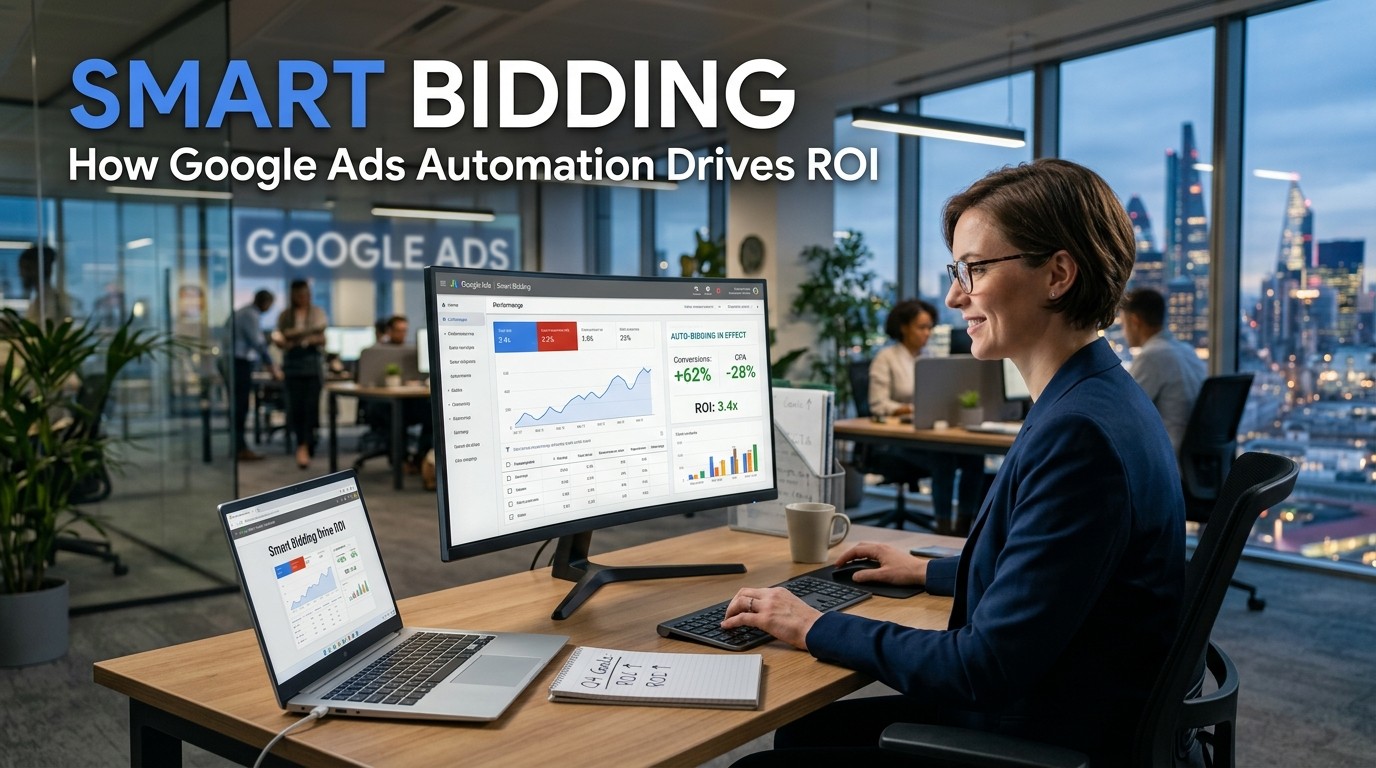
Smart Bidding in Google Ads uses auction-time AI to adjust bids around conversion goals, contextual signals, and expected value, helping advertisers manage search budgets with greater precision at scale.
Google Ads bidding used to feel like a numbers game where advertisers continuously adjusted bids based on clicks, costs, positions, devices, and recent campaign performance. That model becomes difficult to manage when thousands of searches happen across different users, locations, devices, times, and levels of purchase intent. Smart Bidding in Google Ads changes that operating model by allowing Google AI to make auction-time decisions rather than relying entirely on manually assigned bids. Google defines Smart Bidding as conversion- or conversion-value-focused bidding that uses AI to optimize every eligible auction.
The important distinction is that automation does not simply mean “Google spends the budget for you.” Smart Bidding in Google Ads attempts to estimate the likelihood of a conversion or the expected conversion value for an individual auction, then use that prediction when determining how aggressively to bid. Google says its systems can make millions of unique bid decisions per second across campaigns, using auction-level context and account performance information.
That makes the system especially interesting for advertisers who want to understand what happens behind the bidding interface. A campaign may appear to have a single target CPA or ROAS, but the underlying process is far more dynamic. Smart Bidding in Google Ads can evaluate a combination of contextual signals and query-level patterns before deciding how valuable a particular auction may be.
The real opportunity is therefore not “letting AI do marketing.” The opportunity is separating strategic thinking from repetitive execution. A marketer can define the business objective, conversion rules, acceptable economics, campaign structure, offer, and customer journey, while Smart Bidding in Google Ads performs a large volume of mathematical decisions that would be impossible to handle manually at the same speed.
That distinction also explains why sophisticated campaigns still need experienced human oversight. A machine can optimize what it is told to optimize. It cannot independently decide whether a form submission is genuinely valuable, whether a product margin is adequate, whether an offer makes sense, or whether a sales team can handle the generated demand. Smart Bidding in Google Ads is therefore best understood as an optimization mechanism inside a larger marketing system.
When advertisers understand that system, automation becomes much easier to evaluate. Instead of asking whether AI is “good” or “bad,” the more useful question is how the platform interprets signals, how those signals influence bids, and whether the resulting decisions produce the business outcomes the advertiser actually wants.
What Is Smart Bidding in Google Ads?
At its core, Smart Bidding in Google Ads refers to Google Ads bid strategies that use machine learning to optimize for conversions or conversion value at auction time. Google currently identifies Target CPA, Target ROAS, Maximize conversions, and Maximize conversion value as Smart Bidding strategies.
The phrase “auction time” is critical because an auction is not identical to another auction. One searcher may be on a mobile device, another on desktop. One person may search from a service area during business hours, another from a location where the advertiser cannot realistically serve them. One user may have previously interacted with the business while another may be discovering it for the first time. Smart Bidding in Google Ads attempts to incorporate such context into the bid decision.
For a deeper supporting explanation of automated bidding behavior, the related Smart Bidding resource can help connect the mechanics of bidding automation with practical ROI considerations.
This distinction separates Smart Bidding in Google Ads from simpler automated strategies that focus on awareness-oriented outcomes such as clicks or impression share. Google notes that Maximize clicks and Target impression share are automated bid strategies, but they do not use the same auction-time conversion/value optimization framework as Smart Bidding.
Another important idea is that Smart Bidding in Google Ads is not limited to a single static variable such as keyword CPC. Instead, Google’s documentation explains that the system can use combinations of signals and evaluate how those signals interact with one another. That means the algorithm is not merely looking at one isolated characteristic; it can attempt to recognize patterns associated with stronger or weaker conversion performance.
This is why Smart Bidding in Google Ads can behave differently even when two searches use very similar wording. If the contextual environment and historical probability of a valuable outcome differ, the system may value the auctions differently. From an advertiser’s perspective, this creates a more fluid bidding model than manually assigning one bid to every keyword.
The practical benefit is scalability. Smart Bidding in Google Ads can continuously repeat these calculations without requiring a marketer to inspect every auction. Human operators can then focus on higher-level questions: Is the campaign reaching the right audience? Are conversions valuable? Is the landing page persuasive? Is the target profitable? Is the account collecting clean data?
How Automation Decides What to Bid
The decision process behind Smart Bidding in Google Ads begins with the objective. Google needs to understand what the campaign is trying to maximize. For conversion-focused campaigns, the objective can be conversion volume or acquisition efficiency. For value-based campaigns, the objective can be conversion value or a target return on ad spend. The selected strategy becomes a key constraint within the automated decision process.
Once the objective is known, Smart Bidding in Google Ads can evaluate the context surrounding the auction. Google lists signals such as device, location, time of day, remarketing lists, browser, operating system, and language among the types of contextual information its systems can use.
The algorithm then attempts to estimate how likely the auction is to produce the desired outcome. For conversion-based bidding, Smart Bidding in Google Ads can predict the probability that a click will convert. For value-based bidding, the system can estimate both the probability of conversion and the likely conversion value. Google describes these distinctions directly in its explanation of how bids are calculated.
That prediction does not have to be identical for every keyword. Smart Bidding in Google Ads can use broader query-level performance across an account, which means an individual query with limited historical data may still benefit from patterns identified elsewhere in the account. Google describes this broader approach as using search query-level performance alongside contextual signals when calculating bids.
The next step is translating prediction into bid intensity. If an auction is estimated to have stronger potential for the chosen objective, Smart Bidding in Google Ads can bid more aggressively within the strategy’s constraints. If the expected outcome is weaker, the system may reduce bid pressure. This is fundamentally different from treating every eligible auction as having the same value.
The process is continuous rather than occasional. Smart Bidding in Google Ads is making decisions whenever eligible auctions occur, while the model continuously receives new information from recorded outcomes. Google’s documentation describes this as auction-time bidding and notes that the systems can set millions of unique bids per second across campaigns.
This does not mean the algorithm knows the future with certainty. Smart Bidding in Google Ads operates through predictions. Predictions can be strong, weak, uncertain, or affected by changes in demand. That is why marketers should evaluate trends over meaningful periods instead of assuming that every individual bid decision will look perfect in isolation.
The final point is especially important: Smart Bidding in Google Ads can only optimize according to the information available to it. If conversion tracking is inaccurate, if low-value actions are included as primary conversions, or if revenue values are missing, the system may receive a distorted definition of success. Automation amplifies the objective; it does not automatically correct a poor objective.
Smart Bidding Strategies Explained

Google currently organizes Smart Bidding in Google Ads around four major conversion and conversion-value strategies: Maximize conversions, Target CPA, Maximize conversion value, and Target ROAS. The first pair focuses on conversion quantity or acquisition cost, while the second pair focuses on value and return.
Maximize conversions is designed to use the available budget to generate as many conversions as possible. Smart Bidding in Google Ads can adjust auction-level bids based on predicted conversion rates and contextual information rather than applying one uniform bid to every opportunity. This is useful when conversion volume is the primary goal and a specific CPA constraint is not the immediate requirement.
Target CPA adds a cost-efficiency objective. Smart Bidding in Google Ads can still try to capture conversions, but bid decisions also consider the target cost per acquisition. Some individual conversions may cost more and others less; Google’s documentation explains that the goal is an average outcome around the target rather than an identical cost for every conversion.
Maximize conversion value changes the optimization question. Instead of asking for the largest number of conversions, Smart Bidding in Google Ads attempts to maximize the total conversion value produced by the available budget. This becomes important when transactions differ meaningfully in economic value, such as ecommerce purchases with different order sizes.
Target ROAS adds a return objective to that value-based framework. Smart Bidding in Google Ads can use expected conversion value while taking the specified return target into account. Google explains that when performance is trending below the target ROAS, bids may be adjusted accordingly to help move performance toward the specified goal.
For advertisers deciding among these strategies, the business model should lead the choice. Smart Bidding in Google Ads should not be selected because a strategy sounds more advanced. A lead-generation company may care primarily about qualified acquisition cost, while a retailer may care about revenue or margin-adjusted value.
That is also why Value-Based Bidding can be a relevant concept when the business does not treat every conversion as economically identical.
For example, imagine two ecommerce purchases. One generates $25 in revenue, while another generates $600. If both are reported as one generic conversion, Smart Bidding in Google Ads receives less information about the economic difference between them. Supplying reliable conversion values can give the system a richer optimization signal.
Google’s current 2026 documentation also clarifies a naming change that advertisers may notice. Starting in June 2026, “Maximize conversions with a Target CPA” is being labeled “Target CPA,” and “Maximize conversion value with a Target ROAS” is being labeled “Target ROAS.” Google states that this is a naming change and that the underlying bidding behavior remains the same.
This matters because Smart Bidding in Google Ads tutorials, screenshots, and older training materials may display different names during the transition. Understanding the underlying objective is more useful than memorizing one interface label.
What Signals Does Google Consider?
A major reason Smart Bidding in Google Ads can make auction-level decisions is that Google can use multiple contextual signals together. Device is one example. A mobile visitor searching for a local service may behave differently from a desktop user researching a complex B2B product. Location can also change the expected value of an auction if a business only serves certain regions.
Time is another contextual dimension. Smart Bidding in Google Ads can consider time-of-day patterns when predicting the likelihood of conversion. A restaurant campaign, for instance, may have stronger commercial intent during periods when users are actively planning meals, while a B2B software campaign may behave differently across working hours and evenings. These are examples of why auction-level context matters.
User-related context can also influence the prediction. Google references signals such as remarketing-list membership, browser, operating system, language, device, and location as examples used in its bidding systems. Smart Bidding in Google Ads evaluates combinations rather than necessarily treating each signal in isolation.
Search query behavior adds another layer. Two queries can appear semantically similar but produce very different downstream outcomes. Smart Bidding in Google Ads can use query-level performance signals across the account to improve its predictions, giving the system a way to recognize patterns beyond a single keyword’s isolated history.
This creates an important lesson for advertisers: keyword relevance and bidding relevance are related but not identical. A keyword can be highly relevant to the product and still have lower expected value under certain contexts. Smart Bidding in Google Ads can respond to that difference through its prediction model.
Audience intent can strengthen the broader decision framework too. The concept behind Intent Data for Precise Prospecting is relevant because it demonstrates how behavioral signals can reveal differences in buying readiness before a final conversion happens.
Still, advertisers should not assume every external signal can simply be inserted into Smart Bidding. The system works from the signals and conversion framework available within the Google Ads ecosystem. Smart Bidding in Google Ads should therefore be supported by strong first-party measurement, clean campaign architecture, and accurate conversion definitions.
Why Conversion Tracking Matters So Much
Conversion tracking is the foundation of Smart Bidding in Google Ads because the system needs outcomes to understand what “success” looks like. If a campaign counts every page view, accidental form submission, or low-intent interaction as a primary conversion, the algorithm may learn to pursue those actions rather than the events that actually produce revenue.
Google specifically recommends making sure the conversion actions being optimized are configured correctly and used appropriately for the campaign’s goals. Smart Bidding in Google Ads depends on those optimization signals, so the quality of the data has direct strategic importance.
For lead-generation campaigns, this becomes a common challenge. A business may receive hundreds of leads, but only a fraction might become sales-qualified opportunities. Smart Bidding in Google Ads cannot automatically understand the difference unless that quality is represented through the conversion setup or connected data.
The same principle applies to ecommerce. If an online store sends product purchase values, Smart Bidding in Google Ads can distinguish between different levels of conversion value. If every order is assigned an identical value, the system loses some of that economic information.
Measurement therefore needs to be designed before optimization is judged. A high conversion rate with low customer quality is not necessarily strong performance. Smart Bidding in Google Ads may be behaving exactly as instructed while the business experiences poor profitability.
For complex businesses, deeper downstream signals can make the optimization problem more representative of actual revenue. The broader concept Intent Data Identifies also reinforces why advertisers benefit from distinguishing passive activity from genuine buying intent.
The key principle is simple: better inputs create a more meaningful optimization target. Smart Bidding in Google Ads cannot turn inaccurate tracking into accurate strategy. It can only use the signals it receives.
How to Set Up Smart Bidding in Google Ads
The first setup step is not selecting a bid strategy. It is defining the business outcome. Smart Bidding in Google Ads should have a clear reason for existing in the account. That may be more qualified leads, lower acquisition costs, more transaction value, or a target return on ad spend.
Next, review the conversion actions. Determine which events genuinely matter and which ones are better treated as secondary reporting signals. Smart Bidding in Google Ads should optimize toward actions that represent actual business progress rather than every interaction users have with the website.
The third step is to choose a strategy aligned with that objective. Conversion-volume goals generally map to Maximize conversions or Target CPA, while conversion-value goals generally map to Maximize conversion value or Target ROAS. Google maintains this goal-to-strategy structure in its current guidance.
The fourth step is setting realistic targets. Smart Bidding in Google Ads does not create demand from nothing. If historical performance, margins, competition, and conversion rates imply a certain economic range, a target far outside that range may create unnecessary constraints.
The fifth step is allowing the system to operate with enough consistency to learn. Smart Bidding in Google Ads can be affected by major changes to conversion actions, budgets, targets, campaign structures, landing pages, and traffic sources. Changing many variables simultaneously can make it difficult to understand what caused a performance shift.
The sixth step is monitoring business-level outcomes, not only the bidding status indicator. Smart Bidding in Google Ads should be evaluated through conversion volume, acquisition cost, conversion value, ROAS, lead quality, sales revenue, and other metrics relevant to the business model.
Finally, document major changes. A simple change log can record when targets were changed, when conversion actions were modified, when budgets increased, and when new campaigns were launched. Smart Bidding in Google Ads can produce changing performance patterns, so a timeline helps separate algorithmic learning from business-side changes.
How Search Intent Influences Automated Bidding
Search intent remains one of the most important strategic concepts around Smart Bidding in Google Ads. Automation may decide how aggressively to bid, but the advertiser still determines which search themes, offers, and landing experiences enter the campaign.
Consider three queries: “best accounting software,” “accounting software pricing,” and “buy accounting software for small business.” All three can be relevant, but they represent different positions in the decision journey. Smart Bidding in Google Ads can use historical outcome data to learn that some query patterns convert more effectively than others.
This creates an interesting relationship between human strategy and machine optimization. Marketers identify intent categories, create relevant messaging, control irrelevant traffic, and build appropriate landing pages. Smart Bidding in Google Ads then operates inside that environment and adjusts bids based on expected outcomes.
Search-term monitoring is still important because automation is not a substitute for traffic quality management. Irrelevant queries can consume budget even when the overall campaign strategy is automated. Smart Bidding in Google Ads is designed to optimize the auctions it receives; it is not a guarantee that every matched search is commercially useful.
Ad-message relevance also matters. When the ad promise matches the user’s intent, the visitor is more likely to understand what will happen after the click. Smart Bidding in Google Ads can benefit indirectly from this because stronger conversion rates create stronger outcome signals.
Landing pages complete the chain. If high-intent users arrive on pages with unclear offers, long forms, weak trust elements, slow performance, or mismatched messaging, the campaign may struggle despite sophisticated automation. Smart Bidding in Google Ads cannot directly repair an offer that does not persuade visitors.
Human Psychology and the Automation Layer
Advertising decisions are not purely mathematical. People evaluate risk, credibility, effort, urgency, social proof, and perceived value before acting. Smart Bidding in Google Ads operates mainly on the prediction and bid-allocation side, while marketers remain responsible for the psychological experience that converts attention into action.
This creates a useful division of labor. Smart Bidding in Google Ads can evaluate patterns at a scale that would overwhelm a human operator, while a marketer can ask questions such as: Why would a buyer hesitate? What objection remains unanswered? Does the offer feel safe? Is the next step obvious?
Trust is particularly important for high-consideration purchases. A conversion may fail not because the user lacked intent, but because the site did not provide enough reassurance. Smart Bidding in Google Ads may identify a strong commercial context, but the final outcome still depends on what happens after the click.
Clarity matters too. Users want to understand what they are buying, how much it costs, what happens next, and why the offer is relevant. When these elements are presented clearly, Smart Bidding in Google Ads may benefit from improved conversion performance because better visitor experiences generate stronger measurable outcomes.
This is why advertisers should not isolate bidding from creative strategy. Smart Bidding in Google Ads is part of a connected system involving keywords, advertisements, audiences, landing pages, conversion tracking, and the sales process.
How Smart Bidding Can Influence ROI

Return on investment improves when advertising spend generates more valuable business outcomes relative to cost. Smart Bidding in Google Ads can contribute by differentiating auction-level opportunities according to predicted conversion probability or value rather than treating all eligible traffic equally.
Suppose a campaign spends $10,000 and produces $35,000 in tracked conversion value. If better conversion data, improved landing-page messaging, and more efficient auction allocation increase tracked value to $42,000 at the same spend, the campaign’s ROAS improves from 3.5x to 4.2x. Smart Bidding in Google Ads could contribute to the bidding component of that improvement, but the total result would still depend on other factors.
A useful way to think about this is that Smart Bidding in Google Ads influences one part of the economic equation, while the rest of the marketing funnel influences the quality of the outcome. Offer strength, product demand, conversion rate, average order value, sales efficiency, and retention all remain important.
This is also why low CPA should not automatically be celebrated. A $20 lead can be expensive if that lead never becomes a customer, while a $60 lead can be commercially attractive if it produces significantly more revenue. Smart Bidding in Google Ads needs signals that reflect the economic outcome the business actually values.
For ecommerce companies, conversion value can be especially useful when order values vary. Smart Bidding in Google Ads can operate on richer information when higher-value purchases are represented properly in Google Ads conversion data.
For lead-generation companies, the challenge is often deeper qualification. If possible, businesses should examine whether leads become appointments, opportunities, or closed deals. Smart Bidding in Google Ads may be optimized more meaningfully when the measurable signals reflect those deeper outcomes.
Common Smart Bidding Mistakes
One of the most common mistakes is optimizing toward low-quality conversions. Smart Bidding in Google Ads can produce more of a conversion action very efficiently, but if that action has little commercial value, the campaign can appear successful while the business struggles.
Another mistake is setting an aggressive Target CPA or Target ROAS without considering the current demand environment. Smart Bidding in Google Ads works within the economics available in the market. Targets that are unrealistic relative to historical performance can create restrictions or reduce the system’s ability to explore useful demand.
Frequent changes can also cause confusion. When advertisers repeatedly modify targets, budgets, conversion actions, and campaign structures, it becomes difficult to understand how Smart Bidding in Google Ads is responding. Controlled changes and clear testing are easier to interpret.
Ignoring search terms is another problem. Automation does not make irrelevant traffic useful. Smart Bidding in Google Ads still operates within the queries and auctions the campaign can enter, so negative keywords, keyword structure, and search-term analysis remain practical optimization tools.
A fifth mistake is judging performance too quickly. Conversion delays, changing demand, promotion periods, seasonality, and sales cycles can distort short-term results. Smart Bidding in Google Ads should be evaluated over a suitable window based on the campaign’s conversion behavior.
The final mistake is treating Google Ads metrics as the entire business result. Smart Bidding in Google Ads may show healthy platform-level performance while the sales team reports poor lead quality or low revenue. Connecting advertising data with downstream outcomes produces a more complete picture.
Advanced Optimization Practices
Portfolio strategies can be useful when multiple campaigns share compatible objectives and enough data can be combined meaningfully. Google allows standard strategies to apply to individual campaigns and portfolio strategies to apply across multiple campaigns. Smart Bidding in Google Ads can therefore be structured around broader groups when the business logic supports it.
Experiments are another important tool. Rather than relying only on a simple before-and-after comparison, advertisers can isolate a bidding change and compare a test group with a control setup. Google specifically recommends campaign experiments for testing value-based bidding because the approach helps hold other variables constant. Smart Bidding in Google Ads is easier to evaluate when the test is designed to isolate the bidding change.
Broad match can also be paired with Smart Bidding in Google Ads. Google states that broad match works with Smart Bidding because the system can explore additional auctions while using predicted performance to adjust bids. That combination can expand reach, but search-term quality and conversion measurement still need attention.
Seasonality requires judgment as well. Google describes seasonality adjustments as tools for expected short-term conversion-rate changes around significant events and notes that Smart Bidding already accounts for ordinary seasonality. Smart Bidding in Google Ads therefore should not be manually “corrected” for every normal fluctuation.
Budget management is increasingly important because performance can be limited by available spend. Google announced changes in 2026 aimed at more consistent and predictable performance for target-based bidding on budget-limited campaigns. Smart Bidding in Google Ads can therefore be affected by ongoing platform-side changes, making current documentation and account monitoring more important than relying only on older tutorials.
Another advanced practice is separating exploration from scaling. Smart Bidding in Google Ads needs room to find valuable opportunities, but advertisers still need guardrails around budget, geography, product availability, profitability, and lead capacity. Exploration without business constraints can produce volume that the organization cannot monetize efficiently.
Finally, use a consistent optimization framework. Smart Bidding in Google Ads should be evaluated through a sequence such as measurement, validation, observation, hypothesis, test, comparison, and scaling. This creates a more disciplined process than changing settings every time one day’s metrics look unusual.
Smart Bidding for Different Business Models
For ecommerce, Smart Bidding in Google Ads can be particularly useful when purchase values vary. A retailer selling both low-ticket and premium products has more reason to consider value-based objectives because the business does not view every order as economically identical.
For lead-generation businesses, Smart Bidding in Google Ads can work best when conversion quality is measured rather than simply counting form submissions. If sales teams can identify qualified leads, appointments, or closed opportunities, those signals can provide a more meaningful basis for evaluation.
For local businesses, location and timing can be highly relevant. Smart Bidding in Google Ads can account for auction-level context, while marketers can still define the service area, offer, business hours, and conversion action that matter commercially.
For SaaS companies, the long sales cycle creates another challenge. A demo or trial may be valuable, but the final economic outcome can depend on activation, retention, subscription value, and customer lifetime value. Smart Bidding in Google Ads should therefore be assessed against the deepest practical signals available rather than assuming the first lead is the final business result.
Smart Bidding and 2026 Google Ads Changes
The 2026 Google Ads environment includes an important terminology update. Google began changing the interface labels so Target CPA and Target ROAS appear as standalone strategy names rather than as target settings attached to the maximize strategies. Smart Bidding in Google Ads remains functionally consistent through this naming transition.
Advertisers may therefore encounter older educational content that says “Maximize conversions with Target CPA” while a current interface says “Target CPA.” Smart Bidding in Google Ads should be understood through the underlying objective rather than the exact wording of a screenshot or older tutorial.
Google has also announced 2026 developments around bidding and budgeting, including new AI-powered capabilities and updates intended to help advertisers respond to shifting consumer behavior. Smart Bidding in Google Ads is consequently part of a broader evolution toward increasingly automated campaign management.
How to Measure Whether Automation Is Actually Helping
The first metric to examine is not necessarily clicks. Smart Bidding in Google Ads should be evaluated against the outcome selected for the campaign. That might mean qualified conversions, CPA, conversion value, ROAS, revenue, or another measurable business result.
Second, compare performance with a relevant baseline. Smart Bidding in Google Ads should not be credited for every performance improvement that happens after automation is enabled. Demand changes, promotions, pricing, competitors, creative updates, landing-page changes, and tracking modifications can all affect results.
Third, evaluate efficiency and volume together. A campaign can reduce CPA while losing too much conversion volume, or increase conversions while attracting lower-quality users. Smart Bidding in Google Ads should be considered successful only when the trade-off fits the business objective.
Fourth, examine marginal performance when scaling. The first group of high-intent auctions may be very efficient, while additional budget can reach progressively different demand. Smart Bidding in Google Ads can help manage that expansion, but advertisers should still monitor whether incremental spend remains commercially attractive.
Finally, combine Google Ads reporting with business reporting. Smart Bidding in Google Ads may optimize according to recorded conversions, while finance, CRM, or sales systems reveal whether those conversions generated actual economic value. The closer these systems are aligned, the more meaningful optimization becomes.
The Human + Machine Model

The strongest way to understand Smart Bidding in Google Ads is not as a replacement for the marketer but as a high-speed execution layer. Humans define goals, offers, customer understanding, business constraints, measurement rules, and testing frameworks. The system performs repetitive calculations across auctions.
That division matters because automation can be powerful without being omniscient. Smart Bidding in Google Ads can estimate probabilities from available information, but the advertiser must still determine which outcomes matter and whether the account is collecting useful evidence.
A marketer also needs to recognize when external conditions change. Product availability can shift, competitors can launch promotions, a website can break, a tracking tag can stop firing, or the sales team can hit capacity. Smart Bidding in Google Ads does not replace the need for operational awareness.
The goal is therefore not maximum automation. The goal is useful automation. Smart Bidding in Google Ads becomes strategically valuable when its automated decisions are connected to trustworthy measurement and sensible human oversight.
That relationship creates a more sustainable paid-search workflow. Instead of spending most of the day adjusting individual bids, marketers can invest more time in search intent, creative strategy, offer positioning, landing-page testing, customer quality, profitability, and experimentation while Smart Bidding in Google Ads handles the repetitive auction-level calculations.
Conclusion
Smart Bidding in Google Ads can transform paid search from a collection of manual bid decisions into an adaptive system that responds to auction context. Its value, however, depends on what the account teaches the system through conversion goals, values, campaign structure, and landing-page experience. Strong measurement gives automation a meaningful destination; strong strategy gives it useful boundaries. Advertisers should judge bidding performance through qualified conversions, revenue, customer value, and acquisition economics rather than automation alone. When objectives are clear and data is trustworthy, Smart Bidding in Google Ads becomes a practical mechanism for scaling decisions without abandoning human oversight.
Frequently Asked Questions (FAQ)
1. What is Smart Bidding in Google Ads?
Smart Bidding in Google Ads refers to Google Ads bid strategies that use AI and machine learning to optimize for conversions or conversion value at auction time. Google identifies Target CPA, Target ROAS, Maximize conversions, and Maximize conversion value as Smart Bidding strategies.
The key idea is that bids can vary according to contextual information and predicted outcomes rather than remaining fixed for every keyword or search.
2. How does Smart Bidding in Google Ads decide bids?
Smart Bidding in Google Ads uses contextual and historical signals to estimate conversion probability or expected conversion value. Google says these signals can include device, location, time of day, remarketing status, browser, language, operating system, and query-level performance.
It then uses those predictions alongside the campaign’s strategy target to determine how aggressively to bid for an individual auction.
3. Does Smart Bidding in Google Ads automatically improve ROI?
Smart Bidding in Google Ads can help improve efficiency by adjusting bids toward auctions with stronger predicted outcomes, but it does not guarantee higher ROI.
Results also depend on conversion tracking, targeting, search relevance, offer quality, landing pages, competition, margins, and customer quality. Automation works from the objective and signals supplied by the advertiser.
4. Which strategy should I use with Smart Bidding in Google Ads?
Smart Bidding in Google Ads includes different strategies for different goals. Maximize conversions focuses on conversion volume, Target CPA on acquisition efficiency, Maximize conversion value on total value, and Target ROAS on return efficiency.
The correct choice should come from the business objective rather than from the assumption that one strategy is universally appropriate.
5. Does Smart Bidding in Google Ads need conversion tracking?
Yes. Smart Bidding in Google Ads depends heavily on the conversion or conversion-value signals used for optimization.
If the account records poor-quality or irrelevant primary conversions, the system can optimize toward those actions. Google recommends ensuring that the conversion goals and actions used for Smart Bidding accurately reflect business objectives.
6. Can Smart Bidding in Google Ads work with broad match?
Yes. Smart Bidding in Google Ads can be used with broad match, and Google describes broad match plus Smart Bidding as a way to discover additional relevant auctions while using predicted performance to guide bids.
Advertisers should still review search terms, maintain negative keywords, and monitor conversion quality.
7. How long does Smart Bidding in Google Ads take to learn?
Smart Bidding in Google Ads does not have one universal learning period that applies equally to every campaign. Conversion volume, sales-cycle length, traffic, strategy settings, and account changes all influence how the system behaves.
Advertisers should avoid judging performance from isolated days and should consider conversion delays when evaluating changes.
8. What changed with Smart Bidding in Google Ads in 2026?
In June 2026, Google began updating the labels for target-based strategies. “Maximize conversions with a Target CPA” is being shown as “Target CPA,” while “Maximize conversion value with a Target ROAS” is being shown as “Target ROAS.” Google says the underlying bidding behavior remains the same.
This means older tutorials may use different labels from the current Google Ads interface.
9. Can Smart Bidding in Google Ads optimize for conversion value?
Yes. Smart Bidding in Google Ads includes Maximize conversion value and Target ROAS for advertisers who measure conversion value and want bidding to reflect value rather than simply counting conversions.
This can be particularly useful when purchases, leads, or customers have substantially different economic values. Accurate value tracking is essential because the system can only optimize meaningfully around the values it receives.
10. What should I monitor after enabling Smart Bidding in Google Ads?
After enabling Smart Bidding in Google Ads, monitor the metrics that match the campaign objective: conversions, CPA, conversion value, ROAS, revenue, lead quality, spend, and incremental performance.
Search terms, landing-page conversion rates, sales outcomes, tracking accuracy, and major account changes should also be reviewed. The strongest evaluation connects Google Ads performance with the actual business result rather than relying on a single platform metric.




Leave a Reply