

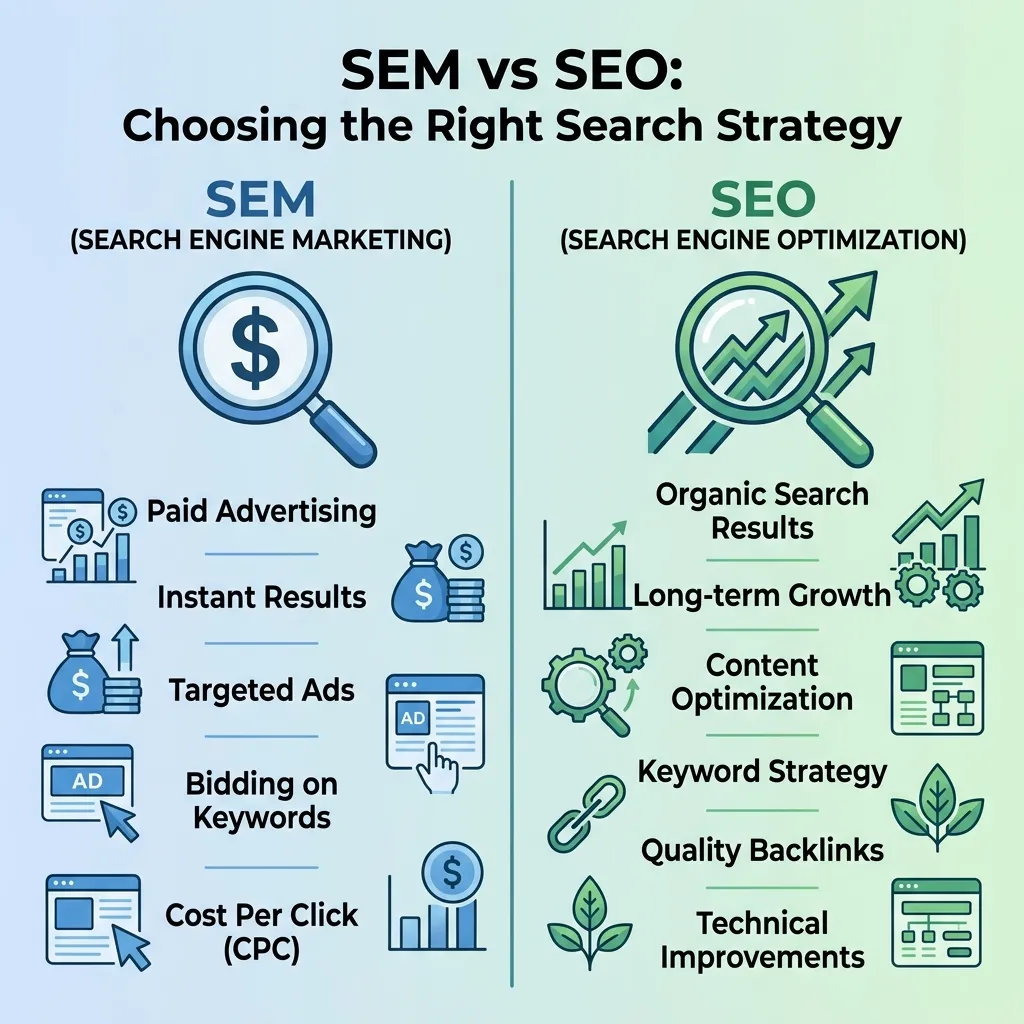
SEM vs SEO are two key search marketing strategies that improve online visibility. SEO focuses on organic rankings, while SEM uses paid ads. Together, they help businesses attract targeted traffic and increase conversions effectively today.
Search engines act as the primary starting point for nearly every online journey. When people want to buy a new product, learn a valuable skill, or find a local business, they type their query into a search bar. For modern businesses, appearing at the top of those specific search results remains a primary objective. Two acronyms constantly dominate this conversation: SEM and SEO.
The debate of sem vs seo is common among business owners and marketing teams. Search Engine Optimization (SEO) and Search Engine Marketing (SEM) share a fundamental goal. They both aim to increase your website’s overall visibility on search engine results pages, driving valuable traffic directly to your digital properties today. However, the paths they take to achieve this exact goal are completely different.
Understanding the mechanics behind sem vs seo allows you to allocate your marketing budget effectively. Some businesses pour money into paid ads without building a solid organic foundation. Others focus entirely on organic content and completely miss out on immediate conversion opportunities. Finding the right balance requires a clear understanding of how each tactic actually works.
This comprehensive guide explores the specific components of the sem vs seo dynamic. We will look at how they function independently, how they complement each other, and how you can measure their success to rapidly grow your digital presence.
Understanding the Basics: SEM vs SEO
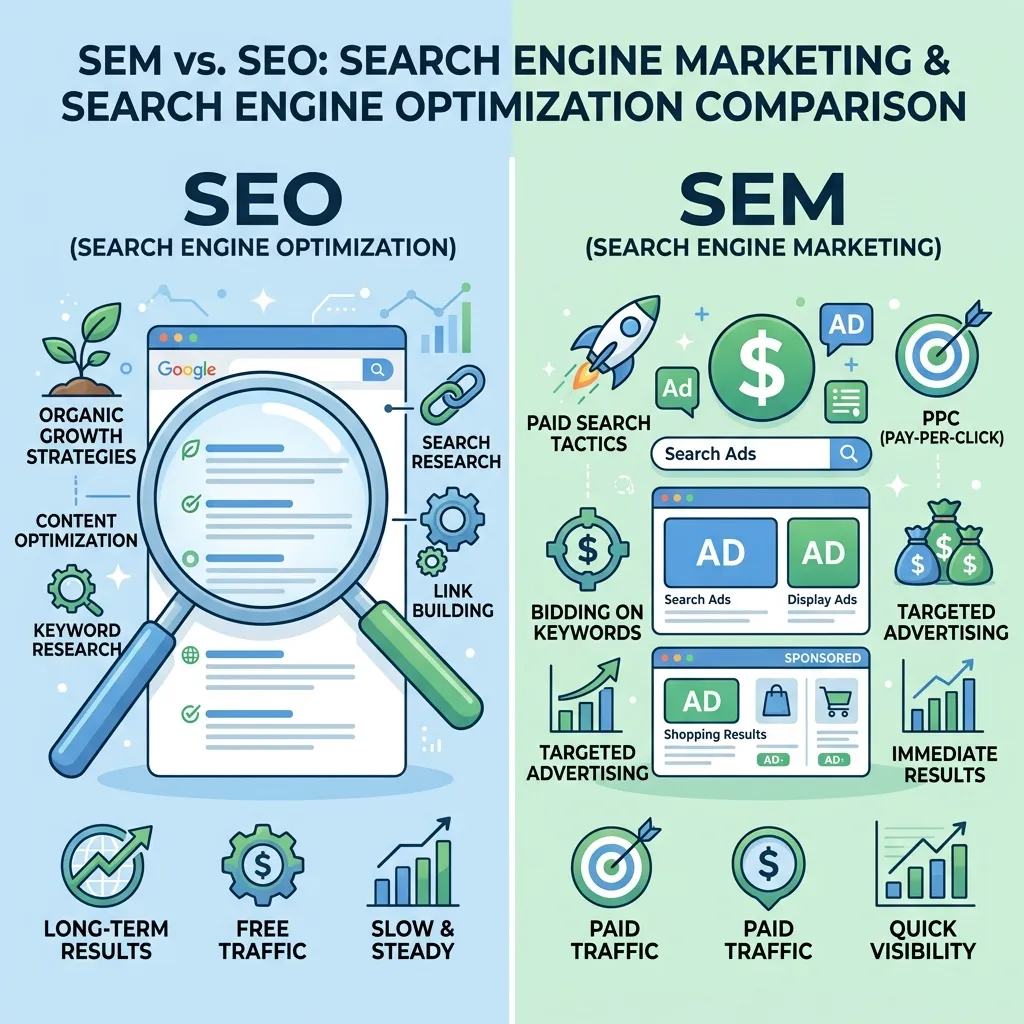
To master the sem vs seo debate, you must understand their core definitions. SEO is the practice of earning traffic through unpaid, organic listings. SEM is the practice of buying traffic through paid search listings.
While people often use the terms interchangeably, keeping them separate clarifies your overall marketing strategy. A strong marketing plan evaluates sem vs seo carefully to decide where to spend time and money.
The Evolution of Search Strategies
Over the past decade, the landscape of sem vs seo has undergone radical change. In the early days, keywords and backlinks were the biggest ranking factors. Today, Google and other search engines use hundreds of signals to determine both paid and organic positioning. User intent, page speed, mobile usability, and even the overall brand reputation now influence both SEM performance and SEO rankings.
Modern marketers must adapt their sem vs seo strategies to ongoing search engine algorithm updates, cookie deprecation, and changes in user search behavior. Voice search and AI-powered queries are sparking unique challenges, causing organic and paid tactics to evolve beyond traditional boundaries.
A Deep Dive into Search Engine Optimization (SEO)
Search Engine Optimization is the dedicated practice of improving your website to increase its organic visibility. You do not pay Google or Bing directly for these organic rankings. Instead, you earn your position by providing highly relevant, authoritative content that search engine algorithms deem valuable to the user. When comparing sem vs seo, remember that SEO is generally broken down into three main pillars.
On-Page SEO
On-page SEO refers to the optimizations you make directly on your website’s pages. This includes conducting deep keyword research to understand exactly what your target audience is searching for online. Once you identify those primary keywords, you weave them naturally into your page titles, headings, and body paragraphs.
Content quality serves as the foundation of on-page optimization. Search engines prioritize content that thoroughly answers a user’s question without fluff. Alongside the text itself, elements like meta descriptions and title tags help search engines fully understand the context of the page. Internal linking is another critical component here. Linking related pages together helps search engines crawl your site efficiently and establishes a clear hierarchy of information.
Featured Snippets and Rich Results
As Google expands its suite of SERP features, optimizing for rich results and featured snippets should be part of every SEO strategy. These concise answer boxes appear above regular listings and dramatically increase visibility. To compete for them, format answers concisely, use bullet points where appropriate, and structure your headings clearly.
Off-Page SEO
Off-page SEO involves all the strategic actions taken outside of your own website to impact your rankings. The most prominent factor in off-page optimization is backlinking. When other reputable websites link back to your pages, search engines view it as a direct vote of confidence. High-quality backlinks signal clearly that your content is trustworthy and authoritative.
Building your domain authority takes time and requires consistent, daily effort.
- You can guest post on popular industry blogs.
- You can launch digital PR campaigns to gain mentions.
- You can create exceptional content that naturally attracts links.
Social signals, such as shares and high engagement on social media platforms, also play a supporting role. They drive referral traffic and indirectly boost your off-page profile over time.
The Impact of Brand Mentions
Beyond direct backlinks, unlinked brand mentions also carry increasing weight. Google recognizes when your brand name is discussed in authoritative contexts—even if no clickable link is provided—and can reward this with higher domain authority. Building positive buzz is now a valuable off-page tactic.
Technical SEO
Technical SEO ensures that search engines can easily find, crawl, and index your website without errors. If your site has major technical flaws, even the best content will fail to rank well. Key technical factors include site speed and mobile-friendliness. Because most users browse on their phones, search engines prioritize sites that load quickly and display correctly on smaller screens.
Other technical elements include optimizing your site architecture, using secure HTTPS connections, and generating clean XML sitemaps. Fixing broken links and eliminating duplicate content also fall directly under this category. A technically sound website provides a smooth, fast user experience, which search engines heavily reward.
Core Web Vitals and Mobile Usability
Google now uses metrics like Largest Contentful Paint (LCP), First Input Delay (FID), and Cumulative Layout Shift (CLS) as ranking signals. Meeting core web vitals benchmarks is increasingly important for both desktop and mobile SEO success. Regularly audit your site using Google Search Console or PageSpeed Insights to identify—and fix—any technical obstacles.
The Value of Long-Term Organic Growth
When analyzing sem vs seo, remember that SEO requires patience. It can take months to see significant movement in your rankings. However, the effort compounds massively over time. Once you secure top positions for valuable keywords, you receive a steady stream of passive traffic without paying for every single click. This makes SEO one of the most cost-effective strategies for long-term, sustainable business growth.
A Deep Dive into Search Engine Marketing (SEM)
While SEO focuses on earned traffic, Search Engine Marketing (SEM) focuses on bought traffic. In the broader marketing industry, the sem vs seo conversation often equates SEM directly with paid search advertising, most commonly referred to as Pay-Per-Click (PPC).
Paid Search Basics
Platforms like Google Ads and Bing Ads allow businesses to bid on specific keywords. When a user searches for those terms, the search engine displays the advertiser’s ad at the very top or bottom of the results page. Advertisers only pay money when a user actually clicks on the ad, making it a highly measurable investment.
Ad Formats, Bidding, and Targeting
SEM offers a wide variety of ad formats to capture attention. Text ads are the most common, appearing similar to organic search results but marked with a distinct “Sponsored” label. E-commerce businesses frequently use shopping ads, which display product images, prices, and store names directly in the visual search results.
Bidding strategies dictate exactly how your budget is spent. You can set manual bids for maximum control or use automated bidding algorithms to optimize for clicks, conversions, or target return on ad spend.
Targeting options in SEM are incredibly granular.
- Specify exact geographical locations.
- Target specific times of day or days of the week.
- Choose device types (mobile vs. desktop).
- Select specific demographic traits like age or income.
Advanced SEM Targeting and Retargeting
Modern SEM allows for powerful retargeting—displaying ads to users who previously visited your website but didn’t convert. You can show dynamic ad content tailored to the pages a user viewed, significantly increasing conversion rates. Remarketing Lists for Search Ads (RLSA) and Customer Match tools allow you to re-engage high-value prospects.
The Value of Immediate Visibility
The biggest advantage in the sem vs seo comparison is the speed of SEM. As soon as your campaign is approved and your bids are set, your ads can appear at the top of the search results. This provides immediate visibility and an instant influx of highly targeted traffic. It is highly predictable and completely scalable. If a campaign is profitable, you simply increase the budget to drive more sales immediately.
Key Differences and Synergies: SEM vs SEO
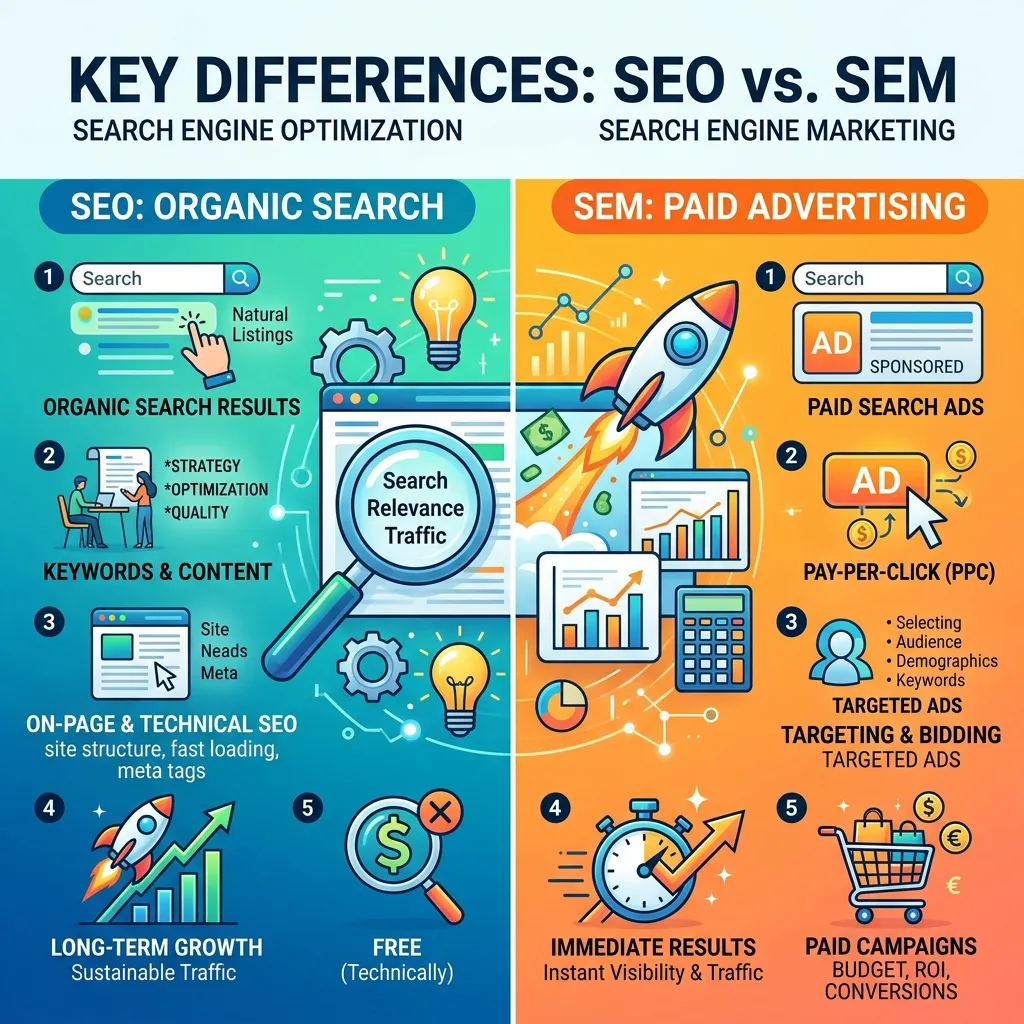
Comparing sem vs seo reveals distinct contrasts in cost, speed, control, and overall sustainability.
With SEO, you invest time and resources upfront, but the clicks are ultimately free. With SEM, you pay for every single visitor. SEO takes months to mature properly, while SEM generates traffic the exact same day you launch. SEM gives you absolute, total control over the ad copy and landing pages users see. SEO is always subject to the unpredictable whims of search engine algorithm updates.
Brand Perception and Trust
A major but often overlooked aspect of sem vs seo is user trust. Studies consistently reveal that users trust organic listings more than ads, seeing top-ranking SEO results as more credible—even though many paid ads offer the same product or solution. However, SEM still garners high click-through for urgent needs and transactional queries.
Striking the Right Balance
Despite these differences, sem vs. seo work best when seamlessly combined. Data gathered from your SEM campaigns can directly inform your SEO strategy. If you discover a specific keyword has a high conversion rate in your paid ads, you can prioritize creating organic content around that exact topic.
Learn how to manage both channels successfully.
Striking the right balance between paid and organic search
This approach helps you maximize your marketing budget.
Additionally, occupying both a paid ad spot and a high organic ranking on the same results page establishes heavy brand dominance and increases your overall click-through rates.
SEM vs SEO: Channel Strengths for Different Funnel Stages
|
Funnel Stage |
SEO Strengths |
SEM Strengths |
|---|---|---|
|
Awareness |
Educational blog content, how-to guides, and evergreen resources boost organic discovery |
Display/video ads and broad search campaigns increase immediate visibility |
|
Consideration |
Detailed comparison pages, reviews, testimonials |
Retargeting ads, shopping/product ads |
|
Conversion |
High-converting product/service pages optimized for keywords |
Branded search ads, targeted offers, time-limited promotions |
|
Loyalty |
Newsletter opt-ins, members-only content for retention |
Ads for upselling and cross-selling past purchasers |
Comparison Table: SEM vs SEO
To clearly understand the sem vs seo dynamic, review this detailed comparison:
|
Feature |
SEO (Organic) |
SEM (Paid) |
|---|---|---|
|
Cost per click |
Free |
Pay per click |
|
Time to see results |
3 to 6 months |
Immediate |
|
Longevity |
Long-lasting |
Stops when budget runs out |
|
Control over placement |
Low (Algorithm decides) |
High (Based on bids) |
|
Primary focus |
Trust and authority building |
Conversions and targeted traffic |
When to Use Which Strategy
Choosing between sem vs seo depends heavily on your current business goals, your available budget, and your required timeline.
Scenarios Preferring SEO
SEO is the right choice when your goal is long-term brand building and educational content marketing. If you are writing comprehensive guides, how-to articles, or deep industry reports, organic search is the best channel to distribute this information.
Startups and small businesses with limited marketing budgets should prioritize SEO early on. Building an organic presence ensures you are not entirely dependent on paid acquisition, which can become prohibitively expensive in highly competitive industries.
Scenarios Preferring SEM
SEM is the preferred channel when you need results immediately. If you are launching a brand new product, hosting a time-sensitive promotion, or trying to capitalize on a sudden market trend, you cannot wait months for organic rankings to kick in.
Paid search is also ideal for highly competitive commercial keywords where the organic results are completely dominated by massive industry giants. Bidding on these keywords allows smaller players to bypass the organic competition and appear directly in front of motivated buyers.
Multi-Channel Attribution
When you use both SEM and SEO, campaign attribution becomes more complex—but more insightful. Combining data from Google Analytics, Google Ads, and heatmapping software helps you understand how paid and organic touchpoints work together before a conversion. This insight allows for better budget allocation.
The Integrated Approach
Most successful businesses do not choose one over the other in the sem vs seo debate. They use a fully integrated approach. They use SEM to drive immediate revenue and test keyword viability while simultaneously investing in SEO to secure long-term, low-cost traffic. This hybrid model perfectly balances immediate cash flow needs with sustainable future growth.
Measuring Success in SEM vs SEO
Tracking the right Key Performance Indicators (KPIs) ensures your search strategies are actually moving the needle for your business.
Key KPIs for SEO
To fully measure SEO success, you should monitor:
- Organic Traffic: The total number of visitors arriving from non-paid search results.
- Keyword Rankings: Where your pages sit in the search results for target phrases.
- Conversion Rate: The percentage of organic visitors who complete a desired action, such as filling out a form or making a purchase.
- Bounce Rate: Metrics that indicate whether users find your content relevant and engaging.
- Page Engagement: Average time on page and pages per session reveal whether your organic content actually serves visitor needs.
Key KPIs for SEM
To measure SEM success, focus heavily on:
- Click-Through Rate (CTR): Percentage of people who see your ad and click on it.
- Cost Per Click (CPC): Average amount you pay for each ad click.
- Conversion Rate: The percentage of paid visitors who take a desired action.
- Return on Ad Spend (ROAS): The actual revenue generated for every dollar spent on the campaign.
- Impression Share: Percentage of impressions your ads received compared to the total available. Higher share signals stronger market reach.
Advanced SEM and SEO Analytics
Leverage custom goal tracking, cohort analysis, and channel segmentation to get granular performance insights. For multi-location or multi-language businesses, segmenting KPIs by region or language reveals additional optimization opportunities in your sem vs seo mix.
Future Trends in Search
The search engine landscape is changing rapidly. Understanding these shifts will help you future-proof your marketing efforts in the sem vs seo ecosystem.
The most significant trend is the direct integration of Artificial Intelligence into search engines. AI overviews and generative search experiences are fundamentally altering how users interact with results pages. Search engines are attempting to answer complex questions directly on the results page, which means zero-click searches are rising fast. To adapt, SEO strategies must focus on providing deep, original insights and strong opinions that AI cannot easily summarize.
AI is also totally transforming SEM. Ad platforms now rely heavily on machine learning to automate bidding, optimize targeting, and even generate ad copy dynamically. Marketers must learn to steer these AI tools effectively, providing the algorithms with high-quality data rather than manually tweaking individual keyword bids every day.
Preparing for Voice and Visual Search
New search habits are on the rise, including voice commands and visual search tools. Websites with structured data, conversational FAQs, and high-quality images are better positioned for these new channels. Both SEM and SEO tactics should evolve to capitalize on these search shifts, targeting long-tail voice phrases or image-based keywords.
Regulatory Changes and Privacy Impact
Regulations such as GDPR and the elimination of third-party cookies alter how marketers track and target users. In the sem vs seo context, SEO becomes more valuable as restrictions on tracking users in paid campaigns increase. SEM strategies will need greater emphasis on first-party data and contextual targeting moving forward.
Frequently Asked Questions
What does SEM stand for?
SEM stands for Search Engine Marketing. It refers primarily to the practice of using paid advertisements that appear on search engine results pages to drive traffic. Businesses bid on keywords to ensure their ads show up when users search for specific products or services.
What is the main difference between sem vs seo?
The main difference is how you acquire the traffic. SEO focuses on optimizing your website to earn free, organic rankings over time. SEM involves paying for advertisements to appear immediately at the top of the search engine results page.
Which is better for a new business, sem vs seo?
A new business needs both, but SEM provides immediate visibility and traffic to generate quick sales. SEO should be started simultaneously to build a foundation, but because it takes months to work, SEM is better for immediate short-term traction.
Does SEM help improve my SEO rankings?
No, paying for SEM ads does not directly improve your organic SEO rankings. Google separates paid ads from organic algorithms completely. However, SEM can increase overall brand awareness, which might lead to more organic branded searches over time.
How much does SEM cost?
The cost of SEM varies wildly depending on your industry and the specific keywords you target. You set your own daily budget and maximum bids. Some clicks cost pennies, while highly competitive legal or insurance keywords can cost over fifty dollars per click.
How long does it take for SEO to work?
SEO is a long-term strategy that usually takes three to six months to show significant results. It requires consistent effort in content creation, technical optimization, and backlink building before search engines fully trust and rank your pages highly.
Can I do SEO on my own?
Yes, you can perform basic SEO on your own by learning keyword research and optimizing your content. However, technical SEO and large-scale backlink building often require specialized knowledge. Many businesses eventually hire experts to scale their organic growth effectively.
What is a good click-through rate for SEM?
A good click-through rate (CTR) depends on your industry, but an average across all industries is generally around 3% to 5% for search network ads. A higher CTR indicates that your ad copy is highly relevant to the keyword and compelling to the user.
Why did my SEO rankings drop suddenly?
SEO rankings can drop for several reasons, including search engine algorithm updates, technical errors on your website, or competitors publishing better content. It is important to audit your site regularly and monitor Google Search Console to identify and fix these issues quickly.
Should I stop SEM once my SEO is working?
You generally should not stop SEM completely, even if your SEO is successful. Running both allows you to dominate the search results page, capturing more total clicks. You can lower your SEM budget on keywords where you rank organically and shift those funds to highly competitive terms.
By fully understanding the unique strengths and best practices behind sem vs seo, marketers and business owners can build smarter campaigns, allocate budgets wisely, and navigate the ever-evolving world of search with confidence. For those ready to forge ahead, integrating both strategies will ensure your brand captures immediate attention while building enduring digital authority well into the future.



Leave a Reply