

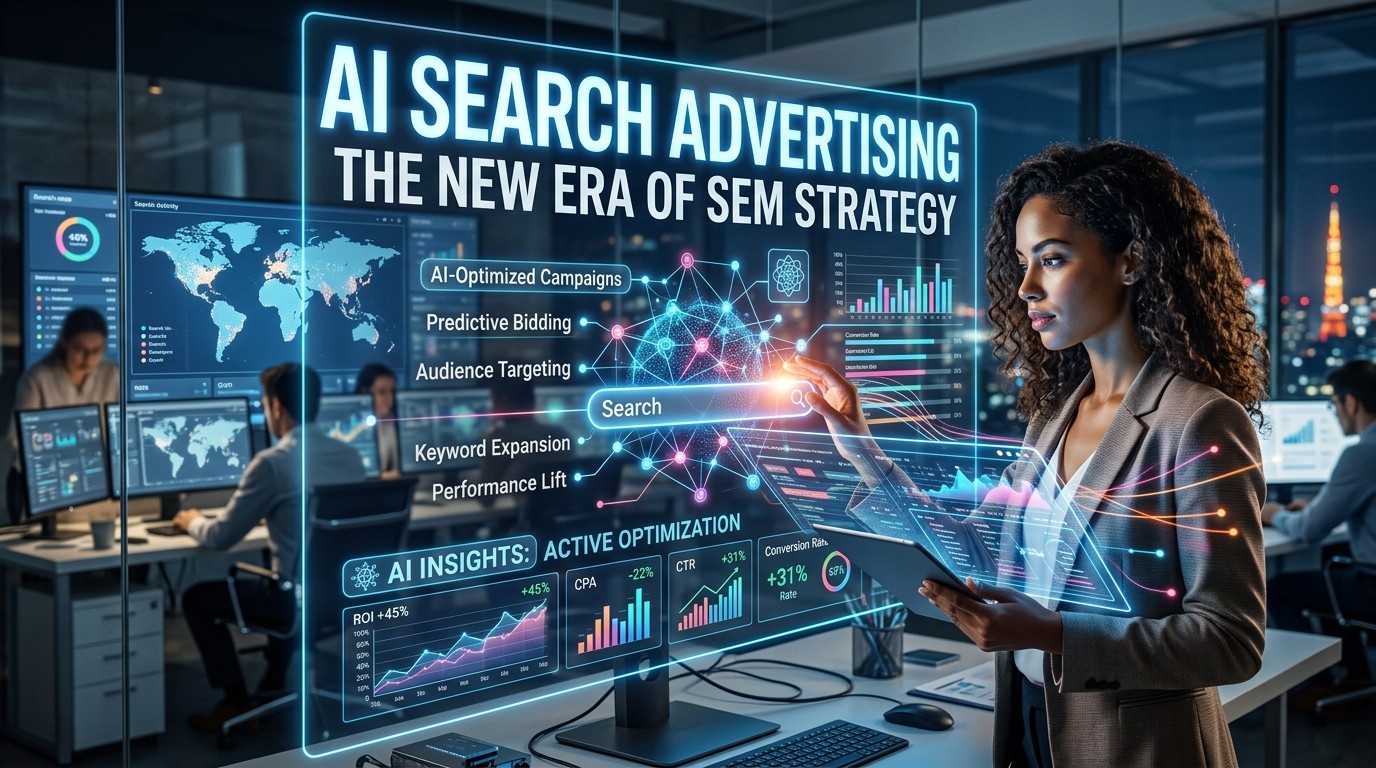
AI search advertising is reshaping modern SEM by combining intent signals, AI-generated search experiences, smarter targeting, adaptive creative, stronger landing pages, and measurement focused on sustainable business outcomes.
Search engine marketing is entering a different phase. For years, paid search revolved around keywords, bids, ad copy, landing pages, and the familiar process of matching a typed query with a relevant advertisement. That model still matters, but the environment around it is changing quickly.
AI Search Advertising represents this transition from rigid keyword matching toward systems that interpret context, intent, behavior, language, and business signals more dynamically. Instead of treating every query as a standalone phrase, modern search advertising increasingly attempts to understand what the user is trying to accomplish.
That matters because consumer behavior is becoming more conversational. A person may no longer search with a short commercial phrase such as “CRM software pricing.” They may ask a longer question, compare several options, describe a specific problem, or ask for recommendations that change as they learn more.
AI Search Advertising is designed for this more fluid environment. It connects paid media with machine learning, automated targeting, adaptive assets, and increasingly intelligent search interfaces. Google’s current Search advertising ecosystem includes AI Max as an optimization layer for Search campaigns, combining features such as expanded search term matching and asset optimization.
The strategic implication is important: advertisers should stop thinking of SEM as simply “buying keywords.” The stronger approach is to build a system that gives machines high-quality signals while preserving human control over business objectives, brand standards, budgets, and customer experience.
AI Search Advertising therefore changes the role of the marketer. Instead of manually controlling every possible query variation, marketers increasingly design the inputs, constraints, creative assets, conversion signals, and measurement framework that guide automated systems.
What Is AI Search Advertising?
AI Search Advertising is the use of artificial intelligence, machine learning, automation, contextual signals, and adaptive advertising systems to deliver paid search experiences based on deeper interpretations of user intent.
Traditional SEM often starts with a keyword list. AI Search Advertising starts with a broader question: what outcome is the user trying to achieve?
That difference sounds subtle, but it changes campaign architecture. A keyword such as “best accounting software” can represent a student researching options, a business owner comparing vendors, or an enterprise procurement team preparing for a purchase.
AI Search Advertising attempts to interpret those differences through available signals rather than relying only on the literal text of the search. Google AI Overviews as a comprehensive suite of targeting and creative enhancements that can expand reach, improve creative relevance, and provide additional controls and insights.
For marketers, the opportunity is not to surrender strategy to AI. The opportunity is to make strategy more scalable.
AI Search Advertising works best when marketers clearly define the business outcome first. A campaign designed to generate qualified sales conversations needs different signals from one designed to increase ecommerce transactions.
That means the real foundation is not automation. It is clarity.
Why Search Behavior Is Changing
The search box is no longer the only meaningful interface between consumers and information. People increasingly ask detailed questions, use voice, interact with visual search, and expect search platforms to synthesize information before presenting options.
AI Search Advertising fits naturally into this changing behavior because machine intelligence can interpret longer and more nuanced requests.
Google has also expanded AI-powered experiences in Search. The company has described AI Overviews and AI Mode as new environments where users discover information and brands, while ads can increasingly appear in relevant AI-driven experiences.
For advertisers, AI Search Advertising means that the buying journey may begin before a conventional product-category query appears.
A user could first search for a problem, then compare solutions, then ask which solution is appropriate for their situation, and only later demonstrate strong purchase intent.
This creates an enormous strategic advantage for advertisers that understand journeys rather than isolated clicks.
AI Search Advertising can support this evolution by using signals that help systems identify relevant audiences across a wider range of queries.
However, expansion without control can also produce waste. Broader matching can increase reach, but increased reach is valuable only when the resulting traffic has commercial relevance.
The marketer’s job is therefore becoming more sophisticated: provide enough flexibility for AI to discover opportunity while maintaining enough guardrails to protect efficiency.
The Difference Between Traditional SEM and AI-Led SEM

Traditional SEM is often managed through tightly segmented keyword groups, manually written variations, bid adjustments, and extensive query-level monitoring.
AI Search Advertising moves toward a more adaptive model. Rather than planning every possible expression of intent, advertisers provide themes, assets, landing destinations, audience signals, exclusions, conversion goals, and business constraints.
The machine then does more of the matching work.
That does not make keywords irrelevant. It changes their role.
Keywords can still communicate core intent, brand categories, products, services, and commercial terminology. But modern systems can interpret related language and variations that may never have appeared in the original keyword research file.
AI Search Advertising therefore rewards strategic breadth combined with disciplined measurement.
A useful way to think about the difference is this:
| Traditional SEM | AI-led SEM |
|---|---|
| Keyword-first | Intent-first |
| Manual expansion | Automated expansion |
| Static creative variations | Adaptive creative |
| Narrow query assumptions | Broader contextual interpretation |
| Manual optimization cycles | Continuous optimization |
| Click-focused reporting | Business outcome measurement |
| Extensive micro-management | Strategic oversight |
The strongest marketers will likely combine both approaches rather than choosing one extreme.
AI Search Advertising should not become an excuse to remove human judgment. It should reduce repetitive tasks so human judgment can move toward positioning, offer strategy, customer psychology, economics, creative quality, and experimentation.
How AI Max Changes Search Campaign Strategy
One of the most important developments is Google’s AI Max offering for Search campaigns. Google describes AI Max as an optimization layer rather than a completely separate campaign type. Its core capabilities include search term matching and asset optimization.
AI Search Advertising becomes especially relevant here because the system is increasingly capable of connecting search intent with relevant messaging and destinations.
AI Max can broaden search matching, customize text, and support final URL expansion. Google says the feature is intended to help advertisers uncover additional queries and improve relevance while providing campaign controls.
This changes campaign planning.
Instead of building hundreds of narrowly defined ad groups for every conceivable variation, advertisers can concentrate more heavily on strong strategic signals.
AI Search Advertising benefits from organized landing pages because automated systems need quality destinations to match against user intent.
Suppose a business sells several categories of software. A campaign might historically use keyword clusters for every feature, use case, industry, and problem.
A modern approach can still use structured themes, but the system may discover additional queries that reflect the same commercial intent.
The advantage comes when the landing experience is genuinely relevant.
Google’s documentation recommends using both search term matching and asset optimization when seeking the full benefits of AI Max because both provide signals that help the system understand business context and find relevant customers.
That makes campaign architecture more dependent on the quality of the underlying ecosystem.
Search Intent Becomes More Important Than Keyword Volume
Keyword volume has always been an important metric, but AI Search Advertising increases the importance of intent quality.
Imagine two keywords with similar monthly search demand. One attracts users looking for free educational content. The other attracts business buyers who are ready to compare suppliers.
The second keyword may have far greater commercial value even with lower volume.
AI Search Advertising encourages marketers to categorize intent across the customer journey.
Informational intent can signal problem awareness. Commercial investigation can signal evaluation. Transactional intent can indicate purchase readiness. Navigational searches can reveal brand familiarity.
The goal is not necessarily to maximize exposure at every stage.
The goal is to identify which forms of exposure create profitable customer movement.
This is where measurement becomes essential. A campaign that produces thousands of low-quality clicks may look successful in an interface while damaging the economics of the business.
AI Search Advertising becomes far more powerful when conversion signals reflect real value rather than superficial actions.
For example, an enterprise marketer might assign stronger value to an opportunity that becomes a sales-qualified pipeline record than to a simple form submission.
An ecommerce brand may optimize against profitable transactions instead of raw checkout activity.
The better the signal, the better the optimization environment.
Build Your Campaign Around Customer Problems
A common SEM mistake is organizing campaigns around internal company terminology.
Customers may not use the same language as the company.
A software company might describe itself as a “customer lifecycle orchestration platform.” The market may search for “automated customer follow-up software.”
AI Search Advertising can discover language variations, but it still benefits from clear business inputs.
Begin with customer problems.
Ask what the user is trying to solve, what outcome they want, what alternatives they are comparing, and what prevents them from buying.
Then map those needs to products, offers, landing pages, creative assets, and conversion goals.
This approach produces stronger campaign signals than simply uploading a long list of keywords.
AI Search Advertising should be treated as an intelligence layer that expands a thoughtful strategy, not a replacement for strategy.
Creative Strategy in the AI Search Era
Advertising creative has traditionally involved writing multiple headlines and descriptions designed to fit exact character limits and keyword themes.
That remains relevant, but the strategic question is changing.
What collection of messages gives AI enough useful material to choose the most relevant communication for different users?
AI Search Advertising works better when creative assets reflect genuine customer motivations.
A strong asset library may contain benefit-led messages, outcome-focused messages, proof points, differentiators, urgency, risk reduction, product features, trust signals, and problem-specific language.
Do not make every headline say essentially the same thing.
Give the system meaningful variety.
For example, one asset might emphasize lower operating costs, another faster implementation, another expert support, and another a measurable business result.
This gives AI more opportunities to combine message elements with different forms of intent.
Google’s responsive search guidance also emphasizes maintaining strong assets and using multiple responsive search ads with good or excellent Ad Strength.
The goal should not be “more AI-generated words.”
The goal should be greater message relevance.
Landing Pages Become More Strategic
Many advertisers focus heavily on ad optimization while treating the landing page as a separate project.
That is increasingly dangerous.
AI Search Advertising can send users to pages that appear relevant based on interpreted intent, but the resulting experience still needs to satisfy the customer.
A landing page should answer the user’s actual question quickly.
If the user searched for a specific solution, the page should explain that solution.
If the user is evaluating alternatives, the page should help with comparison.
If the user is concerned about implementation, the page should reduce that concern.
If the user fears financial risk, the page should provide evidence, terms, guarantees, demos, or credible proof where appropriate.
This is why AI Search Advertising should be connected to conversion-focused content architecture.
The campaign may generate the visit, but the page determines whether the visit progresses.
Connecting SEM With the Full Funnel
Search advertising performs best when it is treated as part of the larger customer journey.
This is where Optimizing Funnel Stages becomes strategically useful. Each stage should have an appropriate message, offer, landing experience, and success metric.
Early-stage audiences may need education.
Middle-stage audiences may need comparison and proof.
Late-stage audiences may need urgency, risk reduction, pricing clarity, social proof, or an easy conversion path.
AI Search Advertising can support different stages when the campaign structure and conversion signals are aligned.
For example, an informational search should not automatically receive an aggressive sales message.
A high-intent commercial query should not land on a generic homepage.
The experience should reflect the mental state of the person searching.
When this alignment exists, both ad relevance and conversion quality can improve.
Human Psychology Still Drives Performance
AI can process signals at enormous scale, but customers still make decisions emotionally and cognitively.
A person asks, “Can I trust this company?”
They wonder, “Will this work for me?”
They think, “Am I paying too much?”
They worry, “What happens if this fails?”
They compare, “Why should I choose this instead of another provider?”
AI Search Advertising becomes powerful when those human questions are reflected in advertising messages and landing experiences.
Strong marketing reduces uncertainty.
It makes benefits tangible.
It gives users reasons to believe.
It makes the next step feel easier.
Trust is especially important in categories involving money, health, technology, professional services, finance, or long-term commitments.
A campaign can generate demand, but weak credibility can destroy conversion.
Brand Trust and AI-Driven Search

As search systems become better at matching commercial intent, brand reputation becomes an even more important competitive asset.
AI Search Advertising can create more opportunities for a business to appear in front of potential customers, but exposure does not automatically create trust.
People still evaluate reviews, expertise, transparency, reputation, proof, policies, and consistency.
That makes Brand Trust Recovery relevant for companies that have experienced negative publicity, poor customer feedback, service failures, or credibility problems.
Advertising can amplify a message, but it cannot permanently hide a weak customer experience.
A brand with strong trust has an advantage because every new search exposure has less psychological friction.
A skeptical user may compare several providers before converting.
A trusted brand may be considered more quickly.
AI Search Advertising therefore works best when paid media, customer experience, reputation management, and content credibility reinforce one another.
The Importance of First-Party Data
As automated advertising becomes more advanced, first-party data becomes increasingly valuable.
Customer lists, purchase records, qualified lead outcomes, product categories, lifetime value, customer segments, and CRM feedback can help a business understand which conversions matter.
AI Search Advertising should not optimize blindly toward the easiest conversion.
Suppose one lead source generates many form fills but very few sales, while another generates fewer forms but far more closed revenue.
A revenue-aware system needs to understand that distinction.
This is why CRM integration can become a competitive advantage.
Feed meaningful downstream outcomes into the measurement process where supported.
When the optimization environment understands which users become valuable customers, the advertising system has a stronger target.
Smart Bidding and Business Economics
Automated bidding is powerful because auction-time signals can be evaluated at scale.
But good bidding cannot rescue poor economics.
Before increasing budgets, calculate customer value, acquisition cost tolerance, gross margin, sales cycle, and acceptable payback period.
AI Search Advertising is most useful when the business knows what a successful acquisition is worth.
A campaign that generates conversions at $100 may look efficient for one company and disastrous for another.
The real question is not “What is the CPA?”
The real question is “What does this customer contribute to the business?”
For ecommerce, that may involve contribution margin rather than revenue alone.
For lead generation, it may involve expected pipeline value.
For subscription businesses, it may involve lifetime value and retention.
This perspective prevents marketers from optimizing toward vanity metrics.
Build Strong Conversion Signals
Not all conversions are equal.
A page visit is not equal to a consultation request.
A consultation request is not equal to a qualified opportunity.
An opportunity is not equal to a closed customer.
AI Search Advertising improves when the conversion framework reflects the actual business funnel.
Start by mapping micro and macro conversions.
Micro conversions might include engaged sessions, product views, calculator interactions, or content downloads.
Macro conversions could include purchases, qualified demos, booked consultations, signed contracts, or recurring subscriptions.
Then determine which signals deserve the greatest weight.
Strong measurement provides stronger feedback loops.
Weak measurement produces misleading optimization.
This is one reason marketers should audit conversion tracking before dramatically increasing automation.
The Role of Search Terms
Search-term analysis remains valuable even in increasingly automated campaigns.
AI Search Advertising does not eliminate the need to understand what users are actually searching for.
Instead, search-term data becomes a discovery engine.
Look for new customer language.
Identify unexpected problems.
Find profitable query themes.
Spot irrelevant traffic.
Discover product terminology that can improve website copy.
Identify emerging competitors or comparison behavior.
Search terms can also reveal psychological language that traditional keyword tools may miss.
Perhaps customers describe a product differently than internal teams do.
Perhaps a particular phrase indicates urgency.
Perhaps users repeatedly mention a concern that the website fails to address.
That insight can improve campaigns and organic content at the same time.
Negative Keywords and Brand Controls
Automation does not mean unlimited freedom.
Every AI Search Advertising strategy should define what is allowed and what is not.
Negative keywords, brand exclusions, geographic limits, audience controls, URL rules, budget constraints, and category exclusions can protect campaign efficiency.
The principle is simple: automate discovery, but establish boundaries.
Google provides controls within AI Max for managing search term matching, asset optimization, URL inclusion and exclusion rules, and brand settings.
Marketers should regularly review whether those controls reflect current business priorities.
A campaign launched six months ago may have very different exclusions and landing requirements today.
Control frameworks should evolve.
Budget Allocation in an AI-Driven Environment
Budgeting becomes more complex when machines can discover incremental demand.
Historically, marketers often allocated budgets by campaign category.
Now the important question may be which combinations of intent, audience, creative, geography, and product produce the best economics.
AI Search Advertising can reveal opportunities that were previously too fragmented to manage manually.
But additional traffic still requires capacity.
Can the sales team handle more leads?
Can customer support manage increased demand?
Can inventory support more purchases?
Can the landing page handle the traffic?
Can onboarding absorb more customers?
Marketing efficiency is meaningless when operational capacity becomes the bottleneck.
How to Test AI-Driven Campaigns Properly
One of the biggest mistakes is changing everything at once.
When introducing AI Search Advertising, use controlled tests where practical.
Google supports AI Max experiments that can compare treatment and control conditions inside an existing Search campaign.
A test should have a clear hypothesis.
For example:
“Broader intent matching will increase qualified conversions without materially worsening cost efficiency.”
That is testable.
“AI will improve the campaign” is not.
Choose a primary metric.
Define a reasonable observation period.
Avoid declaring victory from a short spike.
Then examine secondary signals such as search quality, conversion rate, cost per qualified lead, revenue, impression growth, and landing-page behavior.
AI Search Advertising should be judged by business impact rather than novelty.
Common AI Search Advertising Mistakes
Mistake 1: Chasing Automation Without Strategy
Automation is not strategy.
A poorly positioned offer remains poorly positioned when AI promotes it.
Mistake 2: Measuring Clicks Instead of Outcomes
More clicks do not necessarily mean more customers.
Mistake 3: Ignoring Creative Quality
AI can select from assets, but weak assets still limit message quality.
Mistake 4: Sending Traffic to Generic Pages
More precise intent requires more precise destinations.
Mistake 5: Removing All Human Oversight
AI can optimize patterns, but humans still understand brand positioning, legal requirements, margins, customer emotions, and market context.
Mistake 6: Changing Multiple Variables at Once
Large uncontrolled changes make learning difficult.
Mistake 7: Ignoring Search-Term Quality
Automation can expand reach, but marketers must still inspect whether that reach makes sense.
AI Search Advertising and SEO
Paid search and organic search are different channels, but the intelligence gathered from each can strengthen the other.
Search advertising data can reveal emerging customer language.
Organic content can answer questions that advertising cannot efficiently cover.
Landing pages can support both paid and organic acquisition.
AI Search Advertising can reveal conversational searches that may inspire future content.
SEO teams can then create deeper resources around those questions.
Similarly, strong organic content can help advertisers understand how users frame problems and evaluate solutions.
The relationship should not be viewed as “SEO versus paid search.”
It is more productive to think of both as customer-intent intelligence systems.
AI Overviews and Paid Search
Google has expanded ads into AI-powered search experiences, including AI Overviews, creating new possibilities for how commercial information is presented. Google has stated that Search and Shopping ads can appear within or around AI Overviews when relevant to the query and response.
This matters because the structure of the results page is changing.
A user may receive synthesized information before interacting with traditional organic listings.
AI Search Advertising therefore needs to operate in an environment where users can move between information, recommendations, comparison, and commercial action within the same search experience.
That increases the importance of relevance.
An ad that feels disconnected from the user’s current question is less compelling than one that logically follows the information they are seeking.
Preparing for Conversational Search

Conversational search may produce queries that are longer, more specific, and more contextual.
For advertisers, this means content and offers should answer nuanced questions.
Instead of only targeting “project management software,” think about problems such as:
“How can a remote team reduce project delays?”
“What project management platform works for agencies?”
“How do I manage client projects without constant status meetings?”
These queries provide context.
AI Search Advertising can potentially use that context to identify relevant opportunities.
Marketers should therefore create a library of customer questions.
Sales teams are an excellent source.
Customer support teams are another.
Reviews, live chat transcripts, community discussions, product demos, and onboarding calls can reveal the language customers naturally use.
That language can improve ad assets, landing pages, FAQs, and content.
Measurement Framework for the New SEM Era
A modern SEM dashboard should go beyond impressions, clicks, and average CPC.
A stronger framework includes four layers.
| Layer | Key Questions |
|---|---|
| Visibility | Are relevant audiences seeing the brand? |
| Engagement | Are they responding to the message? |
| Conversion | Are they taking meaningful actions? |
| Business Value | Are those actions generating profitable outcomes? |
AI Search Advertising should be monitored across the complete chain.
If impressions increase but qualified conversions fall, investigate intent quality.
If conversions increase but revenue quality declines, investigate downstream outcomes.
If CPA improves while customer retention falls, the optimization target may be too narrow.
If click-through rate rises while conversion rate drops, the creative may be attractive but misleading.
Good measurement identifies the real problem rather than celebrating the easiest metric.
A Practical Optimization Workflow
Start with business objectives.
Then define high-value customer segments.
Map major search intents.
Create relevant landing destinations.
Build diverse creative assets.
Set conversion values.
Establish exclusions and brand controls.
Activate appropriate automation.
Run structured experiments.
Review search-term insights.
Evaluate qualified conversions.
Feed learning back into campaigns.
This process makes AI Search Advertising part of a repeatable operating system rather than a one-time feature rollout.
Optimization should also include creative refreshes.
Customer expectations change.
Competitors change.
Offers change.
Pricing changes.
Seasons change.
Market language changes.
A system that relies on old inputs may continue optimizing efficiently toward outdated assumptions.
How Small Businesses Can Use AI Search Advertising
Small businesses often assume advanced advertising requires enterprise-scale budgets.
It does not.
The first priority should be focus.
Choose a limited number of high-value services or products.
Build clear landing pages.
Track meaningful conversions.
Use strong, specific messages.
Define geographic or audience boundaries where necessary.
Review search terms frequently during early testing.
AI Search Advertising can reduce some repetitive work, allowing smaller teams to operate more intelligently.
But limited budgets make measurement even more important.
Every wasted click matters more when there is less room for inefficiency.
How Enterprise Brands Should Approach It
Enterprise organizations face a different problem: complexity.
Large companies often have many business units, markets, product lines, agencies, regions, and compliance requirements.
The challenge is not simply activating AI Search Advertising.
The challenge is governance.
Create standardized naming.
Define ownership.
Set conversion standards.
Document exclusions.
Establish brand rules.
Create approved asset frameworks.
Build shared reporting.
Maintain market-specific flexibility where necessary.
Enterprise automation should combine centralized governance with local market intelligence.
That balance prevents chaos while preserving relevance.
The Future Role of the SEM Specialist
The SEM specialist is not disappearing.
The role is evolving.
Less time may be spent manually modifying thousands of bids.
More time will be spent interpreting performance, designing experiments, improving creative systems, validating conversion signals, analyzing customer intent, and connecting advertising to broader business strategy.
AI Search Advertising increases the value of marketers who can think across functions.
The future specialist will understand analytics, CRO, copywriting, customer psychology, automation, experimentation, and commercial economics.
Technical platform skills still matter.
But strategic judgment matters more.
A 30-Day AI Search Advertising Implementation Plan
Week 1: Foundation
Audit conversion tracking.
Review landing pages.
Map business objectives.
Identify top-value products or services.
Review existing keywords and search terms.
Document exclusions and brand requirements.
Week 2: Creative and Intent
Build customer-intent categories.
Write diverse assets.
Map messages to customer problems.
Identify high-value landing destinations.
Create a measurement baseline.
Week 3: Controlled Activation
Introduce automation in selected campaigns.
Maintain clear controls.
Run an experiment where practical.
Monitor search-term relevance.
Review early conversion quality.
Week 4: Optimization
Compare performance against the baseline.
Evaluate qualified conversion volume.
Analyze search-term themes.
Review asset effectiveness.
Identify wasted spend.
Refine targeting, creative, and landing experiences.
Do not optimize purely around the cheapest conversion.
Optimize toward the best business outcome.
Strategic Checklist
Before scaling AI Search Advertising, ask:
Is the campaign tied to a clear business objective?
Are conversion signals trustworthy?
Are landing pages relevant?
Are creative assets meaningfully different?
Are negative keywords and exclusions maintained?
Is brand messaging protected?
Are search terms being reviewed?
Are experiments controlled?
Is revenue or qualified pipeline being measured?
Can the business handle increased demand?
If the answer to several questions is no, the next step may not be more advertising.
The next step may be fixing the foundation.
AI Search Advertising as a Competitive Advantage

Many companies will eventually adopt AI-powered advertising features.
That means simply activating them will not create lasting differentiation.
The advantage comes from the quality of the system around the technology.
Better customer research creates better signals.
Better offers create stronger conversion incentives.
Better landing pages create better experiences.
Better creative creates stronger relevance.
Better data creates better optimization.
Better measurement creates better decisions.
AI Search Advertising amplifies these strengths.
It can also amplify weaknesses.
A confusing website can receive more traffic.
An unattractive offer can receive more exposure.
A weak sales process can receive more leads.
Poor tracking can cause automation to optimize toward the wrong goal.
The technology is powerful, but the strategy determines where that power goes.
The Human-AI Balance
The strongest future model is not human versus machine.
It is human plus machine.
Machines are excellent at processing scale, recognizing patterns, testing combinations, and reacting to signals quickly.
Humans are better at understanding meaning, emotion, strategy, ethics, positioning, customer relationships, and long-term consequences.
AI Search Advertising should therefore be managed through a clear division of responsibility.
Let systems handle repetitive optimization.
Let marketers define goals and boundaries.
Let data reveal patterns.
Let humans interpret why those patterns matter.
Let automation suggest opportunities.
Let people decide whether those opportunities fit the brand and business.
That balance can create a far more resilient SEM strategy.
Final Strategic Perspective
The evolution of search advertising is not simply about replacing manual tools with artificial intelligence.
It is about changing how advertisers define relevance.
Relevance is no longer only about whether a keyword appears in an ad.
It is about whether the complete experience matches the user’s situation.
The right query.
The right message.
The right landing page.
The right offer.
The right timing.
The right proof.
The right next step.
AI Search Advertising connects more of those elements through automated systems and richer signals.
Google’s recent Search developments show that the platform is moving toward more conversational and AI-driven experiences, while advertisers gain new methods for matching and creative optimization.
The marketers who benefit most will not simply use more automation.
They will build better systems for understanding customers.
They will measure what truly matters.
They will protect trust.
They will experiment carefully.
They will turn search data into customer intelligence.
And they will treat every interaction as part of a larger journey rather than a single click.
Conclusion
AI Search Advertising is transforming SEM from keyword management into intelligent intent orchestration. Success now depends on stronger data, clearer objectives, better creative, relevant landing pages, trustworthy conversion signals, and disciplined experimentation. Advertisers should embrace automation without abandoning strategic control. The winning approach combines machine efficiency with human judgment, customer psychology, business economics, and brand credibility. As search becomes increasingly conversational and AI-driven, companies that understand intent and deliver genuinely relevant experiences will have a stronger advantage. The future of SEM will belong to marketers who use artificial intelligence not simply to buy more traffic, but to create better connections between customer needs, advertising messages, and measurable business outcomes.
Frequently Asked Questions (FAQ)
1. What is AI Search Advertising?
AI Search Advertising refers to using artificial intelligence, machine learning, automated targeting, adaptive creative, contextual signals, and advanced optimization systems to improve paid search performance.
2. Is AI Search Advertising replacing traditional Google Ads?
No. Modern AI capabilities are being integrated into existing Search advertising systems. Google describes AI Max as an optimization layer within Search campaigns rather than an entirely separate campaign type.
3. What is AI Max for Search?
AI Max is Google’s set of AI-powered Search campaign features designed to improve targeting, creative relevance, reach, and optimization. Google identifies search term matching and asset optimization as two of its primary capabilities.
4. Do keywords still matter in AI Search Advertising?
Yes. Keywords remain useful for communicating core products, services, categories, and intent. However, automated systems can use broader contextual signals to identify relevant search opportunities beyond rigid keyword lists.
5. Should advertisers use broad matching with AI?
Broad matching can help discover additional relevant queries, but it should be supported by strong conversion signals, appropriate controls, quality creative, good landing pages, and ongoing search-term analysis.
6. How does AI Search Advertising affect landing pages?
It increases the importance of landing-page relevance. As systems interpret more nuanced intent, sending every user to a generic page can reduce the value of otherwise strong targeting.
7. Can small businesses benefit from AI-powered Search advertising?
Yes. Small businesses can benefit by focusing on high-value services, using clear conversion goals, building relevant landing pages, and allowing automation to reduce repetitive optimization work.
8. What metrics should marketers track?
Useful metrics include qualified conversions, conversion value, customer acquisition cost, revenue, return on ad spend, pipeline value, conversion rate, search-term quality, and downstream customer outcomes.
9. Are AI-generated ads always better?
No. AI can help adapt and combine assets, but weak positioning or generic messaging can still produce poor outcomes. Human strategy remains essential for defining compelling value propositions and brand differentiation.
10. What is the best way to start?
Begin with tracking, business objectives, customer intent, landing-page quality, creative diversity, and campaign controls. Then introduce automation through measured experiments and optimize according to meaningful business outcomes rather than clicks alone.



Leave a Reply