

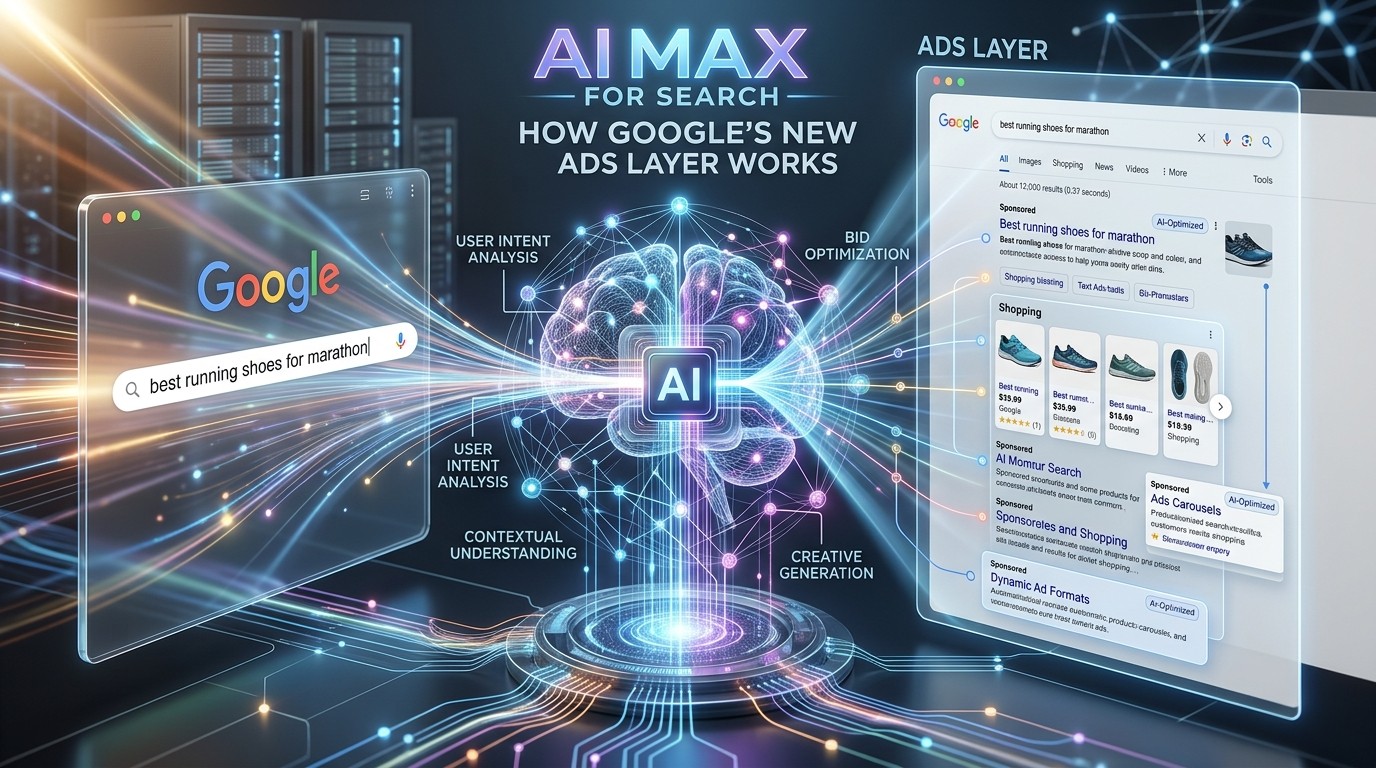
AI Max for Search is transforming Google Ads by expanding intent matching, adapting creative, improving landing-page relevance, and helping advertisers capture valuable demand beyond traditional keyword boundaries.
For years, search advertising followed a familiar formula: discover keywords, write ads, select landing pages, set bids, and optimize based on search-term and conversion data. That system remains foundational, but the behavior surrounding it has become dramatically more complex.
People now search with conversational language, detailed questions, incomplete ideas, product attributes, comparisons, and highly specific use cases. A customer may begin with an informational query, explore an AI-generated answer, compare several products, and return later with a transaction-focused search. The journey can change direction several times before the purchase happens.
That is the environment in which AI Max for Search becomes strategically important.
Google describes AI Max as a comprehensive suite of targeting and creative enhancements that operates as a continuous optimization layer within Search campaigns. Its core capabilities include improved search term matching, text customization, and Final URL expansion.
The significance is bigger than a new settings panel.
AI Max for Search represents a philosophical shift from manually predicting every query toward allowing Google’s systems to interpret intent and discover additional opportunities.
That does not mean keywords are dead.
It means keywords are increasingly becoming signals instead of a complete map of the market.
An advertiser may know that customers want “waterproof hiking jackets,” but customers can express that need through hundreds of different searches. Some may mention rain. Others may mention climate, travel, mountains, durability, or a specific activity.
AI Max for Search is designed to help Google identify relationships among those searches, existing keywords, ad assets, landing pages, and contextual signals.
For marketers, this changes the central question.
Instead of asking only, “Which keyword should trigger my ad?” the better question becomes, “Which customer intent should my business be positioned to satisfy, and have I given Google enough information to understand that intent?”
That is the foundation of the modern search advertising model.
What Is AI Max for Search?
AI Max for Search is an AI-powered enhancement framework for existing Google Search campaigns. Google explicitly says it is not a new campaign type but an optimization layer that adds new ways to expand targeting, customize creative, and improve landing-page relevance.
At a high level, the system works across three connected areas:
| Area | What It Does | Why It Matters |
|---|---|---|
| Search term matching | Finds additional relevant query opportunities | Expands reach beyond rigid keyword assumptions |
| Text customization | Generates additional headlines and descriptions | Makes messaging more contextually relevant |
| Final URL expansion | Selects potentially more relevant website pages | Connects intent with a better landing experience |
The broader goal of AI Max for Search is to use machine learning to reduce the amount of manual work required to respond to the enormous variety of modern search behavior.
Google says search term matching can use broad match and keywordless technology, learning from existing keywords, creative assets, and URLs to identify relevant searches and potential conversions.
This is especially useful for businesses operating in categories where customer language changes constantly.
Think about industries such as:
- ecommerce
- travel
- software
- professional services
- finance
- education
- healthcare
- home improvement
- automotive
In each industry, a customer can describe the same need in many different ways.
AI Max for Search gives Google’s systems greater freedom to recognize those relationships.
The opportunity is greater reach.
The responsibility is maintaining relevance.
Those two things must always be evaluated together.
Why Google Needed an AI Layer for Search
Search is no longer a simple list of predictable phrases.
The number of ways people can communicate the same intent has expanded significantly because users are increasingly comfortable writing full questions and explaining what they need.
Someone searching for a meal-delivery service might say:
“healthy meal delivery for people who work late”
Another might search:
“prepared meals with high protein that arrive weekly”
A third might write:
“best meal subscription for busy professionals who want calorie-controlled dinners”
These searches are linguistically different but commercially connected.
Traditional keyword structures can capture many of these variations, but trying to anticipate every valuable variation manually becomes inefficient.
AI Max for Search addresses this by moving more of the query-discovery process toward machine interpretation.
That is particularly relevant as Google develops broader AI-powered Search experiences.
Google has described Search as becoming more exploratory and multimodal, with experiences such as AI Overviews and Lens changing how people discover information and products.
When users can begin with a question instead of a product name, advertisers need systems capable of understanding the meaning behind the question.
AI Max for Search is part of that evolution.
The Core Idea : From Keyword Matching to Intent Matching

Traditional search advertising is often taught as a keyword exercise.
Research the phrase.
Estimate volume.
Group the phrase.
Write an ad.
Send traffic to a page.
That process still has value.
But modern search requires another layer of thinking.
What does the query actually communicate?
A search for “best standing desk” gives one level of information.
A search for “standing desk for small apartment with cable management” provides much more.
The second query reveals several attributes:
The user wants a standing desk.
Space is limited.
Cable management matters.
The shopper is likely evaluating products.
The customer may be further down the purchase journey.
AI Max for Search can potentially use that richer context to improve how the search connects with campaign assets.
This is where intent becomes more important than exact wording.
The same principle applies to service businesses.
A customer searching “emergency plumber near me” has a different intent from someone searching “how to fix a leaking faucet.”
Both are plumbing-related.
One is likely immediately commercial.
The other may be informational.
A smart advertising system must understand that distinction.
AI Max for Search is designed for this increasingly nuanced environment.
How Search Term Matching Works
Search term matching is one of the central mechanisms behind AI Max.
Google states that enabling the feature expands upon an advertiser’s existing keywords using broad match and keywordless technology. The system can learn from current keywords, creatives, and URLs to identify relevant search queries and capture traffic or conversions that might otherwise be missed.
Imagine a business selling premium noise-canceling headphones.
Its existing keywords might include:
“noise canceling headphones”
“wireless noise canceling headphones”
“best headphones for travel”
But customers could also search:
“headphones that block airplane noise”
“best headphones for long flights”
“comfortable headphones for remote work”
“wireless headphones for noisy office”
These queries may not perfectly resemble the existing keyword list.
Yet the underlying customer need can be strongly related.
AI Max for Search attempts to discover those connections.
That can expand the reachable search universe without requiring advertisers to create an exhaustive list of every possible phrase.
However, broader discovery should never be confused with guaranteed relevance.
Automation can find valuable queries.
Automation can also find queries that look semantically related but are commercially weak.
That is why advertisers must monitor actual outcomes.
The Biggest Benefit: Capturing Demand You Did Not Predict
One of the strongest arguments for AI Max for Search is its ability to discover incremental demand.
Traditional keyword planning is inherently limited by human prediction.
Even excellent keyword research has a ceiling.
Researchers may use:
- keyword tools
- competitor analysis
- search-term data
- customer interviews
- internal site search
- sales-team feedback
- support questions
These methods are valuable, but none can document every future way a person might express intent.
AI Max for Search adds another layer.
Instead of requiring a marketer to anticipate every phrase, Google’s machine-learning systems can identify new query relationships from available campaign signals.
This makes the system particularly useful for large markets with constantly changing language.
Consider consumer electronics.
New devices, features, trends, and use cases create new searches continuously.
An advertiser that tries to maintain a perfect keyword list may spend enormous amounts of time chasing variations.
AI Max for Search allows the advertiser to focus more on the underlying commercial themes while the system explores the long tail.
The marketer’s role shifts from exhaustive prediction toward strategic supervision.
AI Max Does Not Mean Keywords Are Irrelevant
The rise of AI can create a tempting but incorrect conclusion:
“Keywords no longer matter.”
That is too simplistic.
Keywords still communicate commercial intent, category relevance, product themes, and customer language.
They can help establish the territory in which a campaign should operate.
The change is that the campaign no longer needs to treat every meaningful query as a separate manually maintained keyword.
AI Max for Search can use existing signals as a foundation and explore related opportunities.
Think of keywords as coordinates rather than fences.
A coordinate tells the system where the business is positioned.
A fence would imply that nothing outside the exact boundary should ever be considered.
AI-driven Search increasingly behaves more like the first model.
That means keyword research remains important, but marketers should spend less time chasing microscopic variations and more time identifying meaningful commercial themes.
Text Customization: Making Ads More Contextual
The second major component of AI Max is text customization.
Google explains that text customization can generate additional headlines and descriptions using contextual information from the advertiser’s domain, landing pages, existing ads, and ad-group keywords. The technology combines extractive techniques with generative AI to create additional assets designed around search context.
This matters because one message may not be equally persuasive for every customer.
Imagine a furniture company selling an ergonomic office chair.
A shopper searches:
“office chair for lower back support”
Another searches:
“comfortable office chair for long work days”
Another searches:
“ergonomic office chair for tall people”
The same product may satisfy all three users.
But the persuasive angle is different.
One person wants support.
Another wants comfort.
Another wants appropriate fit.
AI Max for Search can potentially adapt messaging around these different signals.
This makes the creative layer more dynamic.
Instead of relying only on one fixed set of messages, advertisers can allow Google’s system to create additional combinations based on contextual intent.
The result can be a more personalized ad experience without requiring marketers to manually write an individual ad for every query.
The Psychology Behind Better Search Creative
Effective advertising is ultimately about reducing uncertainty.
People see a search result and immediately ask:
“Is this for me?”
“Does it solve my problem?”
“Is it worth clicking?”
“Can I trust it?”
A generic message forces the customer to do more mental work.
A specific message reduces that effort.
Suppose the user searches:
“waterproof hiking backpack for a week-long trip.”
A headline such as “Premium Backpack Collection” provides almost no psychological reassurance.
A message emphasizing “Water-Resistant 40L Travel Backpacks for Extended Hiking Trips” connects more directly with the user’s stated need.
That sense of relevance can improve attention.
AI Max for Search becomes valuable when automation can scale this principle across thousands of variations in user intent.
Technology is simply the delivery mechanism.
Human psychology remains the reason relevance matters.
Final URL Expansion: Why the Landing Page Matters More Than Ever
The third major capability is Final URL expansion.
Google describes this as a feature that can use AI to identify potentially relevant pages on an advertiser’s website based on the intent expressed by the user’s search.
This changes something marketers often overlook: the landing page itself becomes part of the optimization system.
Consider an online apparel store.
The website contains:
- a general clothing category
- a men’s collection
- a waterproof jacket category
- a winter coat category
- individual product pages
- a travel clothing collection
- a hiking collection
A generic campaign might send every search to one broad category page.
But a user searching for “lightweight waterproof jacket for alpine hiking” may have a much better experience on a specialized collection page or an individual product page.
AI Max for Search can potentially select that more relevant destination.
This may reduce friction.
And reduced friction can influence conversion performance.
The user does not need to search the site again.
The landing page already reflects the expectation created by the query.
Website Architecture Becomes Advertising Infrastructure
Final URL expansion creates an important implication:
Your website is now part of the information environment used by your advertising system.
If your site has:
- clear categories
- descriptive page titles
- useful product content
- strong internal linking
- unique landing pages
- relevant supporting content
- accurate product descriptions
Google has more information with which to interpret your offer.
If the website has:
- thin pages
- duplicate content
- confusing navigation
- weak product information
- irrelevant landing pages
- outdated offers
automation has fewer high-quality options.
AI Max for Search cannot magically make a poor website persuasive.
It can potentially route traffic more intelligently, but the destination still needs to satisfy the customer.
That is why conversion-rate optimization, SEO, content strategy, and paid search are increasingly connected at the website-information level.
The Growing Importance of Product Data
Ecommerce marketers should pay particular attention to product information.
Google announced AI Max for Shopping in April 2026, explaining that Merchant Center feed information can help the system understand product context and enhance Shopping campaigns for conversational queries. Google specifically mentioned product details such as fabric softness, material durability, and fit.
This creates an important shift.
Product feeds should not be treated only as inventory files.
They are increasingly strategic sources of product context.
A well-structured feed can communicate:
- product type
- brand
- material
- color
- size
- fit
- price
- availability
- features
- identifiers
- other meaningful attributes
That richer information can make product matching more intelligent.
AI Max for Search itself is focused on Search campaigns, but the broader AI Max direction shows where Google is going: systems that understand products and shopper intent more deeply.
That makes product-data quality an increasingly important competitive advantage.
Product Feeds for AI and the New Ecommerce Reality
As machine interpretation becomes more important, structured Product Feeds for AI information becomes more valuable.
Imagine two retailers selling running shoes.
Retailer A provides:
“Running Shoes Model X.”
Retailer B provides:
“Lightweight neutral running shoes with breathable mesh upper, responsive cushioning, wide-fit option, and durable outsole for daily road training.”
The second product description communicates much more useful context.
That does not guarantee superior ad performance.
But it creates richer information about what the product actually is.
AI systems need context to interpret relationships.
For AI Max for Search and related Shopping experiences, that context can become increasingly important because customer queries may contain several attributes at once.
A shopper could ask:
“I want lightweight running shoes with extra cushioning for long daily walks.”
A highly descriptive product ecosystem gives Google’s systems more meaningful information to work with.
This is why ecommerce teams should view feed quality as part of advertising strategy rather than routine catalog maintenance.
AI Product Promotion Is Moving Toward Intent
AI Product Promotion is also changing the role of the advertiser.
Previously, promotion often meant selecting keywords around specific products.
The emerging approach is broader.
A product can be relevant to multiple customer needs.
A single jacket can be:
- a rain jacket
- a hiking jacket
- a travel jacket
- a lightweight shell
- a wind-resistant layer
- a commuter jacket
The exact same product can therefore participate in different intent environments.
AI Max for Search encourages marketers to consider those intent relationships.
Instead of asking only:
“What is this product called?”
ask:
“What problems does this product solve?”
“What attributes matter to customers?”
“What situations cause someone to search for it?”
“What language do customers use when describing those needs?”
Those answers can inform product data, landing pages, creative, and campaign structure.
AI Search Advertising Is a Different Operating Model
AI Search Advertising is increasingly moving from manual mapping to intelligent interpretation.
The traditional model is:
Keyword → Ad → Landing Page → Conversion
The emerging model is:
User Intent → Query Interpretation → Creative Adaptation → Page Selection → Bidding → Conversion Feedback
That is more dynamic.
It also means measurement becomes more important.
If your campaign generates additional traffic, you need to know whether that traffic is valuable.
If AI creates more headlines, you need to understand whether the resulting messages improve performance.
If landing-page selection expands, you need to know whether users convert better on those destinations.
The goal is not to maximize automation.
The goal is to maximize business value.
How Google AI Overviews Change the Search Journey

Google AI Overviews represent another important part of the evolving search environment.
AI-generated summaries can help users explore information before deciding what to do next. This can influence how people move between informational and commercial queries.
For example, a shopper may begin with:
“What should I look for in a beginner hiking backpack?”
After researching, the next search could become:
“best lightweight hiking backpack with rain cover.”
Later, the shopper might search for a specific brand and size.
The customer has moved from learning to comparing to buying.
AI Max for Search becomes increasingly relevant when search journeys contain this kind of progression.
Advertisers need to understand not just the final transactional phrase but the intent ecosystem surrounding their products or services.
However, advertisers should avoid assuming that every AI-powered Search feature produces the same behavior for every query.
Search behavior depends on the industry, user, query type, product category, and commercial context.
Account-level evidence matters more than broad assumptions.
AI Max and Performance Max Are Not the Same
Because both systems rely heavily on AI, advertisers sometimes assume AI Max and Performance Max are basically identical.
They are not.
AI Max is designed to enhance Search campaigns.
Performance Max is a broader campaign type that can access Google’s advertising inventory across multiple surfaces.
Google describes AI Max as an evolution of Dynamic Search Ads and Performance Max Final URL expansion while preserving the controls and campaign environment associated with Search.
This distinction is strategically useful.
AI Max for Search is designed for advertisers that want stronger automation within Search.
Performance Max is designed for broader cross-channel automation.
A business may use both, depending on its goals and account structure.
The right choice depends on the role Search plays in the overall marketing system.
Budget: More Discovery Requires Room to Explore
AI Max can expand opportunity, but campaigns still operate within budgets.
Google explicitly notes that AI Max may not be effective when campaigns are limited by budget and can display an alert when a campaign or portfolio becomes budget-limited.
This makes economic reasoning essential.
Suppose a campaign generates strong profit, but the daily budget is consistently exhausted.
Additional automation could potentially help the advertiser uncover more opportunities.
Now consider another campaign where conversion quality is poor.
Increasing reach there may simply generate more low-quality traffic.
The difference is crucial.
AI Max for Search should not be used as an excuse to increase budgets indiscriminately.
Budget should follow profitable opportunity.
Conversion Tracking Is the Foundation of AI Optimization
No AI advertising system can optimize correctly if the conversion signals are unreliable.
For ecommerce, that means accurate purchase tracking and realistic transaction values.
For lead generation, it may require distinguishing between a form submission and a genuinely qualified lead.
For B2B businesses, importing offline outcomes can become particularly valuable because the most important business event may occur after the initial online conversion.
Imagine two campaigns.
Campaign A generates 500 leads.
Campaign B generates 250 leads.
At first glance, Campaign A looks better.
But suppose Campaign A produces only 10 qualified opportunities while Campaign B produces 60.
The second campaign is clearly more valuable.
AI Max for Search should therefore be evaluated based on the quality of the optimization signal.
A campaign cannot intelligently optimize toward business value if the account only measures superficial activity.
Search-Term Reporting Still Matters
Automation does not eliminate reporting.
Google provides reporting capabilities for AI Max that include search terms, keywords, assets, landing pages, and performance metrics.
This is strategically important because advertisers need visibility into what automation is actually doing.
Review the new search terms.
Look for new themes.
Identify unexpected but valuable intent.
Find clearly irrelevant traffic.
Examine landing-page distribution.
Review generated assets.
Compare conversion quality.
This information can inform the next optimization cycle.
AI Max for Search should therefore be treated as a feedback loop, not a black box.
The system explores.
The advertiser observes.
The advertiser refines.
The system learns from the improved environment.
Brand Controls and Automation
One concern with broader matching is brand protection.
Advertisers may not want to appear for certain competitor-related searches.
Some brands may have strict requirements around messaging.
Others may have geographic restrictions or specific landing-page rules.
Google provides brand inclusions and exclusions within the AI Max framework, allowing advertisers to maintain important boundaries.
This supports a more balanced approach.
Human beings define the boundaries.
Machine learning explores the opportunity space inside those boundaries.
That is generally a more useful mental model than imagining automation as total surrender of control.
AI Max for Search becomes more powerful when advertisers understand which decisions should remain strategic and which repetitive decisions can be automated.
Negative Keywords Still Have Strategic Value
AI-driven targeting does not make negative keywords obsolete.
There will always be searches that are clearly irrelevant.
A premium software provider may not want traffic around:
free downloads
templates
jobs
careers
cracked software
unrelated tutorials
Similarly, an ecommerce retailer may want to prevent traffic around products it does not sell.
The goal, however, should be intelligent exclusion.
Do not automatically reject every query that looks unfamiliar.
A new query may be an unexpected but highly valuable commercial opportunity.
AI Max for Search encourages a more sophisticated question:
“Does this search represent a customer we want?”
That is more useful than:
“Does this search exactly match one of my keywords?”
AI Max Requires Better Creative Foundations
Automation does not eliminate the need for skilled creative strategy.
It changes the job.
Humans should provide strong foundations around:
- value propositions
- differentiators
- customer benefits
- product characteristics
- offers
- proof points
- brand positioning
- calls to action
AI can create and combine variations around those foundations.
This is important because generic AI writing can easily produce bland advertising.
A premium brand should sound premium.
A technical company should sound credible.
A local service should sound trustworthy.
A luxury retailer should maintain elegance.
AI Max for Search should expand relevance without erasing identity.
The Psychology of Contextual Relevance
Human beings notice things that appear personally relevant.
That principle has been used in advertising for decades.
The difference now is scale.
Before AI, marketers might manually create different ads for different keywords.
That worked reasonably well for limited campaigns.
But a large account can have enormous numbers of intent variations.
AI Max for Search creates the possibility of matching context and creative across a much larger search universe.
For example:
Search intent: “budget-friendly family hotel near theme park”
Useful angle: affordability, family convenience, proximity.
Search intent: “luxury hotel near theme park with spa”
Useful angle: premium experience, amenities, relaxation.
The property may even be the same.
The persuasive context changes.
This is why contextual creative can matter.
How AI Max Affects Keyword Research
Keyword research is not disappearing.
Its purpose is evolving.
Instead of attempting to build an exhaustive inventory of every variation, marketers can use keyword research to understand:
- core customer needs
- purchase signals
- category language
- problem language
- feature language
- comparison language
- commercial modifiers
- customer vocabulary
Then AI Max can potentially expand from these foundations.
This makes keyword research more strategic.
An SEO or PPC specialist can spend more time understanding customer language and less time generating endless near-duplicate keywords.
That can improve both efficiency and campaign clarity.
Preparing an Existing Campaign
Before enabling AI Max, advertisers should establish a clean baseline.
Record current:
- conversions
- conversion value
- CPA
- ROAS
- CPC
- CTR
- qualified leads
- average order value
- revenue
- impression share
Then review the campaign itself.
Look at keyword quality.
Review negative keywords.
Audit ad assets.
Check final URLs.
Review landing-page relevance.
Verify conversion tracking.
For ecommerce campaigns, inspect product data and Merchant Center quality.
Only after the foundation is strong should the advertiser evaluate broader automation.
AI Max for Search works best when it has a reliable environment in which to operate.
A Practical AI Max Implementation Framework
Step 1: Establish the Business Goal
Define what success means.
Revenue?
Profit?
Qualified leads?
Customer acquisition?
Conversion volume?
The AI needs a meaningful destination.
Step 2: Audit Measurement
Make sure the optimization signals are accurate.
Step 3: Improve Campaign Inputs
Review keywords, URLs, assets, audience information, and exclusions.
Step 4: Improve the Website
Make sure relevant pages clearly answer user needs.
Step 5: Enable Appropriate AI Max Features
Google allows advertisers to select AI Max features during campaign setup and manage the relevant settings within existing campaigns. New Search campaigns currently have AI Max selected by default, with advertisers able to choose the specific features they want to use.
Step 6: Test Before Scaling
Google provides AI Max experiments that allow advertisers to test the technology within an existing campaign rather than simply cloning the campaign into a separate experiment.
Step 7: Evaluate Incremental Value
Measure not merely additional traffic but additional qualified outcomes.
This process protects against premature conclusions.
AI Max Experiments: Why Testing Matters

Advertising platforms are complex systems.
A campaign can improve or decline for many reasons:
- seasonality
- competitor activity
- demand changes
- pricing
- promotions
- creative fatigue
- market conditions
- website changes
- budget changes
That makes casual before-and-after comparisons unreliable.
Google’s AI Max experiments are designed to help advertisers evaluate the effect of the feature without creating a conventional duplicated campaign experiment.
This is useful because the advertiser can ask a much better question:
“Did AI Max create incremental business value under comparable conditions?”
That is a more defensible way to make an adoption decision.
What Google’s Current Performance Data Says
Google’s current documentation says advertisers activating AI Max in Search campaigns typically see 14% more conversions or conversion value at a similar CPA or ROAS. Google identifies this as internal data from 2025 and notes that the figure is for non-Retail advertisers.
Google has also reported that campaigns using the full AI Max feature suite saw an average 7% more conversions or conversion value at a similar CPA or ROAS compared with campaigns using search term matching alone. That figure is also based on Google’s own data.
These statistics are useful directional evidence.
They are not promises.
Every account has different economics, conversion volumes, audiences, websites, products, and competitive conditions.
A professional advertiser should treat platform-reported averages as hypotheses to test rather than guaranteed results.
The 2026 AI Max Transition
AI Max has moved well beyond its early experimental stage.
Google announced in April 2026 that AI Max for Search was moving out of beta and that legacy features would transition toward AI Max. In June 2026, Google updated the timeline: the Dynamic Search Ads sunset and auto-upgrade process is scheduled to begin in February 2027, while campaigns using Automatically Created Assets and the campaign-level broad match setting continue to be auto-upgraded starting in September 2026.
This makes the current period particularly important for advertisers.
September 2026 is not simply another feature-release month.
It represents a significant transition point for existing Search campaign configurations.
Advertisers should review legacy settings rather than assuming nothing will change.
This is especially important for agencies managing large numbers of accounts.
A campaign transition can influence asset behavior, matching, reporting, and optimization workflows.
What Happens to Automatically Created Assets?
Text customization was previously known as Automatically Created Assets.
Google now places that capability within AI Max and states that campaigns using text customization will automatically be upgraded to AI Max beginning in September 2026.
For advertisers, the lesson is simple:
Do not treat legacy settings as permanent.
Google’s advertising architecture is evolving toward more integrated AI-based functionality.
Understanding how existing settings map into the new system can reduce surprises.
What Happens to Campaign-Level Broad Match?
Google also states that campaigns using its campaign-level broad match setting will automatically be upgraded to AI Max beginning in September 2026. The campaign-level broad match setting previously converted existing phrase and exact keywords into broad match.
This is another reason advertisers should understand the difference between traditional keyword mechanics and the newer AI-assisted framework.
The goal is not simply to preserve the old interface.
Google is consolidating related automation capabilities into a more unified system.
AI Max for Search is effectively becoming the umbrella environment for these technologies.
Dynamic Search Ads and the AI Max Migration
Dynamic Search Ads have played an important role in Google’s automated Search ecosystem because they could generate headlines and destination choices from website content.
Google now describes AI Max as an evolution of DSA and Performance Max’s Final URL expansion.
The timeline matters, however.
Google’s June 2026 update says Dynamic Search Ads will begin their sunset and auto-upgrade process in February 2027 rather than September 2026.
That gives advertisers more time to understand the newer environment before the DSA transition.
The best response is preparation rather than panic.
How Agencies Should Adapt Their Services
The growth of AI automation does not eliminate PPC expertise.
It changes what expertise looks like.
Manual keyword expansion may become less central.
Strategic analysis becomes more valuable.
Agencies should increasingly focus on:
- conversion architecture
- customer intent
- campaign economics
- landing-page relevance
- creative strategy
- product data
- experimentation
- brand controls
- business intelligence
AI Max for Search can handle more repetitive optimization.
That gives professionals more time to solve harder problems.
Instead of manually building thousands of variants, a specialist can analyze why incremental traffic converted, where quality declined, and how the website can be improved.
The role becomes more strategic.
AI Max and Ecommerce Strategy
For ecommerce businesses, the new environment is particularly interesting because product discovery is becoming conversational.
Google’s AI Max for Shopping announcement explicitly describes shoppers asking natural-language questions rather than searching only for exact products. It also says AI Max for Shopping can use Merchant Center information, customize text, expand final URLs, and automatically select between text and Shopping ad formats depending on relevance.
This means ecommerce teams need to connect their:
product catalog,
website,
Merchant Center,
advertising campaigns,
creative,
conversion tracking,
and merchandising strategy.
AI Max for Search sits within that wider ecosystem.
A product is not merely a SKU.
It is an answer to a customer need.
The better a retailer communicates that relationship, the more useful automated discovery can become.
The New Competitive Advantage: Information Quality
An interesting consequence of AI advertising is that information quality itself becomes a competitive advantage.
Two businesses can sell similar products.
Both can use the same advertising platform.
Both can have similar budgets.
Yet one may provide much richer data.
Its website has better descriptions.
Its product feed is more complete.
Its landing pages are more relevant.
Its conversion tracking is cleaner.
Its creative foundation is stronger.
That business gives Google’s systems more useful inputs.
AI Max for Search can potentially benefit from richer context because machine learning requires signals to make decisions.
This is why AI adoption cannot be separated from foundational digital marketing quality.
Automation rewards preparation.
What Not to Do When Adopting AI Max
Do Not Activate Every Feature Without Measurement
Automation should be tested.
Do Not Ignore Search-Term Quality
Expanded matching can introduce new opportunities and new problems.
Do Not Let Generated Creative Go Unreviewed
AI-generated messaging still needs brand and compliance oversight.
Do Not Send Every User to a Generic Page
Landing-page relevance matters.
Do Not Neglect Product Data
Ecommerce automation depends increasingly on structured information.
Do Not Optimize Only for Clicks
The objective is business value.
Do Not Assume Google’s Average Results Are Guaranteed
Internal platform averages are not individual-account forecasts.
Do Not Abandon Human Strategy
Automation performs best when the business direction is clear.
A Simple Decision Framework
Before adopting AI Max, ask five questions.
Is the campaign conversion-ready?
If tracking is unreliable, fix measurement first.
Is the website ready?
If landing pages are weak, improve them.
Is the campaign strategically clear?
If targeting and objectives are confused, AI will not solve the problem.
Is there enough data and budget?
Automation needs room to learn and explore.
Can performance be tested?
A baseline and experiment make the decision more objective.
If the answers are mostly yes, AI Max is much easier to evaluate intelligently.
What AI Max Means for the Future of Search Advertising
Search advertising is moving toward a system in which machines handle more of the operational complexity while humans provide strategic direction.
That does not mean the future is completely automated.
It means the distribution of work is changing.
Humans are increasingly responsible for:
strategy
positioning
customer understanding
brand protection
profitability
creative direction
measurement design
Machines are increasingly responsible for:
query interpretation
matching
asset variation
page selection
bidding
optimization
scale
AI Max for Search reflects that division of labor.
The advertiser decides what matters.
The machine searches a larger opportunity space.
The advertiser evaluates what happened.
The system learns from the resulting data.
That cycle can become increasingly sophisticated over time.
Why Human Customer Research Still Matters
One of the biggest misconceptions about AI marketing is that customer research becomes unnecessary.
It does not.
AI can interpret signals.
But marketers still need to know what those signals mean commercially.
Customer interviews can reveal objections.
Sales calls can reveal purchasing triggers.
Support tickets can reveal frustrations.
Reviews can reveal emotional language.
Search-term reports can reveal unexpected demand.
These sources inform better creative and better landing experiences.
AI Max for Search does not replace customer understanding.
It can help scale the application of that understanding.
The Future Is Not “AI Versus PPC”

The real shift is from manual PPC toward AI-assisted PPC.
The strongest advertisers will not be those that blindly trust automation.
They will not necessarily be those that reject automation either.
They will be the businesses that know where machine learning is useful and where human judgment is essential.
A human can recognize that a particular message could damage a premium brand.
A machine can identify thousands of related searches that might benefit from a different message.
A human can decide that a certain customer segment is strategically important.
A machine can process massive amounts of behavioral data.
AI Max for Search gives advertisers a mechanism for combining those strengths.
Final Takeaway: What Advertisers Should Do Now
The most practical response to AI Max is not to panic, rebuild every campaign, or blindly activate every setting.
Start with the foundation.
Make sure conversion tracking is trustworthy.
Make sure the website clearly communicates products and services.
Make sure landing pages satisfy user expectations.
Make sure product information is accurate.
Make sure creative assets communicate genuine value.
Make sure brand boundaries are defined.
Make sure budgets support the opportunity.
Then test AI Max.
Use reporting to understand what it discovers.
Evaluate incremental conversion quality.
Look beyond clicks.
Look at revenue, profit, qualified leads, customer value, and long-term performance.
Google’s direction is increasingly clear: Search advertising is becoming more AI-assisted, more contextual, and more capable of matching complex customer intent. Google’s current AI Max documentation and 2026 product announcements show that this is becoming part of the platform’s mainstream architecture rather than a temporary experiment.
The opportunity is substantial.
But the competitive advantage will not come from simply having AI switched on.
It will come from giving AI better information, better signals, better creative foundations, and better business objectives.
That is the real future of Search advertising.
Conclusion
AI Max for Search is changing Google Ads from a system built primarily around manually defined keyword relationships into a more dynamic environment centered on intent, context, creative adaptation, and landing-page relevance. AI Max for Search can help advertisers discover searches they did not explicitly predict, while automation can make advertising messages and destinations more contextually relevant. Yet AI Max for Search is not a replacement for strategy, customer research, measurement, or human judgment. As Google expands AI across Search and Shopping, successful advertisers will focus on stronger data, better product information, reliable conversion signals, relevant landing pages, and disciplined experimentation. The winning approach is human strategy combined with machine-scale optimization.
FAQs
1. What is AI Max for Search?
AI Max for Search is Google’s AI-powered optimization layer for Search campaigns. It includes capabilities for broader search-term matching, text customization, and Final URL expansion, helping advertisers discover additional relevant demand and adapt ads to user intent.
2. Is AI Max a separate campaign type?
No. Google explicitly says AI Max is an optimization layer within existing Search campaigns, not a separate campaign type.
3. Does AI Max eliminate keywords?
No. Keywords remain useful signals that communicate important commercial themes. AI Max can use those signals while expanding query discovery through broad match and keywordless technology.
4. How does AI Max improve ad creative?
Text customization can generate additional headlines and descriptions using contextual information from the advertiser’s domain, landing pages, existing ads, and keywords.
5. What is Final URL expansion?
Final URL expansion uses Google’s systems to identify potentially more relevant website pages for particular searches, helping align the destination with the user’s intent.
6. Can AI Max help ecommerce campaigns?
AI Max is specifically designed for Search campaigns, while Google has also introduced AI Max for Shopping. AI Max for Shopping can use Merchant Center product-feed information, customize Shopping ad text, expand final URLs, and select between text and Shopping formats based on relevance.
7. Is AI Max suitable for every advertiser?
Not necessarily. Performance can depend on conversion tracking, campaign maturity, budget, website quality, business economics, and the quality of available signals. Google’s own performance statistics are internal benchmarks, not guarantees for individual campaigns.
8. What is changing in September 2026?
Google says campaigns using Automatically Created Assets, now called text customization, and campaigns using its campaign-level broad match setting will be automatically upgraded to AI Max beginning in September 2026. The Dynamic Search Ads sunset and auto-upgrade timeline was moved to February 2027.
9. Can advertisers still control AI Max?
Yes. Google provides campaign controls around areas such as brands, locations, assets, URL behavior, and other settings. AI Max is designed to expand automation while retaining advertiser controls.
10. What is the best way to test AI Max?
Establish a performance baseline, verify tracking, define the primary business goal, and use Google’s AI Max experiments where appropriate. Evaluate incremental conversions, conversion value, qualified leads, and profitability rather than relying only on clicks or impressions.



Leave a Reply