

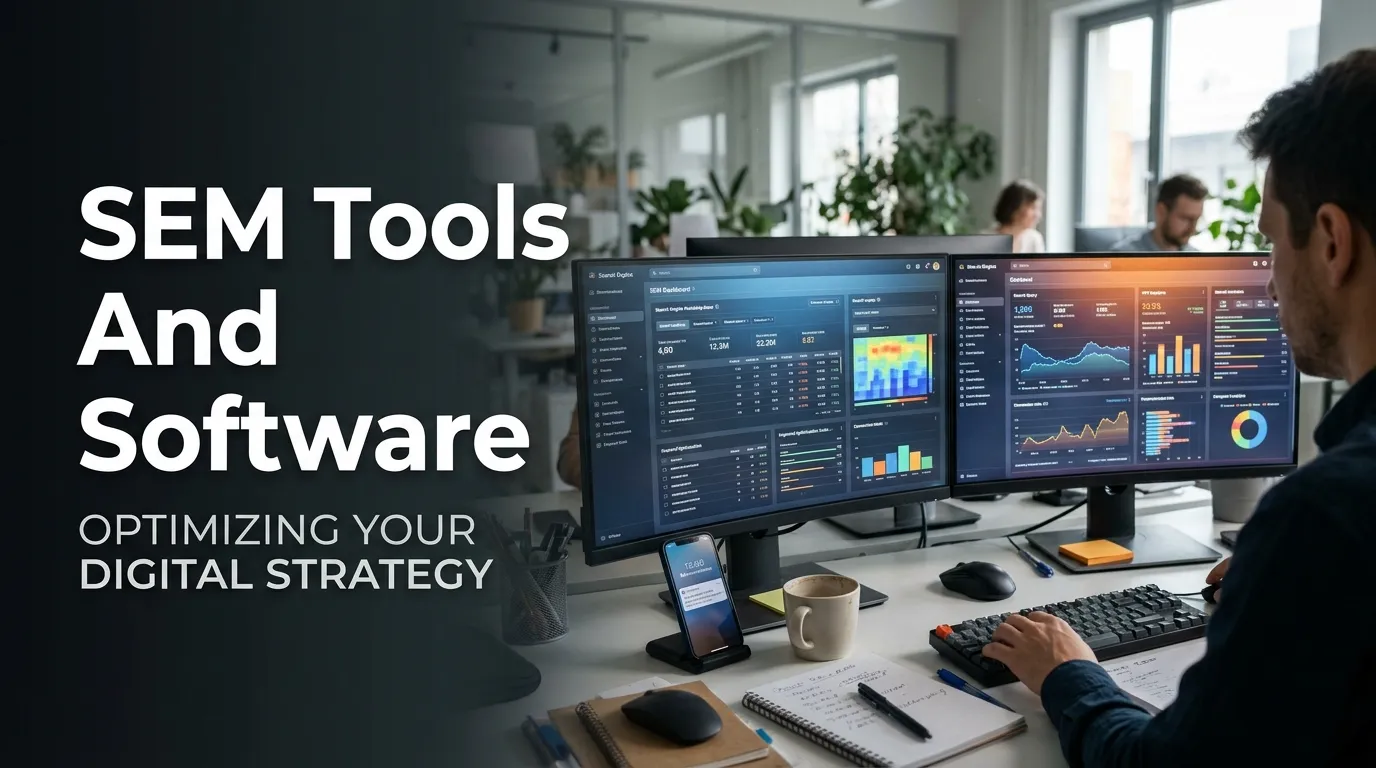
SEM tools and software help marketers automate keyword research, competitor analysis, bid management, ad creation, landing page optimization, and analytics. AI-powered platforms improve campaign efficiency, targeting, personalization, and ROI, enabling businesses to scale search engine marketing strategies effectively.
Search engine marketing moves fast. Search algorithms update frequently, and competitor strategies evolve daily. Executing a successful digital advertising campaign requires precise data, agile execution, and the right technology. Manual processes simply cannot keep pace with the sheer volume of data generated by modern search engines. That is why choosing the right sem tools and software is no longer optional for modern marketing teams.
In this comprehensive guide, we will explore everything you need to know about sem tools and software. You will learn how AI-driven keyword research, bid management, and ad copy platforms can optimize your digital strategy. We will cover how these tools automate complex marketing workflows, identify strategic gaps, and significantly improve your advertising return on investment.
Understanding sem tools and software
Search engine marketing (SEM) tools are specialized software applications designed to help digital marketers research keywords, analyze competitors, manage pay-per-click (PPC) bids, and optimize ad copy. By leveraging artificial intelligence and machine learning, modern sem tools and software transform raw data into actionable insights.
Why SEM Management Requires Advanced Technology
Search engine marketing remains a foundational pillar for businesses aiming to capture high-intent website traffic. SEM encompasses the strategies and tactics used to increase a website’s visibility in search engine results pages through paid advertising.
Without the proper sem tools and software, managing PPC campaigns becomes a guessing game. You need these applications to:
- Identify high-converting search terms.
- Monitor competitor ad spend and strategy.
- Adjust bids in real time to maximize budget efficiency.
- Track conversion paths across multiple devices.
Artificial intelligence and machine learning are fundamentally revolutionizing the search engine marketing industry. Marketers no longer have to guess which keywords will perform best or manually adjust bids every few hours. AI-driven sem tools and software analyze millions of data points in real time to predict user behavior, automate budget allocation, and generate high-converting ad copy.
Core Categories of sem tools and software
The search engine marketing ecosystem consists of several distinct software categories. Each category addresses a specific phase of the advertising lifecycle, from initial research to post-click optimization. To build a robust strategy, you need to understand how each segment of sem tools and software operates.
Keyword Research Platforms
Keyword research platforms help marketers identify the exact phrases potential customers type into search engines. These applications evaluate metrics like monthly search volume, keyword difficulty, and cost-per-click estimates.
Finding High-Intent Traffic
By focusing on long-tail keywords specific, multi-word phrases that indicate high purchase intent—advertisers can capture highly qualified traffic at a lower cost. Leading sem tools and software for keyword research include Ahrefs, Semrush, and Google Keyword Planner.
- Ahrefs excels at providing detailed backlink and keyword reports, unearthing hidden keyword opportunities competitors may overlook.
- Semrush not only discovers new keywords but suggests strategic content gaps, making sure your PPC strategy covers every possible angle.
- Google Keyword Planner is a free, accessible tool for identifying search trends directly integrated with Google Ads, offering baseline data for campaign planning.
AI-Driven Keyword Clustering
Today, advanced sem tools and software feature AI-driven keyword suggestion capabilities. These tools automatically group similar terms into thematic clusters. This clustering process helps marketers structure their ad groups more logically. When your ad groups are highly relevant to the search query, your quality score improves, which directly reduces your overall advertising costs.
Effective keyword clustering empowers granular optimizations—matching ads to user intent, reducing wasted spend on irrelevant clicks, and improving overall PPC campaign results. AI’s role is not just about surfacing popular search terms, but recommending new long-tail combinations that could be overlooked by manual research.
Competitor Analysis and Intelligence

Understanding the competitive landscape is essential for outmaneuvering rival businesses. Competitor analysis sem tools and software reveal exactly what other companies are doing to capture market share.
Marketers use these platforms to discover competitor ad spend, uncover top-performing keywords, and analyze the specific landing pages competitors use to convert traffic. Leading competitive intelligence platforms include SpyFu, SimilarWeb, and Semrush. SpyFu excels at downloading competitors’ most profitable keywords and tracking their paid search history over several years.
- SimilarWeb grants visibility into competitor traffic sources, helping you spot trends and gaps that can refine your own marketing mix.
- With Semrush, you can benchmark your share of paid and organic search traffic across multiple domains, revealing potential opportunity areas.
Modern competitive analysis sem tools and software leverage artificial intelligence to identify specific strategic gaps. AI algorithms pinpoint high-volume search terms that competitors currently ignore, giving savvy marketers a clear opportunity to capture untapped audiences.
Bid Management and PPC Automation
Bid management tools handle the complex financial mechanics of pay-per-click (PPC) advertising. These sem tools and software automate the process of adjusting bids and allocating budgets across various campaigns.
Instead of manually updating bids for thousands of individual keywords, advertisers use software to set performance rules and targets. Popular bid management options include Optmyzr, Kenshoo, and Google Ads Smart Bidding. Optmyzr offers highly customizable rule engines for sophisticated account managers.
- Automation ensures that you’re monitoring campaigns 24/7, adapting to real-time changes in user intent, competition, and budget constraints.
- Google Ads Smart Bidding harnesses machine learning for conversion-driven bid strategies, freeing marketers from the grind of daily bid adjustments.
Machine learning algorithms enable predictive bidding within these sem tools and software. The platform analyzes historical performance, device types, locations, and time of day to determine the exact bid most likely to yield a positive return on investment.
Ad Copy and Creative Generation
Enhancing ad relevance directly improves click-through rates and lowers customer acquisition costs. Ad copy and creative generation sem tools and software assist marketers in writing compelling text and designing engaging visuals for their search campaigns.
Accelerating the Creative Workflow
Creating multiple variations of ad copy used to take hours of manual labor. New sem tools and software have accelerated this process drastically. AI-powered copywriting platforms like Jasper and Copy.ai have transformed creative workflows.
- These applications allow teams to automate repetitive tasks, power content creation, and ensure a consistent brand voice.
- By utilizing these AI-driven sem tools and software, marketing teams can generate dozens of localized ad variations in seconds.
- Dedicated A/B testing features then run these variations simultaneously, identifying which specific headlines resonate most effectively.
Beyond simple text generation, modern tools can now suggest optimal CTAs, emotions, and even automatically tailor messages depending on audience segment or regional nuance.
Landing Page Optimization
Driving traffic through search engine marketing is only half the battle. Once a user clicks an ad, the destination page must persuade them to take action. Landing Page Optimization sem tools and software focus entirely on improving conversion rates through data-driven design adjustments.
Key players in this space include Unbounce, Leadpages, and Hotjar. Marketers rely on these sem tools and software for features like heatmaps, session recordings, and A/B testing. Advanced landing page sem tools and software now use artificial intelligence for personalized content delivery. The software dynamically changes page headlines and images based on the specific search term the user queried.
- Unbounce offers dynamic text replacement and mobile-first design recommendations.
- Leadpages helps quickly build and test new landing pages using proven conversion templates.
- Hotjar supplies heatmaps and session replays, letting marketers see exactly where users lose interest or get stuck.
By integrating landing page optimization into your overall SEM management, you can decrease bounce rates and improve conversion rates for every click you purchase.
Analytics and Reporting Tools
Accurate tracking is the lifeblood of any digital marketing campaign. Analytics and reporting sem tools and software measure essential metrics such as return on investment, total conversions, and average cost per click.
Essential platforms include Google Analytics, Looker Studio, and Tableau. Artificial intelligence elevates these sem tools and software by offering anomaly detection. If a campaign’s cost per click suddenly spikes, the analytics AI will instantly alert your marketing team, saving countless hours of manual data mining and preventing budget waste.
- Google Analytics provides robust integrations for tracking user behavior from click to conversion across channels.
- Looker Studio enables the creation of highly customized, interactive dashboards—centralizing your campaign’s most important KPIs and insights.
- Tableau is perfect for organizations that need in-depth, cross-channel reporting and strong data visualization.
The Impact of AI on Search Engine Marketing

The search engine marketing landscape evolves rapidly. Several emerging trends, heavily driven by artificial intelligence, dictate the future development of sem tools and software.
Voice and Visual Search Evolution
Voice search optimization tools are becoming increasingly important as consumers rely more on smart speakers. Voice queries are typically longer and more conversational. New sem tools and software help marketers identify these natural language queries.
Visual search is also transforming how ads are displayed and targeted. Discover the future of AI-powered visual search advertising here to see how visual elements are changing PPC. AI now powers campaigns capable of understanding images as queries, automatically tagging products, and serving hyper-relevant ads to consumers based on the images they upload or search.
Predictive Analytics and Automation
Predictive analytics is shifting campaign management from a reactive process to a proactive one. Instead of reporting on past performance, predictive sem tools and software forecast future campaign outcomes based on seasonal trends and market volatility.
- AI predicts click-through rate trends, competitor action spikes, and seasonal volume surges—allowing you to adjust budgets and creative in advance.
- Automated tools can pause underperforming campaigns and shift investment to segments that AI predicts will outperform expectations during specific timeframes or geographies.
Large Language Models (LLMs) and Conversational Interfaces
LLMs are reshaping how marketers interact with their sem tools and software. Future applications will operate primarily through conversational interfaces, allowing marketers to build complete campaigns with simple text prompts. Imagine typing, “Launch a remarketing campaign targeting cart abandoners with a 10% discount for the next two weeks,” and the system handling the entire workflow from ad copy to audience configuration.
Personalization at Scale
Modern SEM management platforms use AI-driven personalization to tailor every touchpoint—ad copy, landing page, and follow-up emails—creating a seamless, unique experience for every visitor based on intent, device, location, and behavior. This level of automation was unthinkable just a few years ago, but today it’s necessary for brands that want to maintain a competitive edge.
Comparing Top sem tools and software
To help you build your technology stack, here is a comparison of industry-leading sem tools and software across various categories.
|
Software Platform |
Primary Category |
Best For |
AI Capabilities |
|---|---|---|---|
|
Semrush |
Integrated SEM / SEO |
All-in-one competitor and keyword research |
Keyword clustering, content generation |
|
SpyFu |
Competitor Analysis |
Downloading competitor PPC history |
Strategic gap analysis |
|
Optmyzr |
PPC Bid Management |
Automating complex bid rules |
Predictive budget allocation |
|
Ahrefs |
Keyword Research Platforms |
Deep search volume trends |
Search intent categorization |
|
Unbounce |
Landing Page Optimization |
Rapid campaign deployment |
Dynamic text replacement |
|
Copy.ai |
Ad Copy Generation |
Scaling creative workflows |
Localized ad variation testing |
When choosing your tools, consider integration, user interface, customer support, and pricing tiers. Many of these platforms offer trial versions, giving you a risk-free way to determine which fits best in your workflow.
Building Your SEM Management Technology Stack
Choosing the right marketing software is crucial for modern digital marketers. Selecting the appropriate sem tools and software can mean the difference between a profitable advertising campaign and a drained budget.
- Assess your needs: What are your primary goals? Traffic, conversions, lead generation, or brand awareness? The objective will determine your tech priorities.
- Start small: Small businesses may only require basic keyword research and Google Analytics. Enterprise organizations need sophisticated bid management, landing page optimization, and predictive analytics suites.
- Scalability: Ensure your tools can handle higher data volume and more campaigns as your business grows.
- Integration: Your sem tools and software should integrate seamlessly with your existing Customer Relationship Management (CRM) platform, as well as email, e-commerce, and reporting suites.
- Data privacy and security: Because sem tools and software handle sensitive customer information, always verify that the vendor complies with regional data protection regulations before integrating their tools.
Futureproof your stack by prioritizing platforms that have robust APIs and a history of AI feature rollouts. As SEM management evolves, flexibility and innovation will be just as important as feature depth.
Take Your Search Engine Marketing Strategy to the Next Level

Search engine marketing tools possess immense transformative power. By automating repetitive tasks, providing deep competitive intelligence, and generating AI-powered ad copy, these platforms allow digital marketers to achieve unprecedented efficiency.
The integration of artificial intelligence guarantees that sem tools and software will only become faster, smarter, and more capable. Marketers who embrace these advanced sem tools and software will maintain a distinct competitive advantage. Evaluate your current software stack today, experiment with emerging platforms, and continuously adapt your strategy to capture your target audience effectively.
To stay ahead, invest in ongoing training for your team, remain active in SEM communities, and keep up with platform updates and emerging trends—such as AI-powered video ads, conversational search, and next-generation audience targeting.
Frequently Asked Questions (FAQ)
What is the main difference between SEO and sem tools and software?
SEO tools focus on improving a website’s organic, unpaid ranking in search engine results through content and technical optimizations. Conversely, sem tools and software primarily focus on paid advertising strategies. They help marketers manage pay-per-click bids, create ad copy, and allocate advertising budgets effectively.
How much do professional sem tools and software typically cost?
Costs vary significantly based on the platform’s features and your business requirements. Basic keyword tools may offer free tiers or cost around $30 per month. Comprehensive enterprise sem tools and software usually start around $100 per month, with advanced corporate tiers reaching several thousand dollars monthly.
Can AI completely replace human SEM management?
No, artificial intelligence cannot completely replace human marketers in campaign management. While AI sem tools and software excel at processing large datasets and automating bid adjustments, human managers are essential for setting high-level business strategy. Humans understand nuanced brand voice and make complex creative decisions that resonate emotionally.
Which sem tools and software are best for a beginner?
Beginners should start with foundational, accessible platforms before purchasing expensive subscriptions. Google Keyword Planner and Google Analytics are excellent starting points because they are free and integrate directly with Google Ads. As you gain experience, you can transition to more comprehensive third-party sem tools and software.
How often should I audit my sem tools and software stack?
Marketers should audit their software stack at least once a year to ensure maximum efficiency. The digital marketing technology landscape changes rapidly, and annual reviews ensure your team is not paying for redundant tools. It also helps you identify opportunities to adopt newly released sem tools and software.
Do sem tools and software integrate with my CRM platform?
Yes, most premium sem tools and software offer native integrations or API access to connect with popular CRM platforms like Salesforce or HubSpot. This integration is vital for tracking the complete customer journey from the initial ad click to the final closed sale. It helps you measure the true ROI of your paid search campaigns.
How do sem tools and software help with competitor analysis?
These platforms allow you to peek behind the curtain of your competitors’ advertising strategies. Advanced sem tools and software can reveal the exact keywords your competitors bid on, their estimated monthly ad spend, and the ad copy they use. This intelligence helps you identify gaps in their strategy that you can exploit.
What is predictive bidding in sem tools and software?
Predictive bidding uses machine learning to forecast the likelihood of a conversion before placing a bid in an ad auction. The sem tools and software analyze historical data, device usage, and user location to determine the optimal bid amount. This ensures you only pay top dollar for clicks that are highly likely to generate revenue.
Why do I need dedicated landing page sem tools and software?
Driving clicks to your website is useless if those visitors do not convert into leads or customers. Landing page sem tools and software allow you to build, test, and optimize dedicated destinations for your ads without needing a developer. They provide vital data like heatmaps to show you exactly why a page is or isn’t converting.
Will sem tools and software work for B2B marketing?
Absolutely, sem tools and software are incredibly effective for both B2B and B2C marketing strategies. B2B campaigns often target niche, high-value keywords with longer sales cycles. Using advanced sem tools and software helps B2B marketers track these complex conversion paths and attribute revenue accurately across multiple touchpoints.
In summary, thriving in digital advertising today means equipping your team with the best sem tools and software for every element of search engine marketing. Choose platforms that provide both raw analytical power and the flexibility to adapt as the industry evolves. Stay informed, test new features often, and always integrate AI and automation where it brings the most value—keeping your campaigns efficient, measurable, and ready to outperform the competition.



Leave a Reply