

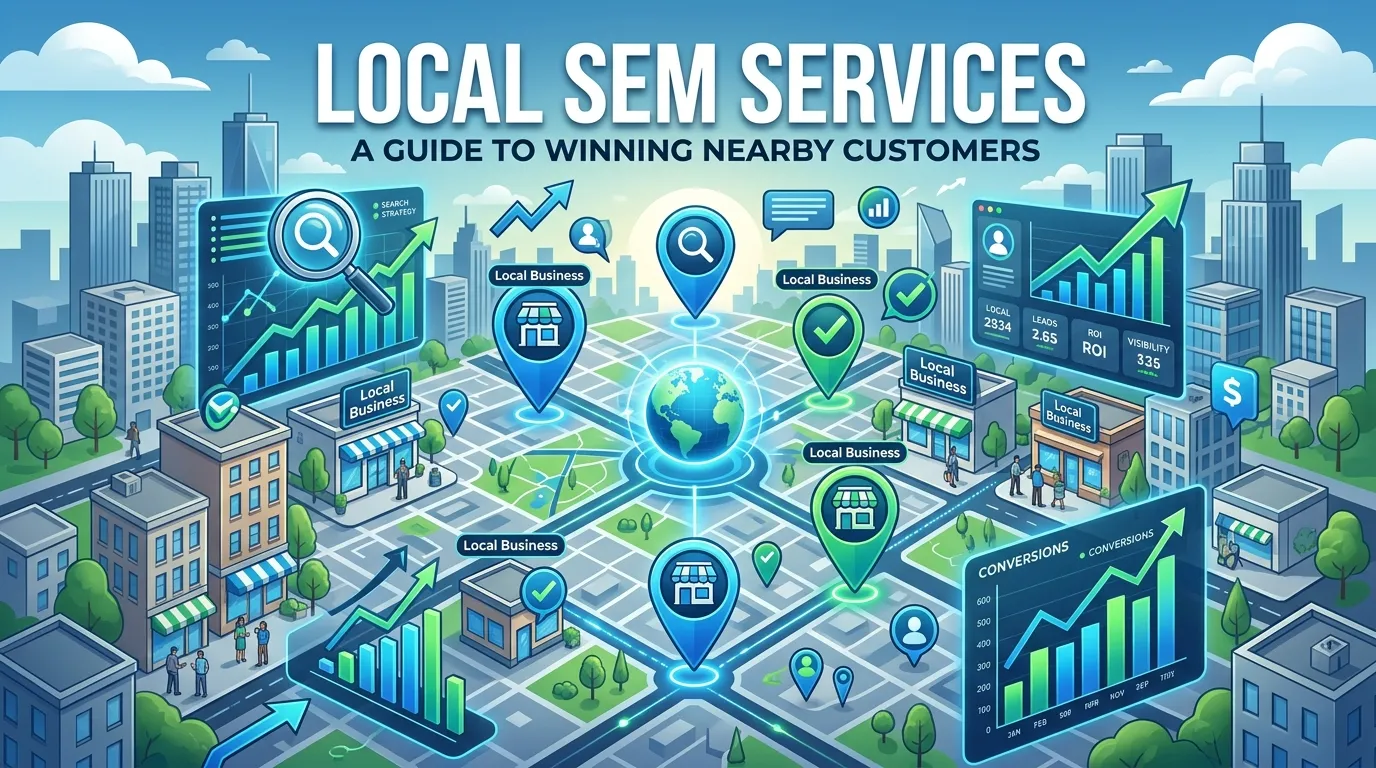
Local SEM services help businesses attract nearby customers through targeted paid search advertising. By combining geographic targeting, keyword strategy, compelling ads, optimized landing pages, and ongoing optimization, businesses can generate more calls, visits, leads, and sales.
Someone three blocks away pulls out their phone and searches for exactly what you sell. Will they find your business, or your competitor’s? Local SEM services answer that question. They put your brand in front of nearby buyers at the precise moment they’re ready to act, turning local search intent into foot traffic, phone calls, and sales.
If you run a business that serves a specific area—a dental clinic, a law firm, a restaurant, a plumbing company, or a boutique retailer—then local SEM services are among the most powerful growth tools available to you. They combine the speed of paid advertising with the geographic precision of local targeting, helping you reach customers who are close enough to actually walk through your door.
In this guide, you’ll learn what local SEM services are, how they work, and why they matter so much for businesses chasing nearby customers. We’ll break down campaign structure, keyword targeting, ad copy, landing pages, budgeting, measurement, and optimization. You’ll also get a practical comparison table, common mistakes to avoid, and answers to the questions business owners ask most. By the end, you’ll understand exactly how to make local search marketing work for you.
Let’s get started.
What Are Local SEM Services?

Local SEM services are paid search marketing efforts designed to reach customers within a specific geographic area. SEM stands for search engine marketing, which covers the paid ads that appear on search engines like Google and Bing. Add the word “local,” and you’re focusing those ads on the people most likely to visit your business or call your team.
At their core, local SEM services connect your business with high-intent searchers nearby. When someone types “emergency dentist near me” or “best pizza in downtown,” they’re signaling strong purchase intent. Local SEM puts your business at the top of those results, capturing attention exactly when it matters.
These services typically blend several disciplines: paid search advertising, location targeting, ad creative, landing page strategy, and ongoing optimization. The goal is simple—drive qualified local customers to your business as efficiently as possible.
SEM vs. SEO: Understanding the Difference
People often confuse SEM with SEO, so it helps to clarify the distinction. SEO, or search engine optimization, focuses on earning organic rankings over time without paying for clicks. SEM, by contrast, uses paid advertising to appear at the top of search results almost instantly.
Both matter, but they work on different timelines. SEO builds slowly and delivers lasting value. Local SEM services produce results fast, often within days of launching a campaign. Many successful businesses run both together, using paid ads for immediate visibility while building organic authority in the background.
The biggest advantage of SEM is control. You decide who sees your ads, where they appear, and how much you spend. That precision makes local search marketing especially valuable for businesses that need to attract nearby customers quickly.
Where Local SEM Ads Appear
Local SEM ads show up in several prime locations across search engines. Understanding these placements helps you appreciate the full reach of a well-run campaign.
- Search results pages: Text ads appear above and below the organic listings for relevant queries.
- Google Maps: Local ads can surface directly within map results, ideal for businesses targeting walk-in traffic.
- Local service ads: Some industries qualify for special “Local Services Ads” with a Google Guarantee badge.
- Shopping results: Retailers can showcase products with images, prices, and store availability.
- Display and remarketing: Banner ads can follow nearby users across websites and apps.
Each placement serves a different purpose, and skilled Google Ads management blends them to match your goals and budget.
How Local SEM Services Work
Behind every successful local campaign sits a structured process. Local SEM services don’t just throw ads online and hope for the best. They follow a deliberate sequence: research, setup, targeting, launch, measurement, and refinement. Let’s walk through how the pieces fit together.
The Auction System Explained
Search ads run on an auction model. Every time someone searches, the search engine runs an instant auction to decide which ads appear and in what order. Your position depends on two main factors: your bid and your quality score.
Your bid is the maximum amount you’re willing to pay for a click. Your quality score reflects how relevant and useful your ad and landing page are to the searcher. A higher quality score can earn you better positions at lower costs, which is why good Google Ads management focuses heavily on relevance, not just spending more money.
This system rewards smart strategy over big budgets. A small local business with tightly focused, highly relevant ads can outperform a larger competitor that simply throws money at broad, sloppy campaigns.
Geographic Targeting in Action
The “local” part of local SEM services comes from geographic targeting. You can define exactly where your ads appear—by city, ZIP code, radius around your location, or even custom map boundaries. This precision ensures you spend only on people who can realistically become customers.
For example, a coffee shop might target everyone within a three-mile radius. A regional HVAC company might target several specific towns it services. This focused approach is the heart of effective local search marketing, eliminating wasted spend on distant searchers who will never visit.
Matching Intent to Searches
Not all searches carry the same intent. Local SEM services prioritize keywords that signal a readiness to buy or visit. Someone searching “plumber near me open now” is far closer to converting than someone reading “how plumbing works.”
By focusing budget on high-intent, location-based searches, local PPC services maximize return on every dollar. The system pairs the right ad with the right searcher at the right moment, which is exactly what makes paid local marketing so effective.
Why Local SEM Services Matter for Nearby Customer Acquisition
Acquiring customers who live or work near you is the lifeblood of most local businesses. Local SEM services deliver that audience faster and more reliably than almost any other channel. Here’s why they deserve a central place in your marketing strategy.
Reaching Customers at the Moment of Need
Local searches often signal urgent, immediate needs. People searching for a locksmith, an urgent care clinic, or a nearby restaurant usually want help now. Local SEM services put you front and center precisely when these high-intent moments occur.
This timing advantage is hard to overstate. You’re not interrupting someone scrolling social media; you’re answering a direct question they just asked. That relevance translates into higher conversion rates and better returns compared to many other advertising channels.
Competing With Larger Businesses
One of the greatest benefits of local search marketing is how it levels the playing field. A small, well-optimized campaign can outperform bigger competitors who neglect relevance or local targeting. You don’t need the biggest budget—you need the smartest approach.
Because the auction rewards quality and relevance, a focused local business often wins prime ad positions affordably. This gives smaller players a genuine chance to capture market share from national chains within their own neighborhoods.
The Power of “Near Me” Searches
Searches containing “near me” have exploded in recent years as smartphones became universal. These queries carry enormous commercial intent, and they’re a goldmine for local PPC services.
When you optimize your campaigns for these location-driven searches, you tap into a stream of ready-to-act customers. The businesses that show up first for “near me” searches consistently capture the lion’s share of local clicks and conversions.
Driving Measurable, Trackable Results
Unlike a billboard or a newspaper ad, local SEM services give you precise data on performance. You can see exactly how many people clicked, called, requested directions, or filled out a form. This measurability lets you prove return on investment and refine your approach continuously.
This transparency is a major reason businesses invest in professional Google Ads management. Every dollar is accountable, and every result is trackable, which removes the guesswork that plagues traditional advertising.
Building a High-Performing Local SEM Campaign
Now let’s get practical. Building an effective campaign requires attention to several connected elements. Skilled local SEM services bring these pieces together into a cohesive strategy that drives consistent results.
Campaign Structure and Organization
A well-organized account is the foundation of success. Strong campaign structure keeps your ads relevant, your budgets controlled, and your reporting clear. Disorganized accounts waste money and make optimization nearly impossible.
Start by grouping campaigns around your core offerings or locations. Within each campaign, build tightly themed ad groups that focus on specific keyword clusters. This structure ensures that every ad closely matches the searches it targets, boosting relevance and quality scores.
Best Practices for Account Structure
Follow these principles when organizing your local PPC services campaigns:
- Separate by service or product: Create distinct campaigns for different offerings so budgets and messaging stay focused.
- Use location-based campaigns: Split campaigns by area when you serve multiple regions with different priorities.
- Build tight ad groups: Keep keywords within each ad group closely related for maximum relevance.
- Align ads to ad groups: Write ad copy that directly reflects the keywords in each group.
- Match landing pages: Send each ad group to the most relevant page on your site.
This disciplined approach makes campaigns easier to manage, optimize, and scale over time.
Keyword Targeting for Local Intent
Keywords are the foundation of any search campaign. For local search marketing, you want keywords that combine your service with local intent. Think “emergency electrician [city],” “best sushi near me,” or “affordable auto repair [neighborhood].”
Research is essential here. Use keyword tools to find what your local customers actually search for, including the specific phrases and modifiers they use. Pay attention to search volume, competition, and commercial intent when selecting your targets.
Match Types and Negative Keywords
Understanding match types helps you control which searches trigger your ads. Broad match reaches the widest audience but can attract irrelevant clicks. Phrase and exact match offer tighter control over relevance.
Equally important are negative keywords—terms you specifically exclude. Adding negatives like “free,” “jobs,” or “DIY” prevents your budget from being wasted on searches that won’t convert. Smart use of negatives is a hallmark of professional Google Ads management.
Writing Compelling Ad Copy
Your ad copy is your first impression, and you have only seconds to earn a click. Effective local ads speak directly to the searcher’s need, highlight what makes you different, and include a clear call to action.
Local relevance matters enormously here. Mention your city or neighborhood, reference local landmarks if appropriate, and emphasize proximity. Phrases like “serving [city] since 2010” or “just minutes from downtown” build trust and signal that you’re a genuine local option.
Elements of a Strong Local Ad
Include these components to make your ads stand out:
- Location signals: Reference your city, neighborhood, or service area.
- Clear value proposition: State what makes you the better choice.
- Strong call to action: Tell people exactly what to do next, like “Call now” or “Book today.”
- Ad extensions: Add call buttons, location info, sitelinks, and reviews to expand your ad.
- Urgency or offers: Highlight limited-time deals or same-day availability when relevant.
These elements work together to boost click-through rates and attract higher-quality traffic.
Designing Landing Pages That Convert
Getting the click is only half the battle. Where you send that click determines whether you actually win the customer. Your landing page must deliver on the promise your ad made and make conversion effortless.
A strong local landing page loads quickly, looks great on mobile, and focuses on a single clear action. Whether you want phone calls, form submissions, or directions to your store, remove distractions and guide visitors toward that goal.
What Makes a Local Landing Page Effective
Keep these factors in mind when building or reviewing your pages:
- Message match: The page should reflect the ad’s promise and keywords.
- Mobile-friendly design: Most local searches happen on phones, so mobile speed is critical.
- Clear contact options: Display your phone number, address, and a map prominently.
- Trust signals: Show reviews, ratings, certifications, and guarantees.
- Simple conversion path: Make it obvious and easy to take the next step.
When your landing pages align tightly with your ads, conversion rates climb and your cost per acquisition drops.
Budgeting and Bidding for Local Campaigns
Money management can make or break your results. Smart budgeting and bidding ensure you get the most from every dollar your local SEM services spend. Let’s explore how to allocate and control your investment wisely.
Setting a Realistic Budget
Your budget should reflect your goals, your market, and the value of a customer. Start by estimating how much a new customer is worth to your business, then work backward to determine what you can afford to pay for clicks and conversions.
Many local businesses begin with a modest budget and scale up as they prove what works. There’s no single “right” number—competitive industries and larger service areas typically require more investment. The key is starting with a sustainable amount and optimizing toward profitability.
Choosing the Right Bidding Strategy
Search engines offer several bidding strategies, each suited to different goals. Manual bidding gives you maximum control, while automated strategies use machine learning to optimize toward outcomes like clicks, conversions, or target cost per acquisition.
For many businesses, starting with manual or enhanced bidding builds understanding, then transitioning to automated strategies once you have conversion data. Effective local PPC services match the bidding approach to your objectives and continually adjust as performance data accumulates.
Allocating Budget Across Campaigns
Not every campaign deserves equal funding. Allocate more budget to your highest-performing services, locations, and keywords. Monitor which campaigns drive the best return and shift spending accordingly over time.
This dynamic allocation is an ongoing process, not a one-time decision. The best local search marketing programs constantly rebalance budgets based on real performance data, maximizing returns as conditions change.
Comparing Local SEM Approaches

Businesses can pursue local SEM services in several ways, each with trade-offs. The table below compares the most common approaches to help you decide what fits your situation.
|
Approach |
Best For |
Pros |
Cons |
Cost Level |
|---|---|---|---|---|
|
DIY In-House |
Very small budgets, simple campaigns |
Full control, no agency fees, direct learning |
Time-intensive, steep learning curve, easy to waste spend |
Low (plus your time) |
|
Freelancer |
Small businesses needing some expertise |
Affordable, flexible, personal attention |
Variable quality, limited capacity, single point of failure |
Moderate |
|
Local SEM Agency |
Growing businesses wanting full management |
Deep expertise, dedicated team, proven processes |
Higher cost, less direct control, contract terms |
Higher |
|
Full-Service Marketing Partner |
Businesses wanting integrated strategy |
Coordinated SEM, SEO, and broader marketing |
Highest cost, requires trust and communication |
Highest |
The right choice depends on your budget, expertise, and growth ambitions. Many businesses start DIY or with a freelancer, then graduate to a dedicated agency as their campaigns and revenue grow. Whatever path you choose, the fundamentals of good Google Ads management remain the same.
Measuring and Optimizing Performance
Launching a campaign is just the beginning. The real value of local SEM services comes from continuous measurement and refinement. The brands that win are the ones that watch their data closely and act on what they learn.
Key Metrics to Track
You can’t improve what you don’t measure. Focus on the metrics that reveal whether your campaigns are actually driving business results, not just vanity numbers.
- Click-through rate (CTR): Shows how compelling your ads are to searchers.
- Conversion rate: Reveals how well your landing pages turn clicks into customers.
- Cost per click (CPC): Tracks how much you pay for each visit.
- Cost per acquisition (CPA): Measures what it costs to win a new customer.
- Return on ad spend (ROAS): Compares revenue generated to advertising cost.
- Phone calls and direction requests: Crucial conversion signals for local businesses.
Tracking these metrics together gives you a complete picture of your campaign’s health and profitability.
Setting Up Conversion Tracking
Without conversion tracking, you’re flying blind. Proper setup tells you which keywords, ads, and campaigns actually drive valuable actions like calls, form fills, and store visits.
Configure tracking for every meaningful action: phone calls, contact form submissions, appointment bookings, and direction clicks. This data is the foundation of all optimization. Reliable local PPC services treat conversion tracking as non-negotiable from day one.
Ongoing Optimization Techniques
Optimization is where good campaigns become great. Regularly review your data and make adjustments to improve performance. This continuous cycle of testing and refining steadily lowers costs and raises returns.
Practical Optimization Steps
Build these habits into your routine to keep campaigns sharp:
- Test ad variations: Run multiple ad versions and keep the winners.
- Refine keywords: Add high-performing terms and pause those that waste money.
- Expand negative keywords: Continuously block irrelevant searches.
- Adjust bids: Increase spend on top performers and reduce it elsewhere.
- Improve landing pages: Test layouts, headlines, and calls to action.
- Review search terms: Study the actual queries triggering your ads for new insights.
Consistent optimization separates profitable local search marketing from money-draining guesswork. Small improvements compound into significant gains over time.
Common Mistakes to Avoid With Local SEM
Even experienced marketers stumble. Watch out for these frequent errors that undermine local SEM services and drain budgets.
- Targeting too broad an area: Casting a wide net wastes money on searchers who’ll never visit.
- Ignoring negative keywords: Skipping negatives lets irrelevant clicks eat your budget.
- Sending traffic to your homepage: Generic pages convert poorly; use dedicated landing pages instead.
- Neglecting mobile optimization: Most local searches are mobile, so a slow or clunky page kills results.
- Skipping conversion tracking: Without it, you can’t tell what works and what wastes money.
- Setting and forgetting: Campaigns need ongoing attention; neglect leads to declining performance.
- Weak or generic ad copy: Ads that don’t emphasize local relevance fail to stand out.
Avoiding these pitfalls protects your investment and keeps your campaigns delivering strong returns.
Further Reading and Resources
To deepen your understanding of paid local advertising, the resource below offers a thorough walkthrough of strategy and best practices.
Want a comprehensive deep dive into local PPC?
Explore strategies, structure, and optimization tips here, Pairing this kind of detailed reading with the fundamentals in this guide gives you a stronger foundation for building campaigns that win nearby customers.
Bringing It All Together
Local SEM services are one of the fastest, most measurable ways to attract nearby customers who are ready to buy. By combining paid search advertising with precise geographic targeting, you put your business in front of high-intent searchers at the exact moment they need you.
Here’s a quick recap of what makes local SEM work:
- Understand the foundation: SEM uses paid ads to capture immediate local visibility.
- Target by location and intent: Reach customers nearby who are ready to act.
- Structure campaigns carefully: Organized accounts drive relevance and lower costs.
- Write strong ads and landing pages: Local relevance and clear calls to action win clicks and conversions.
- Budget and bid wisely: Allocate spend toward your best-performing campaigns.
- Measure and optimize relentlessly: Continuous refinement turns good campaigns into great ones.
Whether you manage campaigns yourself, hire a freelancer, or partner with a dedicated agency, the principles stay the same. Smart Google Ads management, focused local search marketing, and disciplined local PPC services combine to deliver real, trackable growth for your business.
Your next step is simple: define your service area, identify your most valuable keywords, and build your first focused campaign. The customers searching for your business right now are worth winning—and local SEM services are how you reach them.
Frequently Asked Questions
What exactly are local SEM services?
Local SEM services are paid search marketing efforts focused on reaching customers within a specific geographic area. They use search engine ads to put your business in front of nearby people searching for what you offer. These services cover keyword research, ad creation, location targeting, and ongoing optimization. The goal is driving qualified local customers to your business quickly and affordably.
How are local SEM services different from local SEO?
Local SEO focuses on earning organic search rankings over time without paying for clicks. Local SEM services use paid advertising to appear instantly at the top of results. SEO builds slowly and lasts longer, while SEM delivers fast, controllable visibility. Many businesses run both together, using paid ads for immediate results while building organic authority in the background.
How much do local SEM services cost?
Costs vary widely based on your industry, location, competition, and goals. You pay for the advertising clicks themselves, plus any management fees if you hire help. Many local businesses start with a modest monthly budget and scale up as campaigns prove profitable. The key is tracking your cost per customer to ensure you’re spending efficiently and earning solid returns.
How quickly will I see results from local SEM?
One major advantage of local search marketing is speed. Unlike SEO, which takes months, paid ads can drive traffic and leads within days of launching. You’ll often see clicks and calls almost immediately. However, optimizing for the best possible return takes a few weeks of gathering data and refining your targeting, ad copy, and bids.
What makes a local PPC campaign successful?
Success comes from tight campaign structure, relevant keywords, and compelling local ad copy. You also need fast, mobile-friendly landing pages that match your ads and make conversion easy. Strong geographic targeting and continuous optimization matter just as much. Effective local PPC services bring all these pieces together while tracking results closely to maximize return on every dollar.
Should I target keywords with “near me” in them?
Yes, “near me” searches carry strong commercial intent and signal ready-to-act customers. These queries have grown rapidly as smartphone use expanded. Optimizing campaigns for location-driven searches helps you capture high-value local clicks. Businesses that appear first for “near me” searches consistently win the majority of nearby customers, making these keywords extremely valuable.
Why is geographic targeting so important?
Geographic targeting ensures your ads only reach people who can realistically become customers. You can target by city, ZIP code, radius, or custom boundaries around your location. This precision eliminates wasted spend on distant searchers who will never visit. Tight geographic focus is the heart of local search marketing and a major driver of strong returns.
What metrics should I track for local SEM?
Focus on metrics that reflect real business results, not just vanity numbers. Track click-through rate, conversion rate, cost per click, and cost per acquisition. Return on ad spend reveals overall profitability, while phone calls and direction requests matter especially for local businesses. Watching these together gives you a clear picture of your campaign’s health and effectiveness.
Can I run local SEM services myself or should I hire help?
You can absolutely manage campaigns yourself, especially with smaller budgets and simple goals. However, the learning curve is steep, and mistakes waste money fast. Many businesses start DIY, then hire a freelancer or agency as they grow. Professional Google Ads management brings expertise and time savings that often pay for themselves through better performance.
How do negative keywords help my campaigns?
Negative keywords prevent your ads from showing on irrelevant searches that waste budget. For example, adding “free,” “jobs,” or “DIY” as negatives blocks clicks from people unlikely to buy. This keeps your spending focused on high-intent searchers who can actually convert. Continuously expanding your negative keyword list is a hallmark of well-managed local PPC services.
What kind of landing page works best for local SEM?
The best local landing pages load fast, look great on mobile, and focus on one clear action. They should match the ad’s promise, display your phone number and address prominently, and include trust signals like reviews. A simple conversion path guides visitors to call, book, or visit. Strong message match between ad and page lifts conversions significantly.
How often should local SEM campaigns be optimized?
Optimization should be ongoing rather than a one-time task. Review performance data regularly—at least weekly for active campaigns—and make adjustments based on what you learn. Test new ads, refine keywords, expand negatives, and adjust bids continuously. This steady cycle of improvement lowers costs and raises returns over time, separating profitable campaigns from wasteful ones.



Leave a Reply