

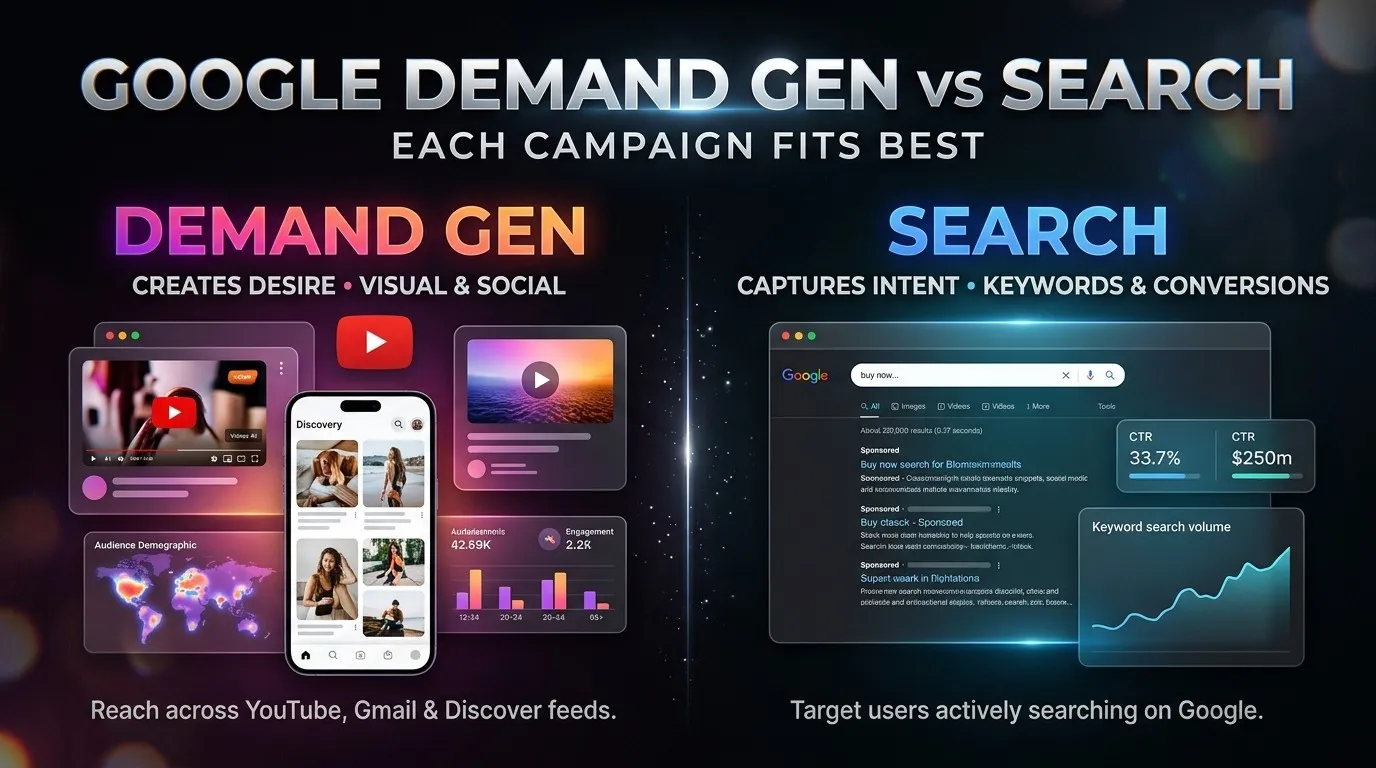
Choosing the right Google Ads campaign type can determine whether your budget reaches people who are ready to buy or people who have not yet realised they need your product. Both groups can become customers, but they often require different messages, timing, and advertising experiences.
That is why understanding Google Demand Gen vs Search matters for businesses that want to improve marketing performance rather than simply increase clicks. Search campaigns can connect advertisers with people actively looking for a product, service, or solution. Demand Gen campaigns can introduce a brand to potential customers while they browse visual content and explore their interests across eligible Google properties.
Neither campaign type is automatically better in every situation. A local service provider responding to urgent searches may need a different strategy from an online retailer launching a new product or a software company building awareness among potential buyers. The right decision depends on customer behaviour, campaign objectives, available creative assets, conversion tracking, and the time required to generate results.
This guide explains Google Demand Gen vs Search in practical terms, compares their strengths and limitations, and shows how to choose, measure, and combine them within a broader advertising strategy.
What Is Google Demand Gen vs Search?
The comparison of Google Demand Gen vs Search starts with a fundamental difference: one campaign type is designed around visual discovery, while the other is built around people expressing interest through search queries.
What is Google Demand Gen?
Google Demand Gen is a campaign type that uses visual advertising formats to reach people across eligible Google surfaces, including YouTube, YouTube Shorts, Discover, Gmail, and other supported placements. Advertisers can use images, videos, product feeds, and audience signals to introduce products and encourage actions.
The main purpose is to reach relevant people while they consume content, browse recommendations, or discover ideas. They may not be actively looking for the advertised brand, but their interests and behaviour can make the offer relevant.
For example, a company selling ergonomic office chairs could use a short video showing how its product improves a home-office setup. Someone watching workspace design videos might discover the chair, visit the website, compare models, and purchase it later.
This is where Google Demand Gen vs Search becomes a strategic decision. Demand Gen can help create interest before a customer begins looking for a specific solution.
Google explains that Demand Gen campaigns use visual assets across its discovery-oriented surfaces and offer audience and creative controls. Advertisers should check the current campaign settings because available placements and features can change.
What is Google Search advertising?
Search campaigns display ads in response to relevant searches on Google and eligible search partner inventory. Advertisers choose keywords, create ad groups, write responsive search ads, set bidding strategies, and direct users to relevant landing pages.
Suppose a person searches for “emergency boiler repair near me.” They have already identified a problem and are actively looking for a provider. A relevant Search ad can offer a direct route to a booking page or telephone number.
In Google Demand Gen vs Search, this is the central strength of Search: it can connect an advertiser with an existing need at the moment that need is expressed.
Search campaigns are not limited to customers who are ready to buy immediately. Searches can also indicate research, comparison, or early interest. The query itself provides an important clue about what the person wants.
The difference in one sentence
-
Demand Gen: Help relevant people discover a product, service, or brand and encourage them to take action.
-
Search: Connect with people when their searches indicate an interest, question, problem, or purchase need.
Neither approach guarantees a conversion. Both depend on the offer, audience or keyword relevance, ad quality, landing page, competition, budget, and measurement setup.
Google Demand Gen vs Search: Key Differences at a Glance
The easiest way to understand Google Demand Gen vs Search is to compare how each campaign reaches people and what advertisers need to provide.
| Comparison factor | Demand Gen | Search |
|---|---|---|
| Primary role | Create interest and drive action through visual discovery | Capture demand expressed through searches |
| Audience context | People browsing content and discovery surfaces | People entering relevant search queries |
| Main creative formats | Images, videos, product feeds, and related visual formats | Primarily text-based responsive search ads |
| Targeting approach | Audience segments, first-party data, and supported audience expansion options | Keywords, search intent, location, and supported audience signals |
| Customer journey | Often useful for awareness, consideration, and conversion activity | Often useful for research, comparison, and high-intent actions |
| Message style | Visual, engaging, and story-driven | Direct, relevant, and closely connected to the query |
| Landing page role | Continue the story and convert newly interested visitors | Deliver the specific answer or solution promised by the ad |
| Creative requirements | Strong images or video are often important | Relevant headlines, descriptions, assets, and landing pages |
| Typical measurement | Conversions, conversion value, cost per action, engagement, and incremental impact | Conversions, conversion value, cost per action, impression share, and search-term quality |
| Common challenge | Generating attention that turns into qualified action | Managing keyword relevance, competition, and search demand |
| Useful for | Product discovery, visual storytelling, new audience reach, and remarketing | Capturing existing demand, lead generation, urgent services, and explicit product searches |
This comparison is a starting point rather than a universal rule. A Demand Gen campaign can generate direct purchases, and a Search campaign can influence customers who are still researching.
When evaluating Google Demand Gen vs Search, focus on the customer behaviour you need to influence, not just the campaign label.
How Customer Intent Changes the Decision

Customer intent is one of the most important factors in Google Demand Gen vs Search because it affects the message, offer, landing page, and expected time to conversion.
High-intent customers
High-intent customers are actively seeking a solution or showing strong signs that they want to take a particular action. Their searches may include terms such as:
-
Buy a product online
-
Book a consultation
-
Hire a local service provider
-
Compare prices for a specific service
-
Request a quote from an agency
For these searches, the advertiser should make the next step obvious. A clear price, service area, product specification, availability statement, or booking option can reduce uncertainty.
For example, someone searching for “SEO agency for small businesses” may be comparing providers. A Search ad that leads to a service page with transparent deliverables, proof of experience, and a clear consultation option can match that intent.
In Google Demand Gen vs Search, Search is often a sensible first choice when a business already knows which queries produce qualified leads or sales.
However, high-intent keywords may attract substantial competition. If many advertisers bid on the same terms, clicks can become expensive. Advertisers must evaluate lead quality and profitability rather than assuming that a high-intent click is automatically valuable.
Early-stage customers
Early-stage customers may be interested in a category without actively looking for a supplier. They may watch tutorials, browse product inspiration, read lifestyle content, or discover solutions through recommendations.
Demand Gen can introduce the brand during these moments. A visually engaging demonstration can help the customer recognise a problem, understand a product’s benefits, or imagine a better outcome.
Consider a fitness brand launching a new adjustable dumbbell set. A person watching home-workout videos might not search for that exact product yet. A short, relevant demonstration can create interest and encourage further research.
That is a different role from capturing an existing search. Google Demand Gen vs Search therefore involves deciding whether the campaign should primarily answer expressed demand or help generate new interest.
Customers who are comparing options
Comparison-stage customers sit between discovery and purchase. They may have heard about a product but still need reasons to choose one brand over another.
Both campaign types can reach these people in different ways:
-
Search can respond to queries comparing products, services, features, and providers.
-
Demand Gen can reinforce product benefits, customer stories, demonstrations, and offers among relevant audiences.
-
Remarketing can help re-engage people who previously visited a website or interacted with a brand, where eligible and consent requirements are met.
The best strategy is to match the advertising message to the question the customer is trying to answer.
Intent is not always obvious
A keyword does not tell the entire story. Someone searching for “best project management software” may be a student, a consultant, a business owner, or an employee researching a purchase for a team.
Likewise, a person who watches a product video may be curious rather than ready to buy.
A strong Google Demand Gen vs Search strategy therefore uses conversion data, audience insights, landing-page behaviour, and downstream business outcomes to learn which interactions are valuable.
When Google Search Campaigns Are the Better Choice
Search is often a strong starting point when customers already know what they need and express that need through a relevant query.
Businesses solving an immediate problem
Emergency services, repair companies, legal services, and other businesses responding to specific needs may benefit from Search because potential customers actively look for assistance.
A plumbing company, for example, can target searches associated with emergency repairs, leaking pipes, or local service availability. Its ads should make the location, service, and contact route clear.
In Google Demand Gen vs Search, a campaign designed to capture urgent demand should not rely solely on a visual discovery strategy. The business needs to appear when a customer is actively searching for help.
Actual performance still depends on local competition, search volume, ad eligibility, operating hours, and the quality of the offer.
Services with a clearly defined buying query
Search can also work well for businesses selling specialised services or products. Prospective customers may search for a specific provider, software category, product model, or professional service.
Useful examples include:
-
Business software subscriptions
-
Accounting and tax services
-
Professional training courses
-
Industrial equipment
-
Marketing and consulting services
-
Product replacement parts
These searches can help advertisers identify what the customer is looking for and tailor the ad accordingly.
A business should organise keywords into tightly related groups, write relevant ads, and send each visitor to a landing page that answers the query. Sending every visitor to the homepage can create unnecessary friction.
Lead generation with measurable outcomes
Search is often a practical choice when the business needs calls, quote requests, appointment bookings, or consultation enquiries.
For example, a B2B agency might advertise for “Google Ads management services” and send visitors to a dedicated page outlining the service, process, case studies, and consultation options.
When assessing Google Demand Gen vs Search for lead generation, the important metric is not just the number of forms submitted. Advertisers should track whether those leads meet qualification criteria and eventually become customers.
A campaign that generates fewer but better-qualified leads may be more valuable than one producing many low-quality enquiries.
When Search may be less effective
Search is not always the right standalone solution. It may struggle when:
-
The product is new and potential customers do not know the relevant search terms.
-
Search volume is limited in a specialised market.
-
Competitors drive keyword costs beyond sustainable levels.
-
The business needs to explain a complex or unfamiliar offer before a customer searches for it.
-
The available queries attract research traffic but few qualified buyers.
In these cases, Google Demand Gen vs Search may lead to a combined approach: Search captures existing interest while Demand Gen introduces the product to new relevant audiences.
When Demand Gen Is the Better Choice
Demand Gen is particularly useful when the advertising message benefits from visual storytelling or when the business wants to reach potential customers beyond the people already searching for its solution.
Launching a new product
A new product often has a discovery problem. People cannot search for a brand they have never heard of, and they may not know which product category or feature would solve their problem.
Demand Gen can demonstrate the product in context. A short video can show how it works, while image assets can communicate its design, benefits, and key use cases.
For example, a company launching a compact travel coffee maker could use visual ads showing the product being used in a hotel room, campsite, or small office. These situations help potential customers understand why the product may be useful.
The Google Demand Gen vs Search decision depends on whether people are already searching for the product category and whether the campaign also needs to create awareness.
Products that are naturally visual
Some products are easier to sell when people can see their appearance, use, or transformation. Fashion, home décor, beauty, consumer electronics, travel experiences, and many lifestyle products can benefit from engaging visuals.
A retailer selling home-office furniture might use a video to show a cluttered desk becoming a functional workspace. A set of product images can then highlight the chair’s design, adjustability, and available colours.
Demand Gen can support this type of communication through eligible visual placements. Google recommends using relevant, high-quality creative assets and testing combinations of image and video formats.
Reaching new audiences
Demand Gen can help advertisers reach potential customers who share relevant interests or characteristics with existing customers, subject to the targeting options available in their account.
For instance, an online learning platform may want to reach professionals interested in developing their digital marketing skills. The campaign can use relevant audience signals and creative messaging to introduce the course to people who might not yet be searching for that particular provider.
The goal is not to reach as many people as possible without distinction. It is to reach a sufficiently relevant audience and persuade the right people to take the next step.
When comparing Google Demand Gen vs Search, advertisers should consider whether the available audience pool is large enough to support discovery while remaining relevant to the business objective.
Remarketing and consideration
Someone who has visited a product page may need more information before purchasing. A visual reminder, product demonstration, customer testimonial, or relevant offer can help bring the brand back into consideration.
Demand Gen can support eligible remarketing strategies, but advertisers should avoid assuming that every website visitor is equally valuable. A person who viewed a single page for a few seconds may have different needs from someone who added a product to their cart.
Use audience definitions that reflect meaningful behaviour, apply appropriate privacy and consent practices, and ensure that the message is relevant to the customer’s stage.
When Demand Gen may not be the best starting point
Demand Gen may be a poor first choice if a business lacks usable creative assets, has no reliable conversion measurement, or expects every impression to generate an immediate sale.
It may also be difficult to evaluate when the target audience is very narrow or when the product is usually purchased only after a specific, urgent search.
In Google Demand Gen vs Search, Demand Gen should be selected because its discovery and visual capabilities fit the business goal—not simply because its campaign interface is available.
Cost, Budget, and Return on Ad Spend

Cost is a major consideration in Google Demand Gen vs Search, but comparing average cost per click alone can lead to the wrong decision.
Search clicks may be more expensive because advertisers compete for specific queries with strong commercial intent. However, a higher click cost can still be profitable if those clicks produce valuable customers.
Demand Gen may generate more affordable reach or engagement in some situations, but inexpensive traffic is not automatically valuable. If visitors do not show meaningful interest, make purchases, or become qualified leads, a low cost per click can hide weak performance.
Compare business outcomes, not just clicks
Consider this illustrative comparison:
| Metric | Search campaign | Demand Gen campaign |
|---|---|---|
| Spend | $1,000 | $1,000 |
| Average cost per click | $5 | $2 |
| Clicks | 200 | 500 |
| Conversion rate | 8% | 2% |
| Conversions | 16 | 10 |
| Cost per conversion | $62.50 | $100 |
These figures are hypothetical, not industry benchmarks. They demonstrate why Google Demand Gen vs Search should be assessed using meaningful outcomes rather than traffic volume alone.
In this example, Search generates fewer clicks but more conversions at a lower cost per conversion. Demand Gen still may have value if it contributes to later purchases, reaches new customers, or improves the performance of other campaigns. Those benefits need to be measured rather than assumed.
Understand customer lifetime value
For subscription businesses, agencies, and other companies with repeat customers, the first conversion may not reveal the full value of a campaign.
A lead that costs $100 to acquire could be more profitable than one costing $40 if the first lead becomes a long-term customer with substantially higher revenue. The same principle applies to e-commerce customers who return to purchase again.
A good Google Demand Gen vs Search evaluation should consider customer lifetime value, gross margin, refund rates, lead-to-sale rates, and sales-cycle length where relevant.
Set realistic budgets
Your budget should be large enough to collect useful performance data, but it should also fit your financial risk tolerance.
Before launching, estimate how many conversions you need to evaluate the campaign, what you can afford to pay for each conversion, and how long it typically takes for a click or lead to produce revenue.
Avoid changing budgets and bidding strategies too frequently based on short-term fluctuations. At the same time, do not continue spending simply because a campaign has been running for several weeks. Review the evidence and make deliberate decisions.
Audience Targeting vs Keyword Targeting
Another major difference in Google Demand Gen vs Search is how advertisers communicate relevance to the advertising platform.
How Search keyword targeting works
Search campaigns use keywords and Google’s matching systems to determine which searches may be relevant to an advertiser’s ads. Match types, negative keywords, landing-page relevance, location settings, and other eligibility factors influence which searches can trigger ads.
Advertisers should start with a clear understanding of how their customers describe the problem they want to solve.
For example, a company selling accounting software might investigate queries related to small-business bookkeeping, invoice management, tax preparation, and financial reporting. Each group may need different ad copy and landing-page content.
The purpose is not to collect the largest possible keyword list. It is to identify queries that represent commercially useful demand.
In Google Demand Gen vs Search, keyword research helps Search campaigns respond to expressed needs, while Demand Gen relies more heavily on audience and creative relevance.
How Demand Gen audience targeting works
Demand Gen supports audience-based strategies, including eligible first-party audience use and lookalike segments. Available options and controls depend on campaign configuration, account eligibility, and Google’s current product features.
Advertisers can use customer insights to identify potential audiences and develop creative messages that fit their interests or likely needs.
For example, a business selling premium kitchen appliances may use product demonstrations and relevant audience signals to reach people interested in cooking, home improvement, or related topics. The campaign should still measure whether the people reached are becoming valuable customers.
Combine audience insights with keyword insights
The two methods can inform one another.
Search query reports may reveal recurring questions, objections, and product features that matter to customers. These insights can become ideas for Demand Gen videos, image ads, and landing-page content.
Demand Gen engagement and conversion data may reveal which product benefits attract attention from relevant audiences. Those insights can help improve Search ad messaging and landing-page structure.
The practical lesson from Google Demand Gen vs Search is that keyword data and audience data should support one shared understanding of the customer, rather than operate as disconnected advertising activities.
Creative Strategy: Text Ads vs Visual Storytelling
Creative requirements can influence which campaign type a business can execute effectively.
Writing effective Search ads
Search ads should respond directly to the user’s query. Strong ads make the product or service clear, communicate a relevant benefit, and give the visitor a logical next step.
For example, an ad for a business accounting service could highlight bookkeeping support, explain which businesses it serves, and invite users to request a consultation.
Useful practices include:
-
Reflect the user’s problem in the headline.
-
Explain the service or product clearly.
-
Include a specific, truthful benefit.
-
Match the ad to the landing page.
-
Use relevant ad assets where appropriate.
-
Avoid exaggerated claims and vague promises.
In Google Demand Gen vs Search, Search creative usually needs to communicate relevance and value quickly, because the user has already expressed an interest through a query.
Creating effective Demand Gen assets
Demand Gen benefits from visuals that stop the scroll and quickly communicate why an offer deserves attention. Images should be clear and relevant, while videos should establish context early and demonstrate a useful benefit.
A practical creative plan might include:
-
A short demonstration showing the product in use.
-
A lifestyle image showing the desired outcome.
-
A comparison visual explaining a meaningful difference.
-
A customer story or testimonial, where truthful and appropriately authorised.
-
A direct-response creative with a clear offer and call to action.
Test different messages rather than producing several near-identical versions. One creative may focus on convenience, another on quality, and another on cost savings. The results can reveal which value proposition resonates with the audience.
Match the message to the landing page
Creative relevance should continue after the click. If an ad promotes a specific product, the visitor should reach that product or a closely relevant collection—not a generic homepage that forces them to search again.
For Search, the landing page should answer the query and make the next step easy. For Demand Gen, the page may need to explain an unfamiliar product, build trust, and help a newly interested visitor understand the offer.
This distinction is central to Google Demand Gen vs Search because a click is only the beginning of the customer experience.
Conversion Tracking and Measurement
Without reliable measurement, advertisers cannot determine whether Google Demand Gen vs Search is producing real business value.
Choose meaningful conversion actions
Conversion tracking should reflect the outcomes that matter to the business. Depending on the business model, these may include:
-
Completed purchases
-
Qualified lead submissions
-
Booked appointments
-
Sales calls that meet qualification criteria
-
Subscription sign-ups
-
Qualified trial activations
-
Revenue or conversion value
Avoid treating every button click or page view as equally valuable. If a campaign is optimised for a low-value action, Google’s automated bidding may pursue that action even when it does not lead to revenue.
Check tracking quality before scaling
Verify that conversion tags and events are implemented correctly, duplicate events are not inflating results, and the chosen conversion actions align with the campaign objective.
For advertisers managing multiple data sources, the Google Ads Data Manager can be relevant when organising supported data connections and improving how customer information is used within Google advertising workflows.
Data quality is not simply a technical concern. It affects budget allocation, bidding decisions, and the conclusions drawn from campaign reports.
Respect consent and privacy
Advertisers should implement tracking in line with applicable privacy laws, platform policies, and the consent choices presented to users. Depending on the region and setup, consent settings can affect which data is collected or used for advertising measurement.
The guide to Consent Mode and Google Ads can help marketers understand how consent signals relate to Google Ads measurement and modelling.
In Google Demand Gen vs Search, measurement differences should be interpreted carefully. If one campaign has incomplete tracking or a different conversion setup, a simple comparison of reported conversions may not provide a fair assessment.
Use attribution carefully
Customers often interact with more than one campaign before converting. Someone may discover a brand through Demand Gen, later search for its name, and finally purchase after clicking a Search ad.
If the advertiser only looks at the final click, the discovery campaign may appear less valuable than it actually was. However, it is equally important not to credit Demand Gen for every later conversion without evidence.
Use available attribution reports, conversion paths, controlled experiments where feasible, and business outcomes to develop a more balanced view. In Google Demand Gen vs Search, the objective is to understand the contribution of each campaign rather than award all credit to the last interaction.
How to Combine Demand Gen and Search

For many businesses, the strongest strategy is not to choose one campaign type permanently. It is to assign each campaign a clear role within the customer journey.
Build a simple two-campaign structure
A business might use Search to capture people actively looking for its products and Demand Gen to reach relevant audiences who have not yet searched for the brand.
A practical structure could look like this:
| Campaign | Main objective | Example message | Primary measurement |
|---|---|---|---|
| Search | Capture existing demand | “Compare plans and request a quote” | Qualified leads and cost per qualified lead |
| Demand Gen | Create interest and encourage action | “See how the solution works” | Conversions, conversion value, and incremental impact |
| Remarketing strategy, where suitable | Re-engage relevant previous visitors | “Explore the features you viewed” | Return visits and completed conversions |
The campaigns should use consistent positioning and a shared understanding of what qualifies as a valuable customer.
Connect advertising with sales outcomes
For B2B companies, a form submission is not always the final goal. Sales teams may need to evaluate a lead’s budget, business needs, decision-making authority, and buying timeline before deciding whether it is worth pursuing.
A shared process for Sales and Marketing Alignment helps marketing teams understand which campaigns create qualified opportunities and helps sales teams provide feedback about lead quality.
This feedback is especially important when Demand Gen reaches people earlier in the buying journey. Some prospects may need education and nurturing before they are ready to speak to a sales representative.
Use lead quality to improve optimisation
A lead scoring framework can help a business distinguish between a casual enquiry and a prospect who is more likely to buy. Signals might include company fit, relevant website activity, requested service, and engagement with high-value content.
The concept of Intent-Based Scoring is useful when evaluating which behaviours indicate meaningful buying interest rather than superficial engagement.
For Google Demand Gen vs Search, the key is to bring downstream lead quality back into campaign decisions wherever tracking and integrations support it. A campaign that generates more leads is not necessarily the winner if those leads rarely progress into sales.
Avoid audience overlap confusion
When both campaigns target related audiences, customers may encounter multiple ads from the same business. This can be useful when messages are coordinated, but it can also create reporting confusion.
Set clear campaign objectives, review audience and placement settings, and assess how campaigns interact. Do not assume that every conversion reported by one campaign represents a completely new customer or an independent result.
A Practical Decision Framework
If you are still unsure about Google Demand Gen vs Search, use the following questions to guide the decision.
Choose Search first when:
-
Customers already search for the product or service.
-
You have evidence that specific keywords produce qualified conversions.
-
The business responds to urgent or clearly defined needs.
-
Your budget requires a direct focus on existing demand.
-
You have relevant landing pages and reliable conversion tracking.
Consider Demand Gen first when:
-
You need to introduce a new or unfamiliar product.
-
The product is easier to explain through images or video.
-
Your audience can be defined using relevant, eligible audience signals.
-
You have creative assets suitable for visual placements.
-
You want to test discovery-led acquisition in addition to capturing searches.
Consider both when:
-
The business needs both immediate leads and longer-term audience development.
-
Search volume is limited but there is a plausible audience for discovery.
-
Customers usually research before making a purchase.
-
You have enough budget and tracking quality to evaluate each campaign properly.
-
Marketing and sales teams can assess lead quality beyond the initial conversion.
This framework makes Google Demand Gen vs Search a decision about the business model and customer journey, not a debate about which campaign type is universally superior.
Common Mistakes to Avoid
Even a well-chosen campaign can underperform if its setup and optimisation do not match the business objective. Avoid these common mistakes when implementing Google Demand Gen vs Search.
Choosing based on clicks alone
Clicks indicate that people interacted with an ad, but they do not prove that the campaign generated profitable customers. Track meaningful conversions and assess lead quality, revenue, and acquisition costs.
Using the same message everywhere
Search ads should answer the user’s query, while Demand Gen creatives often need to establish relevance before asking for action. Reusing identical messaging without considering context can weaken both campaigns.
Ignoring negative keywords
Search advertisers should review search terms and exclude irrelevant queries when appropriate. Otherwise, budget can be spent on searches that are unlikely to produce business value.
Scaling before validating tracking
If conversion events are duplicated, missing, or poorly defined, the campaign reports may be misleading. Confirm that measurement works before increasing spend.
Expecting immediate results from every campaign
Some Search campaigns can produce useful leads quickly when demand already exists. Demand Gen may need time to identify effective audiences and creatives, but advertisers should still evaluate results against clear performance thresholds rather than waiting indefinitely.
Treating attribution as proof of incrementality
A campaign may receive credit for conversions that would have occurred anyway. Where practical, use experiments or other appropriate measurement methods to investigate whether additional advertising creates additional business results.
Conclusion
Google Demand Gen vs Search is ultimately a decision about how customers discover, evaluate, and purchase your offer. Search is often effective for capturing existing demand, while Demand Gen can build interest through engaging visual experiences and reach relevant audiences beyond active searches. Neither campaign guarantees profitable results without relevant messaging, reliable conversion tracking, suitable landing pages, and disciplined optimisation. Start with your business objective, test the campaign type that best fits customer behaviour, and evaluate qualified leads, revenue, and acquisition costs—not clicks alone. For many businesses, combining both campaigns creates a more balanced approach to sustainable growth.
Frequently Asked Questions (FAQ)
What is the main difference between Google Demand Gen vs Search?
Google Demand Gen vs Search mainly differs in how potential customers are reached. Demand Gen uses visual ads across eligible Google surfaces to encourage discovery and action, while Search responds to relevant queries entered by users.
Is Google Demand Gen better than Search Ads?
Neither is universally better. In Google Demand Gen vs Search, the right choice depends on customer intent, campaign goals, available creative assets, competition, and conversion data. Search may suit existing demand, while Demand Gen can support discovery and visual storytelling.
Which campaign is better for lead generation?
Both can generate leads. Search can capture people actively looking for a service, while Demand Gen can introduce the business to relevant potential customers. Compare qualified leads, cost per qualified lead, and eventual sales when assessing Google Demand Gen vs Search.
Is Demand Gen suitable for small businesses?
Yes, if the business has a clear goal, suitable creative assets, and enough budget to test performance responsibly. Small businesses should assess Google Demand Gen vs Search based on their audience, search demand, sales process, and ability to measure meaningful conversions.
Can I run Demand Gen and Search campaigns together?
Yes. A business can use Search to capture existing demand and Demand Gen to create interest or reach new audiences. When running both, define campaign roles clearly and evaluate how each contributes to the customer journey.
Which campaign type has a lower cost per click?
There is no universal answer. Costs depend on competition, audience, location, creative performance, and bidding settings. A lower cost per click does not necessarily mean better profitability, so compare conversions and business outcomes instead.
Does Demand Gen require video ads?
No. Demand Gen can support image-only or video-only campaigns, although combining suitable image and video assets may offer more opportunities to test creative performance. Check current Google Ads requirements and available formats before launching.
How should I measure Google Demand Gen vs Search?
Track relevant conversion actions, cost per conversion, conversion value, and lead quality. Where possible, also examine the contribution of each campaign to later sales and use experiments to investigate incremental impact.
Can Search campaigns create brand awareness?
Yes. Search ads can introduce a business to people researching relevant topics or comparing providers. Google Demand Gen vs Search However, Search generally responds to expressed queries, whereas Demand Gen is designed to support discovery across visual Google surfaces.
How do I decide which campaign to launch first?
Start by identifying how customers currently find your product. If they actively search for it, test Search first. If awareness is limited or the offer benefits from visual demonstrations, consider Demand Gen. In Google Demand Gen vs Search, let customer behaviour and measurable business goals guide the decision.



Leave a Reply