

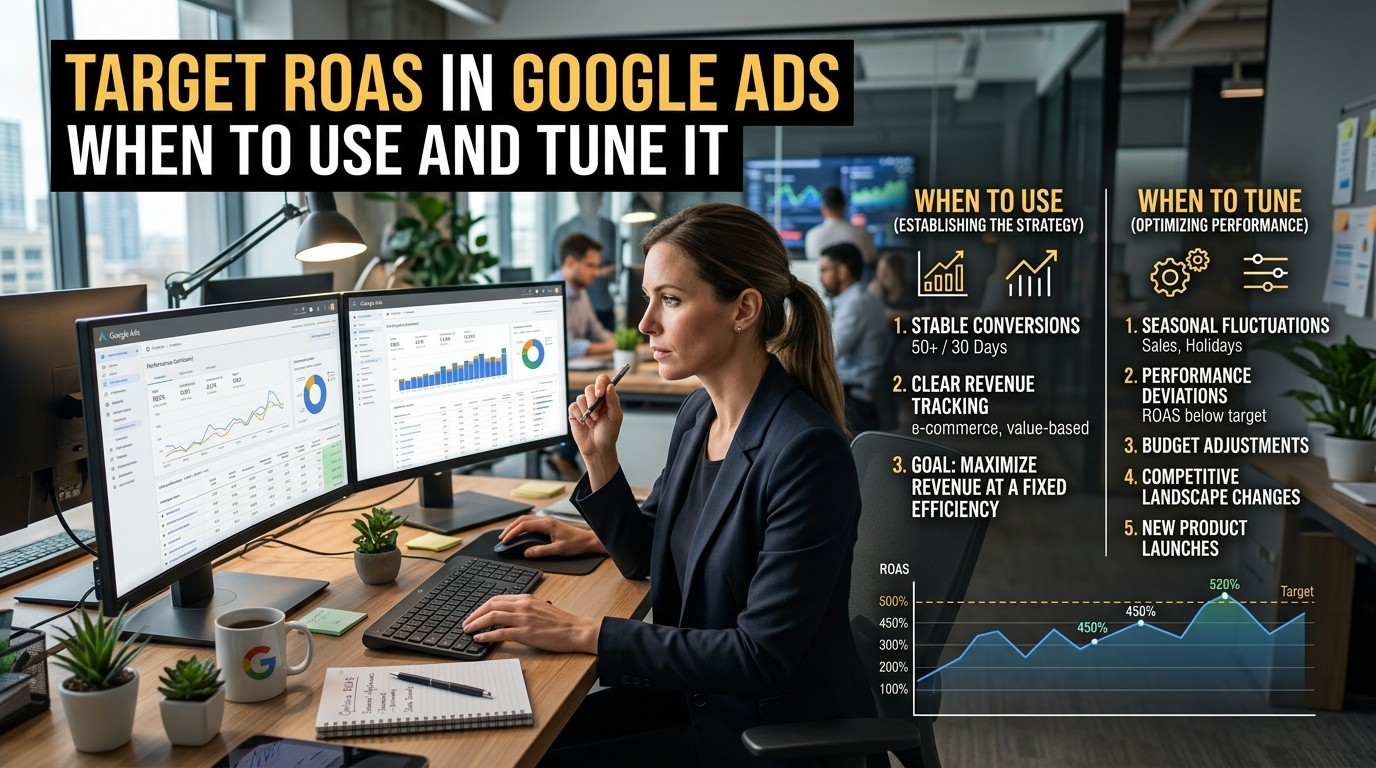
Target ROAS in Google Ads helps advertisers optimize bidding toward conversion value, balancing efficiency and scale when reliable revenue data, tracking, and realistic targets are available.
Target ROAS in Google Ads is designed for advertisers who care about the value generated by conversions rather than simply counting how many conversions occur. That distinction becomes especially important for ecommerce stores, lead-generation businesses with different customer values, subscription companies, and advertisers selling products or services with very different order sizes.
Target ROAS in Google Ads gives Google’s automated bidding system a return-on-ad-spend objective. Instead of manually deciding what each auction is worth, the system uses conversion-value information and auction-time signals to adjust bids with the aim of achieving the return specified by the advertiser. Google currently describes Target ROAS as a Smart Bidding strategy focused on conversion value and notes that it uses AI to predict conversion value at auction time.
But a high target is not automatically a better target. Target ROAS in Google Ads can restrict participation when the system believes the target is difficult to achieve. An advertiser might therefore see an apparently excellent efficiency goal but experience fewer impressions, fewer conversions, and lower total revenue. Google explicitly advises advertisers who want more conversion volume to consider gradually reducing the target, while raising the target can be used when the objective is stronger efficiency or return.
The real skill is knowing when to use Target ROAS in Google Ads, how to calculate a sensible starting point, when to lower or raise the target, and how to avoid confusing short-term volatility with a genuine problem. This guide explains the strategy in practical terms, including conversion tracking, value quality, campaign structure, budgets, testing, diagnostics, and optimization.
What Is Target ROAS in Google Ads?
Target ROAS in Google Ads is a value-based Smart Bidding strategy that aims to maximize conversion value while trying to achieve an advertiser-defined return on ad spend. Google calculates ROAS as conversion value divided by advertising cost, expressed as a percentage.
For example:
$10,000 conversion value ÷ $2,000 ad spend × 100 = 500% ROAS
A 500% target therefore means the advertiser is asking Google to aim for approximately $5 in conversion value for every $1 spent.
Target ROAS in Google Ads does not mean every individual auction or conversion will achieve exactly the target. Google explains that some conversions can produce a higher return while others can produce a lower return; the strategy evaluates performance in aggregate.
This is one of the most important concepts to understand. If an advertiser sets a 500% target, that does not mean every order must generate 5X value relative to spend. It means the bidding system is optimizing across auctions with the goal of achieving that average return.
Why value matters
Suppose an ecommerce campaign generates ten conversions.
Nine orders are worth $50 each, while one order is worth $1,000.
A strategy focused only on conversion count treats all ten conversions equally. A value-based strategy recognizes that they are economically different.
That is where Target ROAS in Google Ads can become useful. The system can use historical conversion values to identify situations that are more likely to produce higher-value outcomes.
How Target ROAS in Google Ads Works
Target ROAS in Google Ads operates through auction-time bidding. Google’s systems estimate the likelihood and potential value of a conversion using available conversion-value data and contextual signals. Bids can then be adjusted for individual auctions rather than relying on one fixed bid for every search. Google lists signals such as device, location, time of day, browser, language, and audience-related information among the contextual inputs Smart Bidding can use.
Target ROAS in Google Ads therefore requires a reliable value signal. If Google receives incomplete, inconsistent, duplicated, or poorly defined conversion values, the bidding system is optimizing against a weak representation of business value.
Imagine an online retailer selling products at $20, $100, and $700. If every purchase is accidentally reported as $1, Google’s system loses the information that distinguishes a high-value customer action from a low-value one.
The bidding strategy is only as good as the value definition behind it.
The basic relationship
The underlying logic can be simplified as:
Conversion Value ÷ Cost = ROAS
Target ROAS in Google Ads tells the system the return you want it to pursue while bidding for conversion value.
This does not mean you are manually controlling every CPC. Instead, you are providing a strategic objective and allowing the automated bidder to decide which auctions appear more valuable.
Target ROAS in Google Ads vs. Maximize Conversion Value
Target ROAS in Google Ads and Maximize Conversion Value are both value-based Smart Bidding approaches, but they emphasize different constraints.
Maximize Conversion Value seeks to generate as much conversion value as possible within the campaign’s budget without requiring a specific ROAS target. Target ROAS adds a return-efficiency objective to that value maximization.
Google’s guidance broadly maps these strategies to advertisers who measure conversion values and want to improve sales, profit, or value under either a budget constraint or a fixed ROAS objective.
| Strategy | Primary objective | Main constraint |
|---|---|---|
| Maximize Conversion Value | Generate as much conversion value as possible | Budget |
| Target ROAS | Generate conversion value while pursuing a target return | Target ROAS + budget |
| Maximize Conversions | Generate as many conversions as possible | Budget |
| Target CPA | Generate conversions around a target acquisition cost | Target CPA |
Target ROAS in Google Ads becomes more relevant when return efficiency is a genuine business requirement rather than an arbitrary reporting preference.
For example, a company with strong margins may prioritize growth and use Maximize Conversion Value. A company with strict acquisition economics may require a defined return threshold.
Neither objective is universally appropriate. The correct choice depends on how the business creates and measures value.
When Should You Use Target ROAS in Google Ads?
Target ROAS in Google Ads is generally most useful when four conditions are present: meaningful conversion values, dependable tracking, enough historical signal, and a business reason to optimize toward return.
Your conversions have materially different values
If every conversion is worth roughly the same amount, conversion-focused bidding may be simpler.
If values vary significantly, value-based bidding becomes more compelling.
An ecommerce account selling $30 accessories and $1,500 products has a clear value difference. A lead-generation business where some leads become $2,000 customers and others become $20,000 customers can also benefit if those values are accurately represented.
Target ROAS in Google Ads can help the system focus on higher-value opportunities instead of treating every conversion as economically equal.
Your conversion tracking is trustworthy
Before using the strategy, verify that purchases, revenue, lead values, subscriptions, or other business outcomes are being recorded correctly.
Google states that conversion values need to be set before applying Target ROAS, and its current guidance emphasizes reporting the values that matter to the business.
If the tracking is unreliable, changing the bidding strategy may simply amplify the tracking problem.
You have enough recent conversion activity
Google currently states that Search and Shopping campaigns using Target ROAS generally require at least 15 conversions over the past 30 days at the conversion tracking level. Other campaign types have different requirements.
That does not mean 15 conversions magically make every account ready for sophisticated optimization. More useful and stable conversion history can make the system easier to evaluate.
Your business actually has a ROAS objective
Target ROAS in Google Ads should reflect a real economic constraint.
If your finance team says the campaign needs to generate at least $4 in revenue for every $1 in media cost, a 400% target has business meaning.
If someone simply selects 800% because it sounds better, the number may work against the account.
When Should You Avoid Target ROAS in Google Ads?
There are situations where the strategy may not be the right starting point.
Your conversion values are missing
Without conversion values, there is no useful economic signal for value-based bidding.
Your values are inaccurate
Incorrect revenue, duplicated purchases, inflated values, or placeholder values can distort optimization.
Your campaign is brand new
A campaign with very little conversion history may need to gather signal before an aggressive return target is introduced.
You care primarily about conversion volume
If your main objective is generating as many qualified conversions as possible at a fixed budget, a conversion-based strategy may align more directly with your objective. Google’s current guidance distinguishes volume-focused strategies such as Maximize Conversions from value-focused strategies such as Target ROAS.
You cannot explain what the conversion value means
If the team cannot answer what $100, $500, or $5,000 in conversion value represents, setting a Target ROAS percentage becomes difficult to justify.
How to Calculate a Starting Target ROAS
A practical starting point for Target ROAS in Google Ads is your recent historical ROAS, adjusted for your actual business objective.
Google’s current guidance recommends using historical ROAS as a reference, ensuring the analysis excludes the most recent conversion-delay period. Google also recommends using the prior four weeks of historical ROAS when transitioning from Target CPA to Target ROAS.
Suppose the last four weeks show:
- Conversion value: $24,000
- Ad spend: $6,000
Historical ROAS:
$24,000 ÷ $6,000 × 100 = 400%
That gives you a factual baseline.
Now suppose the business wants better efficiency and believes a higher return is achievable. The target can be adjusted from that baseline, but the change should remain realistic.
Target ROAS in Google Ads works best when the target reflects a genuine economic objective and is reasonably connected to what the account has demonstrated.
Do not confuse margin with ROAS
A 500% ROAS means $5 of conversion value per $1 of ad spend.
It does not mean $5 of profit.
If a product generates $5 in revenue but costs $4 before advertising, a 500% ROAS does not automatically imply profitable acquisition.
Before using Target ROAS in Google Ads, understand gross margin, fulfillment costs, discounts, returns, fees, and customer lifetime value where relevant.
Revenue ROAS vs. Profit-Oriented Thinking
One major limitation of pure revenue-based optimization is that revenue does not always equal economic value.
Imagine two products:
| Product | Revenue | Gross margin | Approx. gross profit |
|---|---|---|---|
| Product A | $100 | 70% | $70 |
| Product B | $100 | 20% | $20 |
A system that sees only $100 revenue treats both orders equally.
A more sophisticated business may want to communicate different values to Google so that bidding aligns better with profitability.
Google supports conversion value rules that can modify conversion values based on criteria such as audience, device, or location, allowing advertisers to express that some conversions are more valuable than others.
This creates an important strategic principle:
Better value inputs can matter more than more aggressive bidding.
Target ROAS in Google Ads cannot rescue an account whose definition of value is economically incomplete.
How High Targets Can Reduce Volume
One of the most important concepts in Target ROAS in Google Ads is the trade-off between efficiency and available auction volume.
Suppose historical ROAS is around 350%, but the advertiser sets the target at 800%.
The bidding system is now being asked to pursue a return substantially above what recent data demonstrates.
That can make fewer auctions appear attractive enough to bid into. Google explicitly notes that a Target ROAS setting can reduce clicks because the strategy may lower bids on clicks that appear less likely to meet the target.
A high target can therefore create an apparent paradox:
Higher target → fewer eligible opportunities → lower traffic → fewer conversions → less total conversion value
That does not mean high targets are always bad. It means they create a stronger efficiency constraint.
Target ROAS in Google Ads should therefore be treated as a control knob, not a score where higher is always better.
How Low Targets Can Increase Scale
The opposite principle also matters.
If historical ROAS is 500% and the target is reduced to 300%, the system has a wider range of auctions that can potentially qualify.
Google specifically advises advertisers who want more conversion volume to consider gradually reducing the Target ROAS. It also notes that increasing the target can be used when the objective is to increase efficiency.
A lower target can therefore increase auction participation, but that does not guarantee profitability.
The question should not be:
“Can I lower the target?”
The better question is:
“What level of efficiency can the business sustainably accept in exchange for additional conversion value and growth?”
That is where Target ROAS in Google Ads becomes a business decision rather than merely a campaign setting.
Why Historical Data Matters
Target ROAS in Google Ads relies on patterns. If the historical data is too weak, too old, or fundamentally inconsistent with the present market, the target can become difficult to interpret.
Consider a seasonal retailer.
Historical ROAS from December may look excellent because purchase intent is naturally high. Applying exactly the same target in a quieter month may unnecessarily restrict delivery.
A major sale can create the opposite problem. Conversion rates can temporarily rise, making historical data look stronger than normal.
Google recommends accounting for conversion delays and notes that holidays, weekends, special events, changes to campaign data, and auction competition can affect results.
Target ROAS in Google Ads should therefore be evaluated within the relevant business context.
Conversion Delay and Why Recent Data Can Mislead
Suppose a customer clicks an advertisement on Monday but purchases on Thursday.
The Monday click may initially look like a non-converting interaction.
If you judge the campaign too quickly, you can conclude that performance is poor when the conversion simply has not been recorded yet.
Google recommends excluding the most recent conversion-delay period when assessing historical ROAS because recent conversions may still be coming in.
This is one reason Target ROAS in Google Ads should not be tuned every morning.
Daily fluctuations can encourage emotional decisions.
Weekly or longer trend analysis usually provides a more useful view, particularly for lower-volume accounts.
How to Tune Target ROAS Without Creating Chaos
The best tuning process is deliberate.
Target ROAS in Google Ads responds to target changes quickly, but Google notes that the system can need one to two conversion cycles to adapt to a new target.
That means you should avoid making another major change simply because the first few days look unusual.
If volume is too low
Review:
- Current target versus historical ROAS
- Budget constraints
- Conversion volume
- Conversion delays
- Tracking accuracy
- Auction competition
If the target is significantly restrictive, reducing it gradually can open more auction opportunities.
If volume is strong but efficiency is weak
Review whether the conversion values are accurate and whether the target is aligned with business economics.
If the account has stable volume and reliable values, a carefully higher target may be appropriate.
If both volume and efficiency are weak
Do not immediately change the target.
The problem may be broader:
- Poor product-market fit
- Weak landing pages
- Declining conversion rate
- Pricing issues
- Tracking errors
- Low search demand
- Competitive pressure
- Incorrect conversion goals
Target ROAS in Google Ads controls bidding, not the entire marketing funnel.
Use Gradual Target Changes
Large target changes can create unnecessary volatility.
Suppose the campaign is targeting 400%.
Moving to 420% is a relatively small change.
Moving to 700% is a very different instruction.
Google’s guidance favors gradual target adjustments and advises allowing one to two conversion cycles for the bidder to respond.
The exact adjustment size should depend on the account’s data quality, volume, seasonality, and business objective.
The underlying principle is simple:
Change the steering input carefully enough that performance can still be interpreted.
Target ROAS in Google Ads should be tuned like a control system, not like a daily stock price.
What to Monitor After Changing the Target
After adjusting Target ROAS in Google Ads, monitor both efficiency and scale.
| Metric | Why it matters |
|---|---|
| Actual ROAS | Measures return against spend |
| Conversion value | Shows total economic output |
| Cost | Shows media investment |
| Conversion volume | Shows scale |
| Conversion rate | Indicates traffic quality and funnel health |
| Impression volume | Reveals auction participation |
| Average order value | Helps explain value changes |
| Revenue per click | Connects traffic quality with economics |
Do not look at ROAS in isolation.
A campaign producing $2,000 in revenue at 600% ROAS may be less commercially valuable than a campaign producing $20,000 at 400% ROAS, depending on margins, capacity, and growth objectives.
Target ROAS in Google Ads should therefore be assessed alongside total conversion value.
A Simple Example of Target Tuning
Imagine an ecommerce advertiser with the following monthly performance:
Spend: $10,000
Conversion value: $45,000
Historical ROAS: 450%
The campaign currently uses a 600% target.
The system may be struggling to find enough auctions that appear likely to satisfy that return.
The business has two possible objectives.
Objective A: Increase efficiency
The advertiser may retain or increase the target if the business values stronger return efficiency and can accept slower growth.
Objective B: Increase value and volume
The advertiser may reduce the target closer to the campaign’s demonstrated performance, allowing the bidder to participate in more auctions.
Google specifically recommends lowering Target ROAS when the goal is more conversion volume and raising it when the goal is greater efficiency or return.
The correct decision therefore comes from business priorities, not from the number that looks more impressive in the dashboard.
Target ROAS and Budget Constraints
A target and a budget work together.
Suppose a campaign has a $100 daily budget but demands a very high ROAS target.
The bidder has both a limited amount of money and a strict return requirement.
If the eligible auction pool becomes too narrow, the campaign may struggle to spend its budget.
Target ROAS in Google Ads is therefore not a substitute for adequate budget strategy.
Google notes that bidding and budgets are key controls when optimizing a value-based campaign and recommends adjusting targets and budgets according to the desired outcome.
Budget increases can change the problem
A campaign may appear efficient only because it is capturing a limited number of highly valuable opportunities.
Increasing budget can expose the campaign to incremental auctions with lower predicted value.
This creates a useful distinction:
Efficient current volume is not the same as scalable efficient volume.
Target ROAS in Google Ads needs to be evaluated against the next available layer of demand, not only the traffic you already capture.
Campaign Consolidation and Data Quality
More campaigns are not automatically better.
Fragmented structures can split conversion data across multiple campaigns. In some situations, larger campaigns with more conversions provide stronger learning opportunities.
Google’s guidance notes that performance can improve with fewer, larger campaigns and more conversions, particularly when evaluating Target ROAS strategies.
That does not mean advertisers should merge everything.
Campaigns may legitimately require separation because of different products, business units, budgets, geographies, profitability rules, or reporting requirements.
The principle is to avoid fragmentation that does not serve a meaningful business purpose.
Target ROAS in Google Ads performs within the data structure you give it.
Target ROAS and Value-Based Bidding
Target ROAS in Google Ads is part of the broader value-based bidding approach.
Value-based bidding shifts attention away from “How many conversions did we generate?” toward “How much business value did those conversions create?”
For a deeper conceptual framework around this model, advertisers can explore Value-Based Bidding as part of a broader paid-search strategy.
This is important because Target ROAS in Google Ads is not simply a more advanced version of manual CPC. It represents a different optimization philosophy.
The advertiser is saying:
“Do not value every conversion equally. Pursue conversion opportunities based on the value we report.”
That makes data architecture critical.
Target ROAS and Smart Bidding
Target ROAS in Google Ads belongs to Google’s Smart Bidding ecosystem.
Smart Bidding uses machine learning and auction-time optimization to adjust bids in individual auctions. Google’s current documentation describes Target ROAS as one of the strategies that optimize toward conversion value.
Advertisers who are new to the automation layer can review Smart Bidding in Google Ads to understand how automated bidding compares with more traditional bid-management thinking.
The key psychological shift is important:
You are no longer telling Google exactly how much a click is worth.
You are telling Google what business outcome the bidding system should prioritize.
Target ROAS in Google Ads therefore requires advertisers to think more carefully about goals and measurement.
Conversion Value Rules and More Accurate Business Value
Not every customer has the same long-term economic value.
A repeat customer may be worth more than a one-time customer. A lead from one location may close at a higher rate. Certain devices or audience types may produce different economics.
Google’s conversion value rules can help advertisers modify values according to defined conditions, including audience, device, and location. These rules can be applied across several campaign types, including Search, Shopping, Display, Hotel, and Performance Max.
This can make Target ROAS in Google Ads more aligned with real business priorities.
However, value rules should be built carefully.
If the values become arbitrary, constantly changing, or difficult to explain, they may make reporting harder rather than better.
Use values your business can defend
A useful value model should answer:
- Why is this conversion worth this amount?
- What evidence supports the value?
- How often is it updated?
- Does it reflect revenue, margin, expected lead value, or another business outcome?
- Will the value definition remain consistent enough for bidding to learn?
Good value architecture creates better inputs for Target ROAS in Google Ads.
Performance Max and Target ROAS
Performance Max is one of the campaign types where Target ROAS can be used for value-based optimization.
Google’s current guidance for lead-generation Performance Max recommends value-based Smart Bidding when the objective is lead value and suggests selecting a conversion goal close to the sale or closed deal. Google also warns that an overly high target can limit impressions and conversions.
This is especially relevant for businesses that optimize for lead volume but ultimately care about revenue.
For example, a form submission may not be the true business outcome.
A better value signal might distinguish:
Lead → Qualified lead → Opportunity → Closed deal
The further downstream the value signal can reliably move, the more economically meaningful the bidding objective can become.
Target ROAS in Google Ads can benefit from this deeper measurement architecture.
Search Campaigns and Target ROAS
Search campaigns can use Target ROAS when conversion values are available and the account meets the relevant data requirements.
Because Search captures active intent, the system can evaluate contextual and query-related information when setting bids. Google’s documentation notes that value-based Smart Bidding can use search-query-level performance along with contextual signals and the specified target.
But search intent alone does not guarantee high-value conversion.
A generic query may generate traffic that converts at lower order values. A highly specific query may have stronger commercial intent and higher average value.
Target ROAS in Google Ads tries to estimate these differences through the signals available to the system.
Shopping and Ecommerce Applications
Shopping is a natural environment for Target ROAS in Google Ads because transaction values can vary directly by order.
Suppose:
- Order A = $40
- Order B = $120
- Order C = $700
A value-based strategy can use those reported differences instead of treating each transaction as one identical conversion.
This matters for businesses with broad catalogs where average order value can change significantly.
However, ecommerce advertisers should also consider:
- Returns
- Cancellations
- Discounts
- Product margin
- Shipping costs
- Customer lifetime value
- New versus existing customers
If these factors materially affect profitability, revenue-only ROAS may not provide the full picture.
Target ROAS for Lead Generation
Lead generation requires additional care because there may be no immediate revenue transaction.
A form fill could represent:
- A low-intent inquiry
- A qualified prospect
- A sales opportunity
- A closed customer
Treating all four as identical conversions can distort value.
Target ROAS in Google Ads becomes more useful when advertisers can assign realistic values to different lead stages.
For example:
Basic lead = $50
Qualified lead = $250
Sales opportunity = $800
Closed customer = $4,000
These are illustrative figures, not universal benchmarks.
The values need to come from the business’s actual economics and historical close rates.
Using Offline Conversion Data
Some businesses complete sales outside the website.
A person might submit a lead form online, speak to sales, negotiate over several calls, and eventually purchase through a salesperson.
If the advertising platform only sees the original lead, the bidding system cannot fully understand the final economic outcome.
Where reliable integrations are available, bringing qualified or offline outcomes back into the advertising system can improve the relationship between advertising signals and business value.
The principle behind Target ROAS in Google Ads remains the same: the system needs a useful representation of value.
How AI Fits Into Target ROAS Optimization
Google’s Smart Bidding infrastructure already uses AI and machine learning to estimate conversion probabilities and values.
Advertisers can also use AI elsewhere in the workflow to support analysis, forecasting, segmentation, and reporting.
For example, AI Sentiment Analysis may help a marketing team identify changes in customer attitudes that could influence conversion behavior, product demand, or messaging performance.
An AI Workflow for Marketing Teams can also help connect campaign analysis, creative iteration, reporting, and decision-making into a repeatable process.
The important distinction is that AI should support the decision process rather than replace business judgment.
Target ROAS in Google Ads still needs a human-defined objective.
What to Do When ROAS Falls Below Target
A campaign can temporarily fall below its Target ROAS.
That does not automatically mean the strategy is broken.
Some conversions may have longer delays. Auction conditions can change. Product demand can shift. Competitors can change bids. Promotions can end.
Google recommends considering conversion delays and allowing one to two conversion cycles after major target changes before making further adjustments.
Instead of immediately lowering the target, ask:
Has enough time passed?
Are conversion values still accurate?
Has conversion volume changed?
Did the landing page or offer change?
Did the market become more competitive?
Is the recent decline isolated or persistent?
This diagnostic mindset prevents unnecessary target changes.
What to Do When ROAS Is Above Target
Above-target performance can be positive, but it also creates a question.
Is the target too conservative?
Suppose a campaign consistently achieves 700% ROAS while targeting 400%.
The business may be leaving incremental conversion value on the table if it could profitably spend more.
A higher target could be tested carefully, but advertisers should understand that increasing the target can reduce eligible auction volume.
Target ROAS in Google Ads should therefore be increased only when the business actually wants stronger efficiency and is comfortable with the potential trade-off in scale.
The Difference Between Target and Actual ROAS
This distinction is essential.
Target ROAS is the objective given to the bidding system.
Actual ROAS is what happened.
They do not have to match every day.
A target of 500% does not mean today’s campaign must produce exactly 500%.
The relevant evaluation window should account for conversion delays and enough data to make the comparison meaningful.
Google specifically recommends evaluating Target ROAS performance over time and accounting for conversion delay rather than overreacting to very recent results.
Target ROAS in Google Ads should therefore be viewed as a strategic steering target rather than a daily guarantee.
Common Target ROAS Mistakes
Setting the target too high
An aggressive target can restrict auction participation and reduce conversion volume. Google explicitly warns that a high target can limit impressions and conversions in value-based bidding environments.
Changing the target too often
Frequent changes make it difficult to understand which adjustment affected performance.
Ignoring conversion delay
Recent data may understate true results.
Optimizing for revenue when profit matters
Revenue may not capture margin differences.
Using poor conversion actions
If bidding optimizes toward micro-conversions instead of meaningful business outcomes, the algorithm can pursue the wrong signal.
Splitting campaigns unnecessarily
Excessive fragmentation can weaken data density.
Ignoring budget limitations
A strict target combined with a constrained budget can restrict scale.
Reacting emotionally to daily ROAS
Automated bidding requires enough data and enough time for patterns to emerge.
A Practical Target ROAS Optimization Workflow
A structured workflow can reduce guesswork.
Phase 1: Audit the data
Check purchase values, lead values, primary conversion actions, transaction IDs, duplicated conversions, attribution settings, and tracking consistency.
Phase 2: Establish a historical baseline
Use a sufficiently recent window while excluding the appropriate conversion-delay period. Google recommends four weeks of historical ROAS as a reference when transitioning from Target CPA to Target ROAS.
Phase 3: Define the business objective
Decide whether the next phase is primarily about volume, value, efficiency, or profitability.
Phase 4: Set a realistic target
Use historical performance as evidence rather than selecting a target because it sounds ambitious.
Phase 5: Allow learning time
Avoid evaluating the first few days as though they represent stable performance.
Phase 6: Analyze scale and efficiency together
Look at conversion value, spend, conversions, ROAS, impression volume, and other commercial indicators.
Phase 7: Adjust gradually
Reduce the target when additional volume and value are needed, or increase it when stronger efficiency is genuinely the objective.
Phase 8: Repeat from evidence
Treat every adjustment as an experiment informed by data.
Target ROAS in Google Ads becomes much easier to manage when this process is repeated consistently.
A Decision Matrix for Target Tuning
| Situation | Possible interpretation | Potential action |
|---|---|---|
| High ROAS + low volume | Target may be restrictive | Consider a gradual target reduction |
| Low ROAS + high volume | Target may be permissive or traffic quality may be weak | Audit data, goals, and economics |
| High ROAS + strong volume | Account may be healthy and scalable | Consider controlled target increase if efficiency is the priority |
| Low ROAS + low volume | Multiple issues may exist | Diagnose tracking, demand, budget, and conversion quality |
| Sudden short-term decline | Could be delay or market fluctuation | Wait for a meaningful evaluation period |
| Stable decline over multiple cycles | Structural issue possible | Audit funnel, values, competition, and bidding inputs |
This framework should be treated as a diagnostic starting point, not a mechanical rule.
How Human Psychology Affects Target ROAS Decisions
Even though Target ROAS in Google Ads is algorithmic, marketers still make emotionally influenced decisions.
A dashboard showing 250% ROAS can create anxiety even when the business is growing profitably.
A dashboard showing 800% can create confidence even when the account is too restricted to scale.
The human brain naturally prefers attractive ratios.
That is why marketers should separate the visual appeal of a metric from its commercial meaning.
Ask:
How much conversion value are we generating?
How much profitable growth can we support?
What is the opportunity cost of restrictive bidding?
What level of return does the business actually require?
This mindset makes Target ROAS in Google Ads a business-control mechanism rather than a vanity metric.
How to Balance Efficiency and Growth
Marketing rarely exists on a single axis.
A campaign can be extremely efficient but too small.
A campaign can be large but unprofitable.
The challenge is finding a range where the business can acquire enough demand at acceptable economics.
Target ROAS in Google Ads influences that balance by changing how selective the bidding system becomes.
A higher target generally communicates stronger efficiency requirements.
A lower target generally allows more auction flexibility.
The correct position depends on margins, cash flow, inventory, sales capacity, growth expectations, and customer lifetime value.
There is no universal “perfect” Target ROAS.
Google’s 2026 Naming Changes
Google began updating the way some Smart Bidding strategies are labeled in June 2026. Google states that “Maximize conversion value with a Target ROAS” is being renamed “Target ROAS,” while the underlying bidding behavior remains the same.
That means advertisers may encounter slightly different labels while working in the interface during the transition.
The strategic concept has not changed: Target ROAS in Google Ads remains a value-focused automated bidding approach that uses a ROAS objective.
Google also introduced changes affecting budget-limited target-based bidding from August 17, 2026, noting that campaigns using Target ROAS may experience temporary traffic and performance fluctuations as those bidding-system changes roll out.
Therefore, sudden performance movement in a live account should always be analyzed in the context of platform changes, campaign edits, seasonality, tracking, competition, and conversion delay.
Advanced Tuning: Think in Conversion Cycles
One of the strongest optimization habits is to stop thinking only in calendar days.
A conversion cycle is the time it takes for meaningful conversion outcomes to accumulate.
If customers commonly buy within several days of clicking, evaluating performance immediately after a target change can produce incomplete data.
Google advises allowing one to two conversion cycles for significant bidding changes to stabilize.
This means the right evaluation window depends partly on business buying behavior.
A fast ecommerce store may learn more quickly than a B2B company where prospects need several weeks to close.
Target ROAS in Google Ads should always be evaluated against the speed and economics of the customer journey.
What “Good” Target ROAS Actually Means
There is no universal percentage that defines a good Target ROAS.
For one business, 250% may support healthy margins.
For another, 500% may be necessary.
For another, a lower return may still make strategic sense because first purchases create valuable recurring customers.
Target ROAS in Google Ads should therefore be tied to unit economics rather than industry myths.
A target becomes meaningful when the business can explain why it is financially sustainable.
Final Checklist Before Launching Target ROAS in Google Ads
Before switching a campaign, verify:
- Conversion tracking is functioning.
- Revenue or lead values are accurate.
- Primary conversion goals represent meaningful outcomes.
- The account has useful historical data.
- The target is based on evidence.
- Conversion delay is understood.
- Budget is appropriate for the desired scale.
- Product margins are understood.
- Recent promotions and seasonality are considered.
- The team knows what success means.
- A review period has been established.
- Major changes are documented.
Target ROAS in Google Ads should not be treated as a setting you choose once and forget forever. Market conditions, economics, tracking, product mix, customer behavior, and business goals change.
The strongest operators revisit the target because the business changed—not because the dashboard changed color.
Conclusion
Target ROAS in Google Ads is most useful when advertisers have reliable conversion values and a genuine return-based objective. The strategy can help balance conversion value, efficiency, and auction-level decision making, but an aggressive target can restrict traffic and reduce total volume. Start from historical performance, account for conversion delays, verify value quality, and make target changes gradually. Evaluate total conversion value alongside ROAS instead of chasing the highest percentage possible. When the target reflects real business economics, the bidding system receives a clearer objective and marketers gain a more disciplined framework for scaling or tightening performance. The strongest results come from treating bidding, measurement, margins, and growth as one connected system.
Frequently Asked Questions (FAQ)
What is Target ROAS in Google Ads?
Target ROAS in Google Ads is a Smart Bidding strategy that uses conversion-value data to optimize bids toward a specified return on ad spend. It aims to maximize conversion value while pursuing the target return across auctions.
What does a 500% Target ROAS mean?
A 500% target means the advertiser wants approximately $5 in conversion value for every $1 spent on advertising. The target applies as an overall objective, not as a guarantee for every individual conversion.
Is Target ROAS better than Maximize Conversion Value?
They serve different objectives. Maximize Conversion Value prioritizes total conversion value within budget, while Target ROAS adds a return-efficiency target. The appropriate strategy depends on whether the business primarily needs scale, value, or efficiency.
How much conversion data do I need?
Google currently states that Search and Shopping campaigns generally need at least 15 conversions in the past 30 days at the conversion tracking level to use Target ROAS. Other campaign types have different requirements.
What happens if my Target ROAS is too high?
A high target can make the bidding system more selective, potentially reducing impressions, clicks, and conversion volume. Google specifically notes that lowering the target can help increase conversion volume.
Should I change Target ROAS every day?
No. Frequent adjustments make performance difficult to interpret and can interfere with the system’s adaptation. Google recommends allowing one to two conversion cycles after target changes.
How should I choose my first Target ROAS?
Use recent historical ROAS as a baseline, excluding the latest period affected by conversion delay. Google recommends using the prior four weeks of historical ROAS when transitioning from Target CPA to Target ROAS.
Can Target ROAS optimize for profit instead of revenue?
It can move closer to profit-oriented optimization when the conversion values supplied to Google accurately represent business value. Advertisers can also use conversion value rules to adjust values for certain audiences, locations, devices, or other defined conditions.
Why is my ROAS above target but sales volume low?
The target may be restrictive, particularly when the campaign is achieving strong efficiency but participating in fewer auctions. In such situations, advertisers can evaluate whether a lower target could create additional profitable volume.
How long should I wait after changing Target ROAS?
There is no universal number of days because conversion speed varies by business. Google advises allowing one to two conversion cycles for the system to adjust and accounting for conversion delays before judging performance.




Leave a Reply