

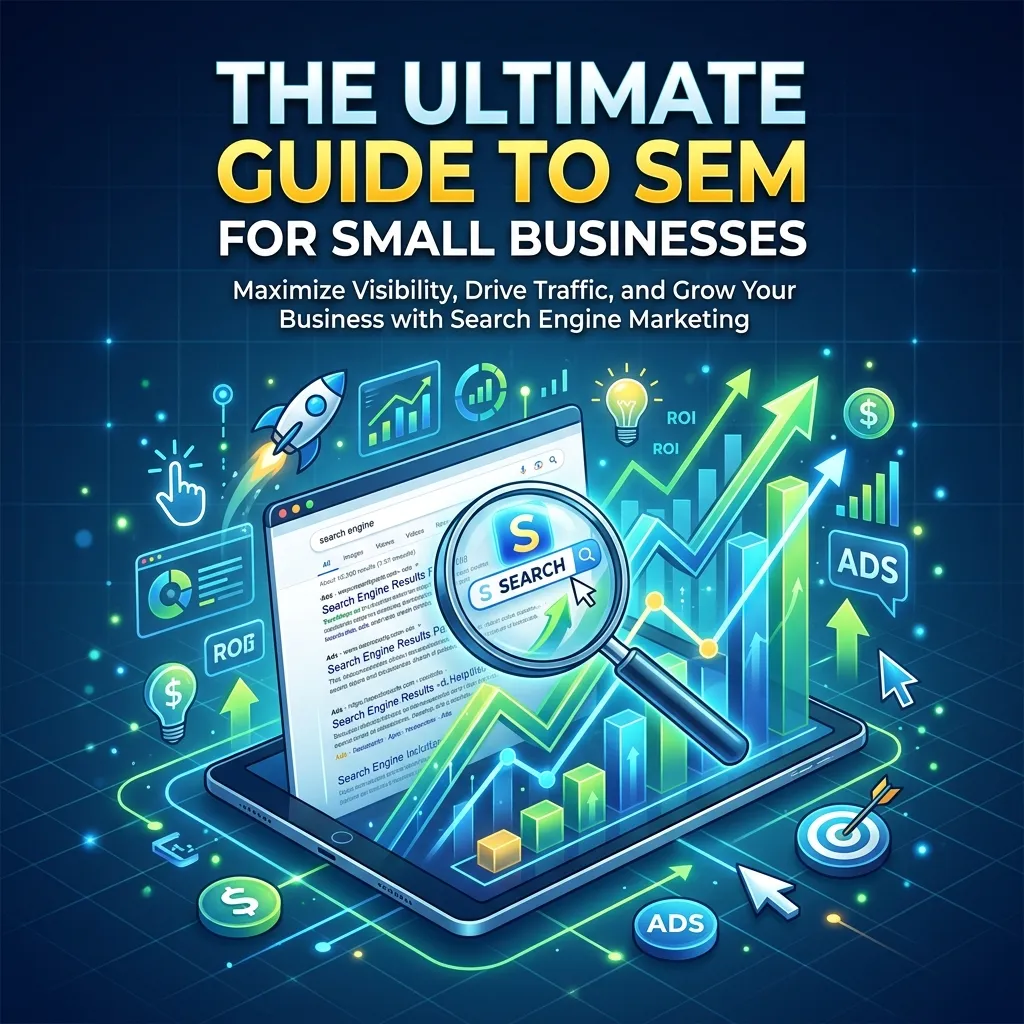
This blog explains how small businesses can use SEM to gain instant visibility, attract targeted traffic, and increase ROI through keyword research, ad creation, budgeting, and continuous optimization strategies for profitable growth.
Search Engine Marketing (SEM) offers a direct pathway to visibility when your potential customers are actively looking for your products or services. While organic search engine optimization builds long-term traffic, utilizing paid search provides immediate results by placing your business at the top of search engine results pages through paid advertising. For many local and growing companies, implementing a robust strategy for sem for small businesses can mean the difference between steady growth and stagnation.
Getting started with sem for a small business can feel overwhelming at first glance. The platforms are complex, the metrics are abundant, and the fear of wasting a limited budget is entirely valid for new advertisers. However, understanding the fundamentals of paid search allows you to easily compete with larger brands on a level playing field. You do not need a massive marketing budget to succeed; you just need a strategic approach focused on relevance and high return on investment.
This guide breaks down exactly how to use sem for small business to drive targeted traffic, generate qualified leads, and increase online sales. We will cover everything from initial audience research and keyword selection to crafting compelling ad copy and measuring your success, giving you a clear roadmap to build profitable paid search campaigns.
Understanding Your Target Audience in SEM
Your sem for small business strategy will only succeed if you know exactly who you are trying to reach. A deep understanding of your specific audience ensures your advertising budget is spent on the right people at the exact right time. Mastering this foundational step is critical for all SEM strategies.
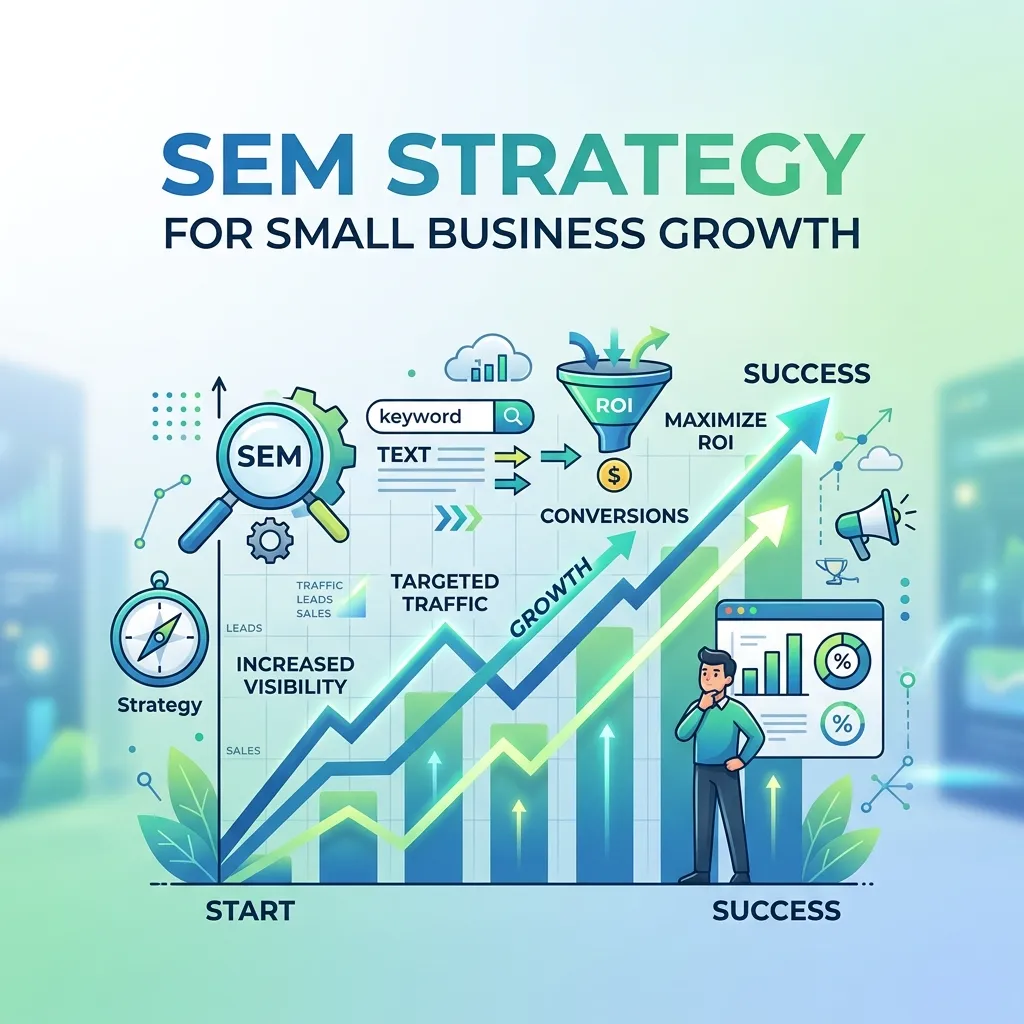
Defining Your Ideal Customer
Start by creating highly detailed buyer personas for your paid search campaigns. Identify the distinct demographics, specific pain points, and core motivations of your absolute best customers. Ask yourself what specific problems your business actively solves for them and what exact language they use when searching for those solutions.
Creating Accurate Buyer Personas
Building personas requires digging into your existing customer data. Look at past purchase history, customer support inquiries, and website analytics. This clarity forms the foundation of your entire sem for small business approach.
Market Research and Competitive Analysis
Examine closely what your direct competitors are doing in the paid search space. Look at the specific keywords they target and the exact messaging they use in their text ads. Tools like SEMrush or Ahrefs can quickly reveal your competitors’ paid search strategies, highlighting specific gaps you can immediately exploit and areas where you need to be much more aggressive.
Setting Clear SEM Goals
Determine exactly what success looks like before spending a single dollar on paid search. Your primary goal might be driving profitable e-commerce sales, generating local phone calls, or collecting qualified lead form submissions. Assigning specific, easily measurable targets allows you to structure your sem for small business campaigns properly and evaluate overall performance accurately.
Keyword Research for Small Businesses
Keywords are the vital bridge between your customers’ search queries and your digital business presence. Selecting the absolute right keywords ensures your ads appear for highly relevant searches with very strong purchase intent, maximizing the value of your sem for small business efforts.
Identifying Relevant Keywords
Brainstorm the exact terms people might logically use to find your business online. Group these terms into tight, core themes based on your different products or services. Focus heavily on keywords that indicate strong commercial intent, such as terms including “buy,” “hire,” “near me,” or highly specific product models. Effective paid search thrives on capturing high-intent searchers.
The Long-Tail Keyword Strategy
Small companies often struggle to compete for very broad, highly competitive search terms. Long-tail keywords—phrases containing three or more words—are usually much less competitive and significantly cheaper to bid on. For example, instead of targeting the broad word “plumber,” target “emergency residential plumber in Austin.” These highly specific queries typically convert at a much higher rate, making them perfect for sem for small business.
Benefits of Long-Tail Targeting
Targeting long-tail variations drastically lowers your average cost per click while simultaneously increasing your conversion rates. It is one of the most effective SEM strategies available today.
Essential Tools for Keyword Research
Leverage software platforms to strategically build your target keyword lists. Google Keyword Planner is an excellent, free tool that provides search volume estimates and historical click data. Other premium options like Moz and Ubersuggest offer deeper, actionable insights into keyword difficulty and related search terms to massively expand your sem for small business campaign structure.
Crafting Compelling Ad Copy
Once your carefully chosen keywords trigger a live ad, the actual copy must convince the user to click. Great ad copy speaks directly to the user’s immediate needs while clearly and quickly communicating your unique value proposition.
Best Practices for Ad Headlines and Descriptions
Your main headline is the absolute most critical visual element of the ad. Include the specific target keyword naturally to show immediate relevance to the user. Use the longer description lines to highlight core benefits, unique product features, or special limited-time offers. Ensure the overall tone perfectly aligns with your brand and directly addresses the searcher’s core query.
Incorporating Clear Calls to Action
Tell the user exactly what you actively want them to do next. Clear, direct calls to action (CTAs) like “Shop Now,” “Get a Free Quote,” or “Book Your Appointment” guide the prospect gently toward the final conversion. A very strong CTA entirely removes user ambiguity and drastically improves your overall click-through rate, a crucial component of sem for small business.
A/B Testing Ad Variations
Never settle blindly for a single text ad version. Create multiple creative variations testing entirely different headlines, descriptions, and CTAs. Monitor closely which specific combinations consistently generate the highest conversion rates and continuously refine your messaging based entirely on the hard data.
Landing Page Optimization in Paid Search
A great paid search ad is completely useless if it sends expensive traffic to a highly confusing or deeply irrelevant webpage. The specific landing page must flawlessly deliver on the exact promise made in your ad copy.
Designing High-Converting Landing Pages
Keep the page design very clean and focused entirely on the single conversion goal. The main headline of the landing page should perfectly match the ad’s core messaging. Use high-quality images, clear bulleted benefits, and highly visible trust signals like real customer reviews or industry certifications. Remove distracting top navigation menus that might easily lead the user away from the primary CTA.
Ensuring Mobile Responsiveness
The vast majority of paid search traffic now occurs strictly on mobile devices. Your dedicated landing page must load incredibly quickly and display absolutely perfectly on small smartphone screens. Ensure clickable buttons are very easy to tap and lead forms are remarkably simple to fill out without requiring excessive zooming or frustrating scrolling.
A/B Testing Landing Page Elements
Similar to testing ad copy, your paid search landing pages require continuous, rigorous testing. Experiment frequently with different overall page layouts, bold button colors, and specific form lengths. Even incredibly small adjustments to the top headline or the precise placement of a security trust badge can significantly impact your overall conversion rate in sem for small business.
Mastering Google Ads Basics

Google Ads is the undisputed dominant player in the vast SEM landscape. Mastering these Google Ads basics gives you immediate access to the absolute largest pool of search traffic in the world, which is vital for any sem for small business initiative.
Setting Up Your First Campaign
Structure your new account highly logically. Create entirely separate campaigns for different distinct product categories or specific geographical regions. Ensure your location targeting is incredibly tight to completely avoid wasting money on accidental clicks from areas you simply do not serve. Properly structuring campaigns is one of the most important Google Ads basics.
Ad Groups and Bidding Strategies
Group your target keywords incredibly tightly within highly specific ad groups. If you sell shoes, keep running shoes and dress shoes in entirely separate ad groups so you can easily write highly relevant ads for each. Start carefully with manual bidding to maintain total control over your click costs, and strongly consider transitioning to advanced automated bidding strategies like Maximize Conversions once you have successfully collected sufficient account data.
Leveraging Bid Adjustments
Adjust your bids dynamically based on device performance, time of day, and geographic location to squeeze the absolute maximum financial value out of your sem for small business budget.
Measuring and Optimizing Performance
Review your search terms report very regularly to clearly see the actual, real-world queries triggering your ads. This is a fundamental aspect of Google Ads basics. Pause wasteful keywords and double down on terms that drive profitable sales.
Expanding Reach: Bing Ads and Other Platforms
While Google is the giant, alternative digital platforms offer highly valuable paid search opportunities often completely overlooked by your local competitors. Diversifying your sem for small business approach reduces risk.
Exploring Bing Ads for a Broader Reach
Microsoft Advertising (formerly Bing Ads) typically features significantly lower cost-per-click rates and much less aggressive competition than Google. The general audience often skews slightly older and typically has a higher average household income, making it an absolutely excellent platform for certain B2B offerings and high-end consumer products.
Local Search Advertising
For traditional brick-and-mortar businesses, highly localized advertising options on Yelp, Google Maps, and Nextdoor connect you instantly with active customers in your immediate physical vicinity. Ensure your local business profiles are completely fully optimized with highly accurate hours, high-quality photos, and correct contact information.
Integrating Search and Social Growth Strategies
Search engine marketing captures existing demand, but social media marketing helps generate new awareness. Combining your sem for small business approach with audience growth tactics creates a highly comprehensive digital marketing flywheel.
When you expand your digital footprint, implementing strong social media audience development techniques can significantly lower your overall customer acquisition costs. Building a community allows you to actively retarget engaged users with specific paid search ads later.
- Capture immediate buyer intent using targeted Google search campaigns.
- Retarget your website visitors aggressively through engaging social media ads.
- Build deep brand loyalty and long-term trust via consistent organic social content.
- Utilize advanced lookalike audiences to find new, highly profitable customers.
For deeper insights into expanding your digital community across newer platforms, you can review this
social media marketing audience growth.
to learn innovative tactics for capturing attention.
Comparing Paid Search vs. Social Media Growth
|
Marketing Channel |
Primary Purpose |
User Intent |
Time to Results |
Cost Structure |
|---|---|---|---|---|
|
Paid Search (SEM) |
Lead generation and sales |
High (Active searching) |
Immediate |
Pay Per Click (CPC) |
|
Social Media Ads |
Brand awareness and retargeting |
Low (Passive scrolling) |
Fast to Medium |
Pay Per Impression (CPM) |
|
Organic Social |
Community building and loyalty |
Medium (Following interests) |
Long-term |
Time and Labor |
Measuring and Analyzing SEM Performance

Accurate data drives every single successful sem for small business campaign. You absolutely must track the exact right metrics to deeply understand what is actually working and what is quietly draining your advertising budget.
Key SEM Metrics to Track
Focus entirely on the metrics that directly impact your company’s bottom line. Track your overall Click-Through Rate (CTR) to accurately gauge ad relevance, Cost Per Click (CPC) to closely monitor efficiency, and Conversion Rate to accurately measure landing page effectiveness. Most importantly, closely track your Cost Per Acquisition (CPA) to ensure you are acquiring new customers highly profitably.
Using Google Analytics for Deep Insights
Connect your paid ad platforms directly to your Google Analytics account. This vital integration allows you to clearly see exactly what users do immediately after they click your paid ad. Look closely at engagement metrics like bounce rate and average session duration to accurately determine the actual quality of the traffic your sem for small business campaigns are actively driving.
Interpreting Data and Making Informed Decisions
Do not just passively collect data; aggressively act on it. If a specific keyword drives massive traffic but zero conversions, pause it immediately. If a specific geographical area consistently yields a very low CPA, proactively increase your bid adjustments specifically for that exact region. Let the hard data completely dictate your SEM strategies.
Budgeting and ROI for Small Business SEM
Careful, strategic financial management ensures your paid search campaigns contribute highly positively to your overall business growth. Budgeting is a critical component of sem for small business.
Setting a Realistic SEM Budget
Start very small and strategically scale your spend upward as you actively prove profitability. Calculate your exact profit margins and accurately determine the absolute maximum amount you are safely willing to pay to acquire a new customer. Use this specific figure to establish your strict daily and monthly campaign budget caps.
Calculating Return on Investment (ROI)
Compare the total revenue successfully generated directly from your SEM campaigns against the total combined cost of the ads and agency management. A highly positive ROI indicates a truly successful sem for small business campaign. Factor in the total lifetime value of a returning customer, not just the initial first purchase, to get a highly accurate picture of your paid search campaign’s true financial worth.
Strategies for Maximizing Budget Efficiency
Focus strictly on high-intent conversion keywords and actively utilize custom ad scheduling to only show your ads during your historically most profitable business hours. Regularly clean up your ad account by immediately pausing underperforming text ads and quickly reallocating that wasted spend directly to your absolute top-performing campaigns.
Common Mistakes to Avoid in SEM
Many companies lose substantial money on sem for small businesses by making completely avoidable errors. Sidestepping these common paid search pitfalls will easily put you far ahead of the local competition.
Ignoring Negative Keywords
Negative keywords actively prevent your paid ads from showing for completely irrelevant user searches. If you successfully sell high-end luxury furniture, adding words like “cheap” or “used” as negative keywords instantly stops your ads from appearing to bargain hunters, thereby saving your valuable budget strictly for highly qualified luxury buyers.
Poorly Optimized Landing Pages
Sending expensive paid traffic directly to your website’s main homepage is an incredibly common and highly expensive paid search mistake. The homepage is almost usually far too broad in its messaging. Always strictly direct paid search traffic to a highly dedicated landing page that exactly matches the specific intent of the text ad the user just clicked.
Not Monitoring Competitor Strategies
Your active competitors are constantly adjusting their own paid search campaigns. If a brand new competitor suddenly enters the local market and bids very aggressively, your average ad positions will quickly drop. Actively monitor the auction insights report regularly to stay highly aware of exactly who is bidding directly against you and quickly adjust your SEM strategies accordingly.
Future Trends in Small Business SEM
The global search landscape evolves continuously and rapidly. Staying acutely aware of upcoming digital trends helps you actively maintain a strong competitive edge when executing sem for small business.
Voice Search Optimization
Consumers increasingly use smart voice assistants to easily find local businesses. Voice searches are usually much longer and highly conversational in tone. Proactively incorporating natural language phrases and question-based long-tail keywords into your paid search strategy actively helps capture this rapidly growing segment of mobile search traffic.
AI and Automation in SEM
Major ad platforms are heavily integrating advanced artificial intelligence. Powerful features like responsive search ads and smart automated bidding actively utilize machine learning algorithms to aggressively optimize ad delivery. You can actively leverage these smart tools to save time and massively improve overall performance without needing a dedicated data scientist on staff.
The Evolving Landscape of Search Engines
Visual image search and instant zero-click searches (where the direct answer is provided directly on the main results page) are rapidly changing exactly how users interact with search engines. Actively adapting your written content and paid ad formats to successfully meet these new consumer behaviors will be entirely crucial for maintaining sustained online visibility and paid search success.
Take Control of Your Search Engine Growth
Executing sem for small businesses provides companies with an unparalleled, highly measurable opportunity to actively reach customers exactly when they are ready to buy. By deeply understanding your core audience, conducting highly thorough keyword research, and continuously optimizing your paid ads and landing pages, you can easily build a highly profitable digital marketing channel.
The absolute key to paid search success is total vigilance and a strong willingness to test everything. Start with a highly focused paid search strategy, monitor your data incredibly closely, and aggressively scale your marketing efforts as you consistently see highly positive financial returns. Your business possesses exactly what your target audience is desperately searching for online. It is definitely time to make sure they can easily find you.
Frequently Asked Questions (FAQ)
What is the primary benefit of sem for small businesses?
The primary benefit is immediate visibility on search engine results pages, which drives highly targeted traffic almost instantly. Unlike organic SEO, which takes months to mature, SEM places your ads in front of active buyers exactly when they search for your products. This rapid deployment generates leads and measurable sales immediately.
How much should I initially budget for paid search?
You should start with a modest budget that you are comfortable testing with, often around a few hundred dollars per month. Once you collect enough data to understand your average cost per click and conversion rate, you can scale safely. Never invest more than you can afford to lose during the initial learning phase.
What are the core Google Ads basics I need to know?
You must understand how to properly structure your campaigns, select high-intent keywords, and write compelling ad copy. Additionally, mastering bid adjustments and setting up precise conversion tracking are non-negotiable Google Ads basics. These foundational elements ensure your ads reach the right audience without wasting your budget on irrelevant clicks.
Why is using negative keywords so important?
Negative keywords prevent your paid ads from triggering when users search for irrelevant or unprofitable terms. For instance, if you sell premium software, adding “free” as a negative keyword stops bargain hunters from clicking your ad and draining your budget. This strategy drastically improves your overall campaign ROI.
How do SEM strategies differ from SEO strategies?
SEM strategies rely on paid advertising to secure immediate top placements on search engines, requiring continuous financial investment. SEO strategies focus on optimizing website content to earn free, organic rankings over a longer period of time. The most successful marketing campaigns effectively combine both tactics for maximum search engine dominance.
Do I need a dedicated landing page for every ad?
Yes, directing users to a highly relevant, dedicated landing page drastically increases your chances of securing a final conversion. Sending paid traffic to a generic homepage confuses users because they have to hunt for the specific information promised in your ad. Focused landing pages remove friction and directly boost your campaign profitability.
How do I know if my paid search campaign is successful?
You determine success by tracking your precise Cost Per Acquisition (CPA) and calculating your overall Return on Investment (ROI). If the revenue generated from your paid search leads exceeds the total cost of running the ads, your campaign is successful. Always rely on hard conversion data rather than just counting ad clicks or impressions.
Are long-tail keywords really better for small businesses?
Long-tail keywords are absolutely better because they represent highly specific search queries with intense commercial purchasing intent. Because these phrases are more detailed, they typically feature far less competition from massive brands, resulting in much cheaper click costs. They provide a highly cost-effective way to capture qualified traffic.
Can I run sem for small business campaigns on my own?
You can absolutely run your own campaigns if you dedicate time to learning the platforms and actively monitoring your daily data. However, the systems are complex, and making structural mistakes can drain your budget very quickly. Many business owners eventually hire specialists to maximize efficiency once their ad spend increases significantly.
What role does A/B testing play in paid search?
A/B testing allows you to scientifically determine which specific headlines, ad descriptions, and landing page layouts generate the most sales. By running two variations simultaneously, you let user behavior dictate which version is permanently adopted. This continuous testing process ensures your campaigns become more profitable over time.



Leave a Reply