


SEM helps local businesses gain fast visibility and attract high-intent customers through paid ads. It boosts foot traffic, promotes time-sensitive offers, and provides budget control, making it a powerful tool for immediate growth and measurable ROI.
In today’s digital-first world, online visibility has become essential for local businesses. Customers now rely heavily on search engines to find nearby restaurants, shops, and service providers. If your business doesn’t appear when people are searching, potential customers may quickly choose a competitor instead.
This raises an important question: Can Search Engine Marketing (SEM) help with local business growth? The answer is yes. When used strategically, SEM allows local businesses to reach customers at the exact moment they are ready to take action.
What is SEM and How Does It Work?
Search Engine Marketing refers to paid advertising that appears on search engine result pages (SERPs). These are the sponsored listings you usually see at the top when you search on Google.
Unlike SEO, which focuses on organic ranking, SEM gives businesses a way to appear instantly in front of potential customers through paid placements.
Core Components of SEM:
- Google Ads (formerly AdWords)
- Local service ads
- Display ads and remarketing
- Geo-targeting and bid adjustments
SEM campaigns are tailored using target keywords, audience demographics, location, and even device usage. This precision allows local businesses to show their ads only to relevant users in their service areas.
Why SEM Matters for Local Businesses

When someone searches for “best pizza near me” or “local handyman service,” chances are they’re ready to buy or inquire. SEM helps your business appear right then—when their intent is strongest. To run more targeted campaigns, it’s useful to know what negative keywords in SEM are and how they work.
Here’s how SEM supports local growth.
Immediate Visibility
Organic SEO takes months. SEM will get you to the top now. If your business is new or in need of traffic, fast, this is the most straightforward way to visibility.
Geo-Targeted Traffic
If you want to customize based on the location, then the Sem advertising services are even facilitating you to go up to the city level or even to a suburb or radius around your place. You may ignore non-relevant and focus only on your people.
Better Intent Matching
Search engines can better match user intent in local SEM campaigns, which use keywords like “near me”, “open now” or specific locations, as opposed to broad or national ads.
Key Benefits of SEM for Local Growth
Search Engine Marketing offers local businesses a powerful way to attract nearby customers who are actively searching for their products or services. When executed correctly, SEM delivers measurable growth with speed and precision.
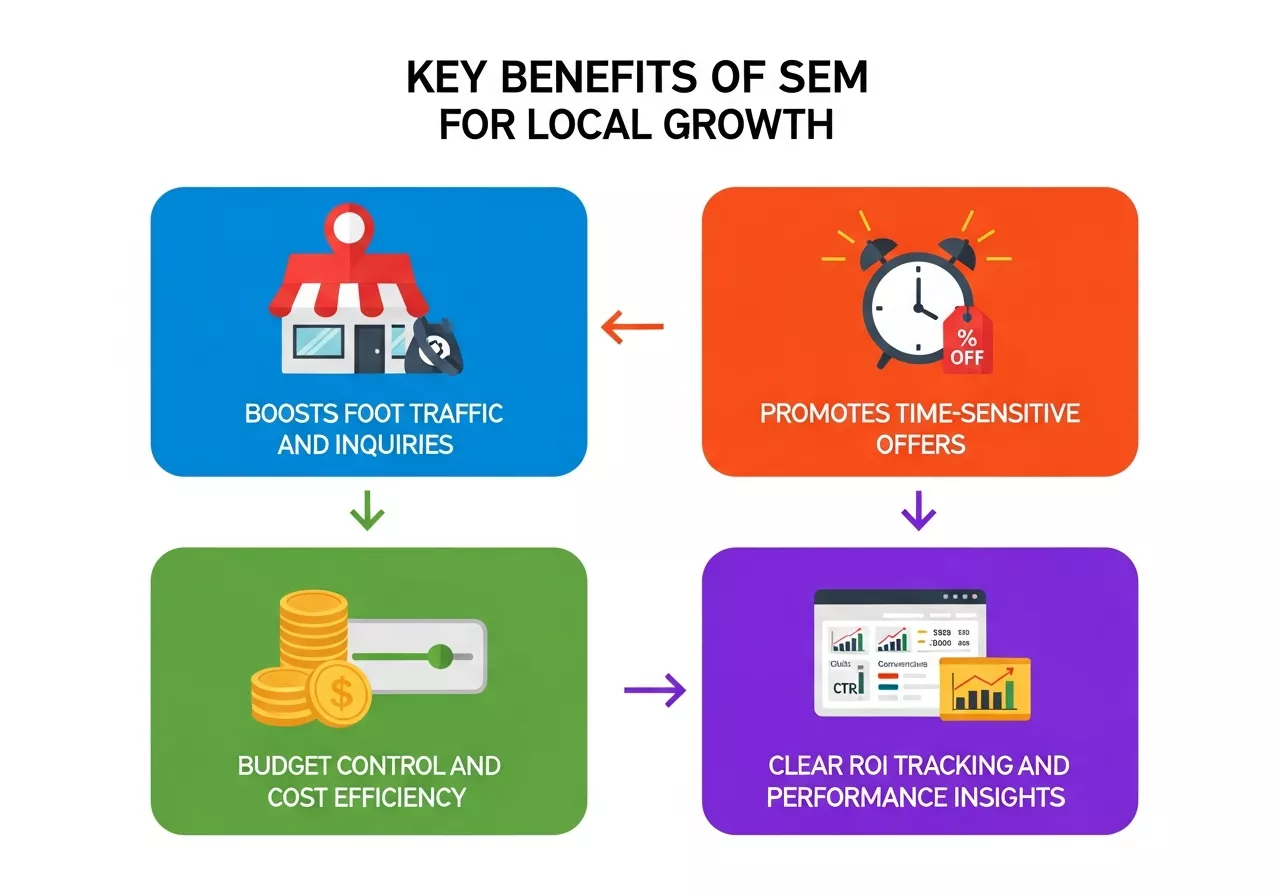
1. Boosts Foot Traffic and Inquiries
SEM doesn’t just generate online clicks—it drives real-world actions. With features like call extensions, location extensions, and “Get Directions” buttons, potential customers can instantly contact or visit your business.
For example, a customer searching for “coffee shop near me” can call your café, view your address, or navigate to your location directly from the ad. This frictionless experience significantly increases walk-ins, calls, and appointment bookings.
Why this matters:
- Captures high-intent local searches
- Converts online interest into offline visits
- Reduces steps between search and action
2. Promotes Time-Sensitive Offers
SEM is ideal for promoting limited-time deals and seasonal campaigns. Whether you’re running a weekend discount, holiday promotion, flash sale, or launching a new product, paid search lets you reach customers exactly when demand is highest.
You can start, pause, or modify campaigns instantly—making SEM far more flexible than traditional advertising.
Use SEM for:
- Weekend or holiday promotions
- Event-based campaigns
- New product or service launches
- Slow-season traffic boosts
3. Budget Control and Cost Efficiency
One of the biggest advantages of SEM for local businesses is complete budget control. You only pay when someone clicks your ad, and you can cap spending daily or monthly to stay within your limits.
Even small businesses with limited budgets can compete by focusing on high-intent, local keywords and narrowing geographic targeting. This same principle applies to Google Ads for Ecommerce, where businesses selling products online can carefully manage ad spend to target high-intent shoppers, ensuring every dollar drives measurable ROI.
Budget benefits include:
- Pay-per-click pricing (no wasted impressions)
- Daily and monthly spend limits
- Easy scaling as results improve
- Lower risk compared to traditional ads
4. Clear ROI Tracking and Performance Insights
SEM provides full visibility into campaign performance. You can track every interaction—from impressions and clicks to phone calls, form submissions, and conversions.
This real-time data allows businesses to quickly identify what’s working and optimize underperforming ads without waiting weeks or months.
Key metrics you can track:
- Click-through rate (CTR)
- Cost per click (CPC)
- Phone calls and direction requests
- Conversions and cost per lead (CPL)
Why These Benefits Matter for Local Businesses
Together, these benefits make SEM one of the fastest and most measurable growth channels for local businesses. It allows you to reach customers at the exact moment they’re ready to buy, control spending, and continuously improve performance based on real data.
For businesses that need speed, precision, and accountability, SEM is not just an option—it’s a strategic advantage.
Learn more about: The Importance of Search Engine Marketing for Your Brand
The Importance of Data in SEM for Local Businesses
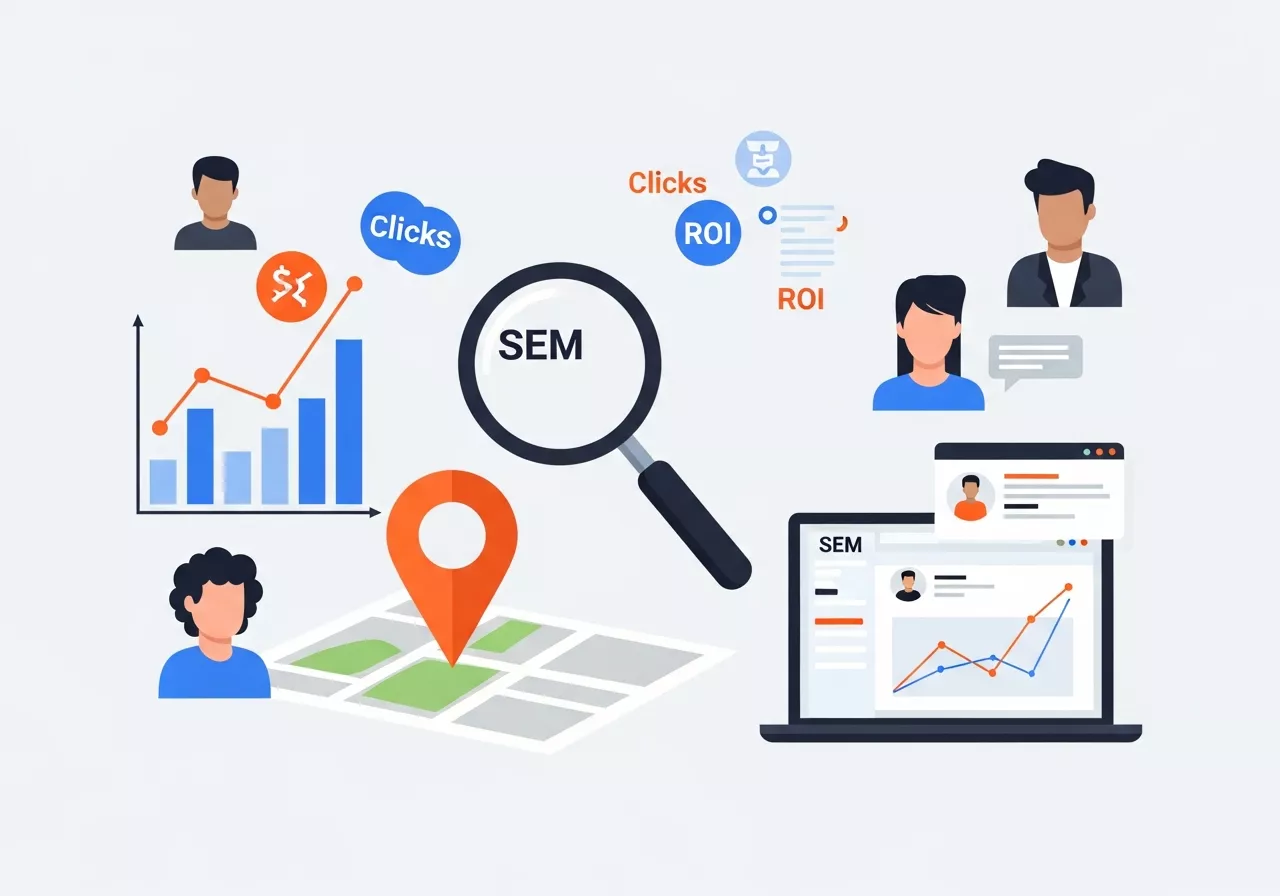
Data plays a critical role in the success of SEM campaigns, especially for local businesses. With the right data, you can create highly targeted, efficient campaigns that maximize return on investment (ROI). By using detailed customer data, local businesses can ensure they are spending their marketing budgets wisely and reaching the right audiences at the right time.
Key Types of Data to Leverage:
- Demographic Data: Age, gender, income level, and interests can be used to target specific customer segments effectively.
- Geo-Data: The location of your customers is paramount in local SEM. By using geo-targeting, you can adjust campaigns to target specific zip codes, neighborhoods, or even proximity to your business.
- Behavioral Data: Insights from customer searches, browsing behavior, and past interactions help refine the targeting and messaging of ads.
- Conversion Data: Tracking conversions (calls, form submissions, sales) enables you to gauge the success of your SEM campaigns and optimize accordingly.
- Device and Time Data: Understanding which devices your customers use (mobile, tablet, desktop) and the times of day they engage allows for better ad scheduling.
Best Data-Driven SEM Practices:
- Segment Campaigns by Audience Type: Use demographic and behavioral data to run personalized ad campaigns for different audience segments.
- Use Geo-Targeting to Create Localized Ads: By targeting specific locations, you can increase the relevance of your ads, ensuring they show up when a customer is nearby.
- Track and Analyze Performance: Continuously monitor your ad performance to identify which campaigns are working best and adjust your strategy based on conversion data.
Examples of Data Types to Enhance SEM Campaigns
| Data Type | Description | SEM Application |
|---|---|---|
| Demographic Data | Information about age, gender, and income levels. | Create personalized ads for specific segments (e.g., young professionals vs families). |
| Geo-Data | Location data (city, zip code, neighborhood). | Geo-target ads to people in a specific city, radius, or neighborhood. |
| Behavioral Data | Insights from users’ searches and browsing history. | Show ads based on past searches (e.g., “open now” or “near me”). |
| Conversion Data | Data on how many users converted from clicks to actions. | Adjust bidding strategies for keywords that generate the highest ROI. |
| Device & Time Data | Data on user devices and times of engagement. | Schedule ads for when most users are active on specific devices. |
Now that we know SEM is effective, the next step is learning how to run it efficiently. Poorly set-up campaigns can waste money fast, especially for local businesses with limited budgets. Following proven best practices ensures your ads reach high-intent users at the right moment.
Use Location Extensions
Add your address, phone number, and business hours to your ads. Location extensions make it easier for nearby customers to find and trust your business while improving ad visibility in local search results.
Why it matters:
- Increases click-through rates by providing immediate context
- Encourages walk-ins and direct calls
- Helps your ads appear in Google Maps and local pack results
Target the Right Keywords
Focus on keywords that include local and intent-driven terms such as:
- “Affordable plumber in [city]”
- “[City] bakery open now”
- “Emergency electrician near me”
Avoid generic, broad-match keywords that attract the wrong audience or drain your budget. Instead, use phrase match and exact match for better control.
Pro tip: Regularly review search term reports to identify irrelevant queries and add them as negative keywords.
Optimize Landing Pages for Local Intent
Your ads should send users to a mobile-friendly landing page with clear calls to action like “Call Now,” “Get Directions,” or “Book Appointment.”
Key elements of a high-performing local landing page include:
- Local headlines mentioning the city or neighborhood
- Click-to-call buttons for mobile users
- Trust signals such as reviews, ratings, and local testimonials
- Embedded Google Maps or location details
A strong local landing page improves both conversion rates and Quality Score, lowering your cost per click.
Leverage Ad Scheduling
Run ads during your business hours or peak customer times to maximize efficiency. For example, a café may want ads to show only from 7 AM to 2 PM, while a locksmith may prioritize late-night or emergency hours.
Benefits of ad scheduling:
- Prevents wasted spend during low-intent periods
- Aligns ads with staff availability
- Improves response times and customer experience
Use Geo-Targeting and Radius Targeting
Instead of targeting an entire city, narrow your reach using radius targeting around your physical location or service area. This ensures your ads appear only to users who are most likely to convert.
For service-based businesses, you can also adjust bids by location, increasing spend in high-performing neighborhoods.
Optimize for “Near Me” Searches
Many local searches include phrases like “near me” or “close by.” Make sure your campaigns and landing pages support these searches by:
- Keeping your Google Business Profile updated
- Including localized content on your website
- Using location extensions and call extensions
Monitor Performance and Optimize Continuously
Local SEM isn’t a “set it and forget it” strategy. Track key metrics such as:
- Click-through rate (CTR)
- Cost per conversion
- Call volume and direction requests
Use this data to refine keywords, adjust bids, test ad copy, and improve landing pages over time.
Local SEM vs. Local SEO: What’s the Difference?
Local SEM and Local SEO are both essential digital marketing strategies for growing a local business, but they serve different purposes and timelines. Understanding how they differ—and how they complement each other—can help you build a balanced and effective local growth strategy.

Local SEM: Fast Visibility and Immediate Results
Search Engine Marketing (SEM) focuses on paid search ads that appear at the top of search engine results pages. These ads deliver instant visibility and are ideal for businesses that need quick exposure.
When to Use SEM:
- Launching a new business or opening a new location
- Promoting seasonal offers, limited-time discounts, or events
- Generating leads quickly during slow periods
- Testing new services or markets before long-term investment
Key Advantages of Local SEM:
- Immediate placement at the top of search results
- Highly targeted by location, time, device, and intent
- Full budget control and measurable ROI
- Ideal for high-intent searches like “near me” or “open now”
However, SEM visibility lasts only as long as your ad budget does. Once spending stops, so does the traffic.
Local SEO: Long-Term Visibility and Brand Authority
Local SEO focuses on improving your organic search presence over time. This includes optimizing your website, Google Business Profile, local citations, and earning reviews.
When SEO Helps Most:
- Building long-term brand trust and credibility
- Ranking in Google’s local map pack and organic listings
- Reducing dependency on paid ads over time
- Establishing authority in your local market
Key Advantages of Local SEO:
- Sustainable, long-term traffic
- Stronger trust signals for customers
- Better visibility in map listings
- Lower cost per lead over time
SEO takes time—often months—but once established, it delivers consistent results without paying per click.
SEM and SEO Work Best Together
The most successful local businesses don’t choose between SEM and SEO—they combine both. SEM drives quick results and valuable data, while SEO builds a strong foundation for long-term growth.
How to Use Them Together:
- Use SEM to generate leads while SEO efforts mature
- Identify high-converting keywords from SEM and apply them to SEO
- Retarget organic visitors with paid SEM campaigns
- Gradually reduce ad spend as organic rankings improve
SEM vs. SEO Comparison Table
| Factor | Local SEM | Local SEO |
|---|---|---|
| Speed | Immediate results | Takes time (months) |
| Cost Model | Pay per click | No direct cost per click |
| Longevity | Stops when budget stops | Long-term visibility |
| Targeting Control | Highly precise | Limited control |
| Best For | Fast leads & promotions | Brand trust & organic growth |
| ROI Tracking | Highly measurable | Gradual, long-term ROI |
Real-World Example
A local gym in Dhaka wanted to boost memberships during the New Year season. By running a geo-targeted SEM campaign focusing on “New Year fitness Dhaka,” they reached users within a 5-km radius.
The result?
- 4,000 ad impressions in 10 days
- 320 clicks
- 75 phone inquiries
- 18 new memberships
The ad spend was only $150. That’s the kind of ROI that local SEM can deliver when managed properly.
Understanding the SEM Auction System
To run an effective SEM campaign, it’s important to understand how search engines like Google auction ads. This auction system determines which ads show up on search engine results pages (SERPs) and at what positions. The SEM auction is not a “first-come, first-served” system—rather, it’s driven by several factors that determine the ad’s visibility and cost.

How the SEM Auction Works:
- Keywords: Businesses bid on keywords that align with their target audience’s search intent. The higher the bid, the more likely your ad will appear.
- Ad Quality: Google considers how relevant and high-quality your ad is. If your ad copy is well-crafted and your landing page is optimized, you can achieve a high Ad Rank, even with a lower bid.
- Bid Amount: The more you’re willing to pay per click (CPC), the higher your ad’s position on the SERP. However, simply bidding higher doesn’t guarantee success.
- Ad Rank: A score calculated by Google based on your bid and the quality of your ad. It determines where your ad will appear on the page.
How to Improve Your Ad Rank:
- Use Relevant Keywords: Ensure your ad copy and keywords are highly relevant to the user’s search intent.
- Create Compelling Ads: Write clear, persuasive ad copy that directly addresses the user’s needs.
- Optimize Landing Pages: Ensure your landing pages load quickly, are mobile-friendly, and offer the information the user is looking for.
Table: Factors in the SEM Auction Process
| Factor | Description | Impact on SEM Campaign |
|---|---|---|
| Bid Amount | The amount you’re willing to pay for each click on your ad. | Higher bids can improve ad position but may be costlier. |
| Ad Quality | Google evaluates the relevance of your ad and landing page. | Higher quality ads (relevant, well-designed) can improve ranking, even with lower bids. |
| Keyword Relevance | Ensures your keywords match the user’s search intent. | Using the right keywords ensures your ad reaches the right audience. |
| Landing Page Experience | Google evaluates the landing page experience in terms of user-friendliness and relevance. | A well-optimized landing page leads to better conversion rates and improved Ad Rank. |
Mistakes to Avoid in Local SEM
Even though SEM is powerful, it can backfire if not done right.
Common Pitfalls:
- Using broad match keywords that waste budget
- Forgetting to exclude non-service areas
- Linking ads to the homepage instead of a relevant service page
- Not testing different ad versions (A/B testing)
Staying aware of these can help your SEM campaigns stay efficient and profitable.
How to Optimize Your SEM Budget for Local Business Growth
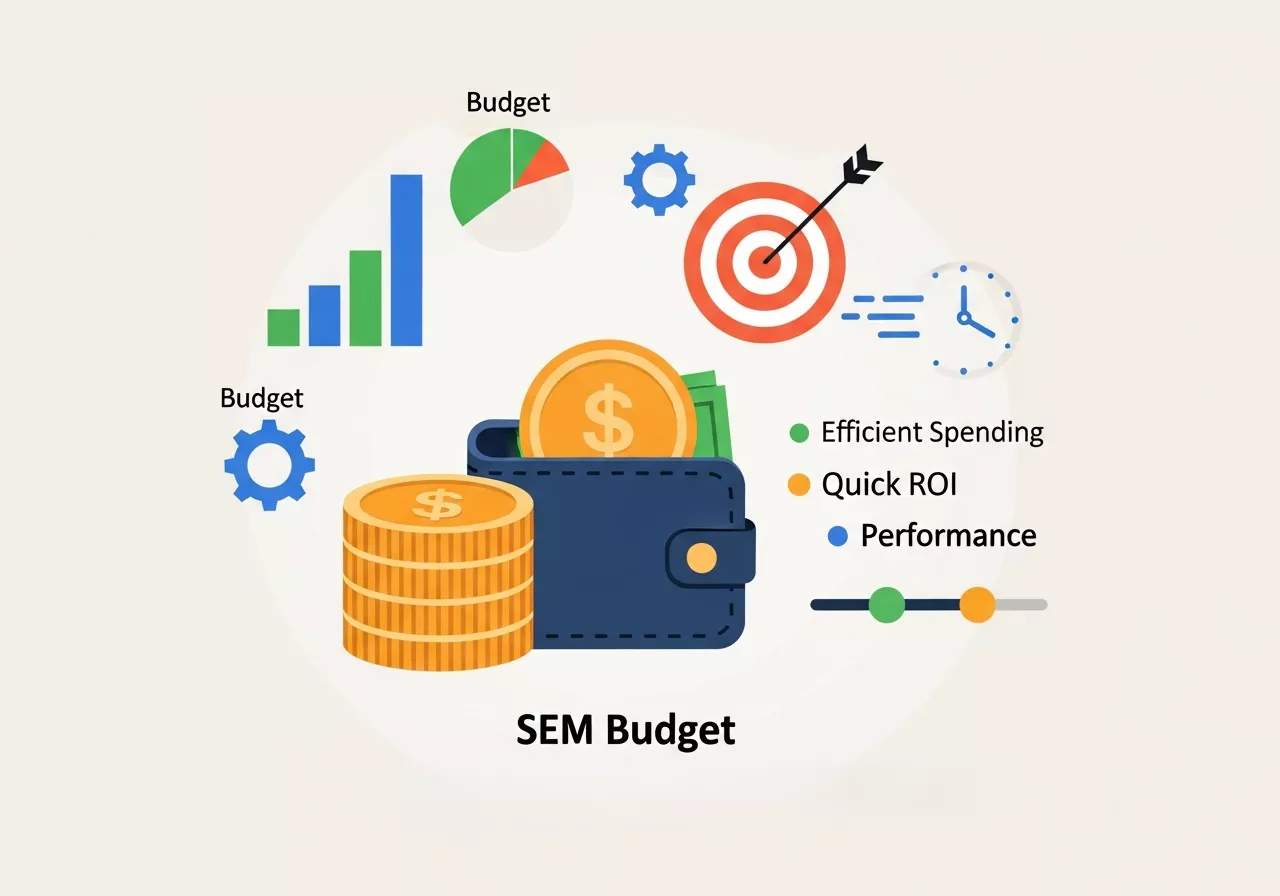
Effective budget management is one of the keys to successful SEM campaigns for local businesses. Because SEM operates on a pay-per-click (PPC) model, it’s important to ensure you’re getting the best possible return on your investment (ROI). Here are some strategies to maximize your SEM budget.
Budget Optimization Strategies:
- Focus on High-Intent Keywords: Prioritize keywords that indicate strong buying intent (e.g., “buy,” “near me,” “open now”).
- Limit Geographic Targeting: Focus your budget on a specific radius around your business location to ensure ads are reaching relevant, nearby customers.
- Utilize Ad Scheduling: Show ads only during peak business hours to avoid wasting ad spend when your customers are less likely to engage.
- Set Daily and Monthly Limits: To avoid overspending, set a daily or monthly cap on your ad spend, ensuring you stay within budget.
- Use Negative Keywords: Exclude irrelevant searches (e.g., “free” or “cheap”) to prevent your ads from showing up for non-converting users.
Maximizing Ad Spend:
- Start with a Small Budget: Test different ad strategies and keywords with a small budget to see what works best before scaling.
- Analyze and Adjust: Continuously monitor your campaigns and adjust bids based on performance. Focus more on ads that deliver high conversions and ROI.
Table: Budget Optimization Tips
| Strategy | Description | Benefit for Local Businesses |
|---|---|---|
| Focus on High-Intent Keywords | Prioritize keywords with buying intent like “near me” or “open now”. | Higher conversion rates and more relevant traffic. |
| Limit Geographic Targeting | Focus on a specific radius around your business location. | Ensures ad spend is only used for highly relevant users. |
| Use Ad Scheduling | Show ads only during peak business hours. | Prevents wasting ad spend during off-peak hours. |
| Set Daily/Monthly Limits | Control your ad spend by setting daily or monthly limits. | Helps you avoid overspending and ensures cost-efficiency. |
| Use Negative Keywords | Exclude irrelevant search terms that are not likely to convert. | Prevents irrelevant traffic and lowers the cost per click. |
Is SEM the Right Fit for Your Business?
If you’re still wondering, “Can SEM help with local business growth?” consider these questions:
- Do you want to reach people who are ready to buy now?
- Do you want to control your budget and track your ad performance?
- Are you looking for fast results, not just long-term growth?
If the answer is yes, then SEM is definitely worth the investment.
Even if you run a small operation, platforms like Google Ads can be adjusted to fit your needs. The key is to start small, monitor results, and scale as you learn.
Final Thoughts
SEM has changed the way local businesses connect with their communities. It’s no longer about just having a signboard or flyers. Today, being at the top of search results—exactly when your customers are looking—is how you win.
The real strength of SEM lies in its precision and speed. If you’re looking for a fast, measurable way to grow your local business, there’s no better place to start.
As the future of SEM continues to evolve with advancements in AI, automation, and user intent analysis, local businesses will have even more powerful tools at their disposal. From smarter bidding strategies to predictive targeting, staying ahead of these changes will help you remain competitive in your market.
Frequently Asked Questions (FAQ) About SEM for Local Businesses
1. What is SEM, and how is it different from SEO?
SEM (Search Engine Marketing) is paid advertising that helps businesses appear at the top of search engine results immediately. SEO (Search Engine Optimization) focuses on improving organic rankings over time. SEM gives instant visibility, while SEO builds long-term authority.
2. How much does SEM cost for a local business?
SEM uses a pay-per-click (PPC) model, meaning you only pay when someone clicks your ad. Costs vary based on keywords, competition, and geographic targeting. Small businesses can start with modest budgets and scale campaigns based on ROI.
3. Can SEM work for small businesses with limited budgets?
Yes. By targeting high-intent local keywords, setting geographic limits, and scheduling ads during peak hours, even small budgets can generate meaningful leads and foot traffic.
4. How do I know if my SEM campaign is successful?
Measure performance through key metrics:
- Click-through rate (CTR)
- Cost per click (CPC)
- Phone calls and direction requests
- Conversions and cost per lead (CPL)
Regular monitoring allows continuous optimization for better ROI.
5. How is local SEM different from national or global SEM campaigns?
Local SEM targets a specific area, like a city, neighborhood, or radius around your business. Ads are tailored to local search intent, such as “near me” or “[city] services,” ensuring highly relevant traffic.
6. How can SEM complement my SEO efforts?
SEM provides quick results while SEO grows organic visibility over time. Insights from SEM campaigns can inform SEO keyword strategy. Together, they maximize traffic, conversions, and brand awareness.
7. What mistakes should I avoid in local SEM?
- Using broad match keywords that attract irrelevant clicks
- Linking ads to generic homepage instead of relevant landing pages
- Ignoring negative keywords to filter non-target users
- Not monitoring or testing ad performance
Avoiding these ensures efficient budget use and better results.
8. How quickly can I see results with SEM?
Unlike SEO, SEM can deliver traffic and leads immediately after campaigns go live. The speed of results depends on budget, ad quality, targeting, and competition.
9. Do I need professional help to run SEM campaigns?
While platforms like Google Ads are user-friendly, professional help can improve targeting, ad copy, and ROI. Small businesses can start on their own, monitor results, and scale campaigns with experience or expert guidance.
10. What makes SEM particularly effective for local businesses?
SEM targets customers at the exact moment they’re searching with high intent, allows precise geographic targeting, tracks measurable ROI, and drives foot traffic and inquiries instantly.
Learn more about: What’s the ROI of SEM Campaigns?



Leave a Reply