

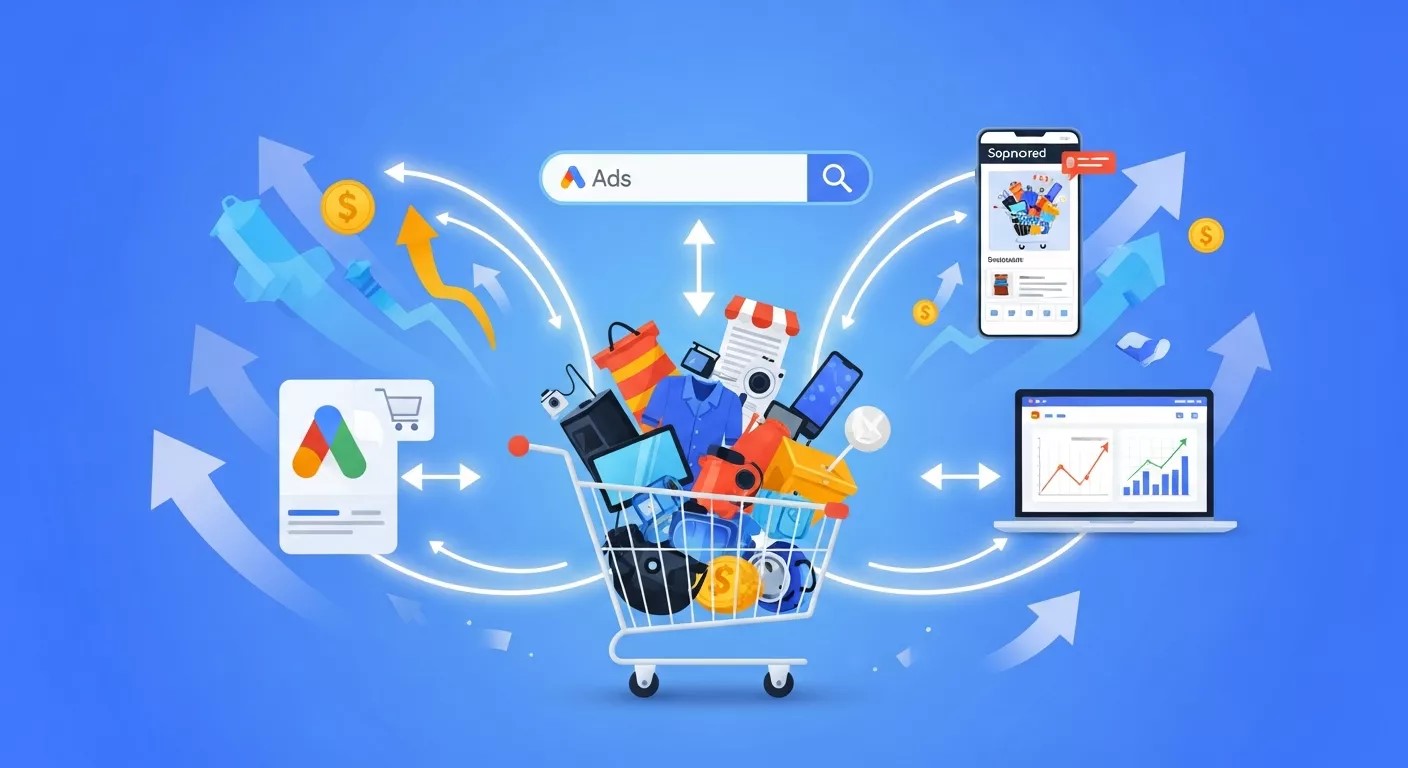
Turning High-Intent Searches into Sales with Google Ads for Ecommerce
The ecommerce landscape has evolved rapidly, and today’s online shoppers are smarter, faster, and more intent-driven than ever before. They don’t browse aimlessly they search with purpose. This is exactly why Google Ads for Ecommerce has become one of the most powerful growth engines for online stores looking to drive consistent, scalable sales.
Unlike traditional digital advertising, Google Ads allows ecommerce brands to meet customers at the exact moment they are searching for a product. When combined with Product Listing Ads (PLAs), this intent-based visibility can transform casual searches into high-value conversions.
In this in-depth guide, we’ll explore how ecommerce businesses can strategically use Google Ads for Ecommerce to drive sales, optimize product visibility, and build a sustainable paid acquisition system that aligns with modern consumer psychology.
Understanding the Role of Google Ads in Modern Ecommerce
Ecommerce marketing is no longer about shouting the loudest it’s about showing up at the right time with the right offer. Google Ads for Ecommerce works because it captures demand rather than creating it from scratch.
When users search for products on Google, they’re often in a decision-making mindset. This is where ecommerce advertising differs from social media or display campaigns. Instead of interrupting users, Google Ads for Ecommerce aligns directly with user intent, making it one of the highest-ROI paid channels for online stores.
What makes this approach especially effective today is how seamlessly ads integrate into the shopping journey. Product images, prices, reviews, and availability appear before users even click—filtering out low-intent traffic and attracting buyers who are ready to act.
Why Product Listing Ads Matter More Than Ever

Product Listing Ads (also known as Google Shopping Ads) have redefined how ecommerce brands compete in search results. Instead of relying solely on text, these ads showcase products visually, creating instant trust and clarity.
PLAs work exceptionally well within Google Ads for Ecommerce because they remove friction from the buying process. Shoppers can compare products, prices, and brands directly from the search results page. This transparency might seem risky, but in reality, it rewards businesses that focus on quality, relevance, and competitive pricing.
From a psychological perspective, visual confirmation reduces uncertainty. Seeing the product image, brand name, and price upfront helps users validate their choice faster—leading to higher click-through and conversion rates.
How Google Ads for Ecommerce Aligns with Buyer Intent
To truly drive sales, ecommerce advertising must align with how users think and behave online. Google Ads for Ecommerce excels here because it operates on intent signals rather than assumptions.
When someone searches for “buy running shoes online” or “wireless earbuds under $100,” they are already deep into the consideration or purchase stage. Unlike awareness-based ads, these queries signal readiness. Product Listing Ads amplify this by immediately presenting relevant options without requiring users to dig through multiple pages.
This intent alignment is what separates profitable ecommerce campaigns from wasted ad spend. The goal isn’t more traffic—it’s more qualified traffic.
The Strategic Foundation Behind High Performing Ecommerce Ads

Before launching any campaign, it’s essential to understand that Google Ads for Ecommerce is not just about ads it’s about structure, data, and optimization.
At its core, a successful ecommerce advertising strategy is built on:
-
Clean and accurate product data
-
Well-structured campaigns and ad groups
-
Smart bidding aligned with business goals
-
Continuous performance analysis
Many ecommerce stores fail not because Google Ads doesn’t work, but because they treat it as a one-time setup instead of an evolving system.
The Importance of Product Feed Optimization
Your product feed is the backbone of Product Listing Ads. Without a well-optimized feed, even the best bidding strategy will struggle to deliver results.
Within Google Ads for Ecommerce, product feeds act as the bridge between your store and Google’s algorithm. Titles, descriptions, categories, and attributes all influence when and how your products appear.
An optimized feed focuses on clarity rather than creativity. Including relevant keywords naturally, maintaining accurate pricing, and ensuring consistent availability signals trust to both Google and users.
This is where ecommerce brands often overlook a crucial factor: Google doesn’t guess—it matches. The more precise your product data, the better Google can match your products with high-intent searches.
Campaign Structure That Scales with Growth
One of the most underrated aspects of Google Ads for Ecommerce is campaign structure. Poor structure leads to wasted budget, while smart segmentation unlocks scalability.
Instead of grouping all products together, high-performing ecommerce accounts segment campaigns based on product categories, profit margins, or performance tiers. This allows better control over bids, budgets, and optimization priorities.
As your store grows, this structure becomes even more important. Scaling doesn’t mean increasing spend blindly it means allocating budget toward products that consistently deliver value.
Smart Bidding and Automation in Ecommerce Advertising
Modern ecommerce advertising relies heavily on automation, and Google Ads for Ecommerce offers advanced bidding strategies that leverage machine learning.
Smart bidding strategies analyze thousands of signals in real time, including device type, location, time of day, and user behavior. This allows bids to adjust dynamically based on the likelihood of conversion.
However, automation works best when guided by clean data. Conversion tracking, revenue accuracy, and audience signals all play a role in helping Google’s algorithm make better decisions.
When used correctly, automation doesn’t replace strategy it enhances it.
Where Product Listing Ads Fit Within Search Engine Marketing
While ecommerce brands often focus on individual campaigns, it’s important to understand how Product Listing Ads operate within the broader ecosystem of Search Engine Marketing (SEM).
SEM encompasses all paid search activities designed to increase visibility and drive action. Product Listing Ads represent the most commerce-focused component of this ecosystem, prioritizing transactional queries over informational ones.
By integrating PLAs into a wider SEM strategy, ecommerce brands can dominate multiple touchpoints—text ads for brand protection, shopping ads for product discovery, and remarketing for conversion recovery.
Understanding Cost Control in Ecommerce PPC
One of the biggest concerns for online stores is cost efficiency. Google Ads for Ecommerce addresses this challenge through performance-based bidding models, making CPC Advertising for E-commerce a controllable and measurable growth channel.
Instead of paying for impressions, advertisers pay when users click—ensuring that budgets are spent on active interest rather than passive exposure. Over time, performance data helps refine bids, eliminate waste, and improve return on ad spend.
This data-driven feedback loop is what allows ecommerce brands to scale profitably without losing control of acquisition costs.
Audience Signals and Remarketing for Ecommerce Growth

Not every visitor converts on the first visit. Google Ads for Ecommerce allows brands to reconnect with users who have already shown interest through remarketing strategies.
By using audience signals—such as product viewers, cart abandoners, or past purchasers—advertisers can tailor bids and messaging to users who are more likely to convert.
This approach aligns perfectly with modern consumer behavior, where multiple touchpoints are often required before a purchase decision is made.
Cross-Platform Thinking in Ecommerce Advertising
Today’s consumers don’t interact with brands on a single channel. They move between search, social, video, and email seamlessly. This is where Cross Channel SEM becomes a strategic advantage for ecommerce brands using Google Ads for Ecommerce.
Rather than treating paid search as an isolated tactic, advanced marketers integrate it with other acquisition channels. Search captures intent, social builds awareness, and remarketing bridges the gap between interest and action.
This interconnected approach reflects real user behavior and creates a more consistent brand experience across platforms.
Leveraging Data to Continuously Improve Performance
The true power of Google Ads for Ecommerce lies in its data. Every impression, click, and conversion provides insights into user behavior.
By analyzing performance metrics such as click-through rate, conversion value, and return on ad spend, ecommerce brands can identify patterns that inform smarter decisions. Which products convert best? Which search terms drive the highest value? Where does budget deliver the strongest return?
This continuous learning process turns advertising from an expense into an investment.
The Psychological Impact of Visual Search Results
Product Listing Ads tap into a fundamental aspect of human psychology: Visual Search decision-making. People process images faster than text, and Google Ads for Ecommerce leverages this by placing product visuals front and center.
When users see products alongside prices and reviews, they subconsciously assess value, trust, and relevance within seconds. This accelerates decision-making and reduces hesitation.
For ecommerce brands, this means less convincing and more facilitating—making it easier for users to choose.
Building Long-Term Growth with Google Ads for Ecommerce
Sustainable ecommerce growth doesn’t come from short-term tactics. It comes from systems that evolve with data, behavior, and market trends.
Google Ads for Ecommerce provides the framework for such systems. With the right structure, optimized feeds, smart bidding, and audience insights, ecommerce brands can build a predictable sales engine that adapts to change.
Rather than chasing every new platform, many successful online stores focus on mastering intent-based advertising—because demand-driven traffic remains one of the most reliable paths to revenue.
Why Ecommerce Brands Continue to Invest in Google Ads
As competition increases, standing out becomes harder but intent remains constant. People will always search for products they want to buy. Google Ads for Ecommerce capitalizes on this timeless behavior while evolving with technology and automation.
For ecommerce brands willing to invest in optimization and learning, this channel offers unmatched visibility, scalability, and performance transparency.
It’s not just about ads it’s about understanding how people search, decide, and buy in the digital age.
How Consumer Psychology Shapes Product Listing Ad Performance
Modern ecommerce buyers don’t just compare prices they compare confidence. When users see Product Listing Ads in search results, their brains instantly evaluate trust signals such as images, pricing clarity, brand familiarity, and perceived value. This split-second judgment heavily influences click behavior.
Google Ads for Ecommerce works effectively here because it aligns with how people naturally shop online. Visual cues reduce cognitive load, meaning users don’t need to imagine the product—they can see it. This shortens the decision cycle and increases the likelihood of action, especially for repeat or comparison-based purchases.
Understanding this psychological layer allows ecommerce brands to optimize beyond keywords and bids. Clean product images, accurate pricing, and consistent branding subtly reinforce credibility, which directly impacts conversion rates over time.
The Role of Data Signals in Scaling Ecommerce Sales
Scaling ecommerce campaigns isn’t about spending more it’s about spending smarter. Google Ads for Ecommerce relies on a constant stream of data signals to determine when, where, and how ads appear. These signals include search behavior, device usage, location, and historical performance.
As more data flows into the system, campaigns become more efficient. High-performing products gain more visibility, while low-converting queries are gradually filtered out. This creates a self-optimizing loop that improves efficiency without manual intervention at every step.
For ecommerce brands, this means long-term growth becomes predictable. Instead of reacting to performance drops, advertisers can proactively scale what works, guided by real-time insights rather than assumptions.
Why Product Listing Ads Support Long-Term Brand Trust

While Product Listing Ads are often viewed as performance-driven tools, they also contribute to brand perception. Repeated visibility in relevant searches builds familiarity, even when users don’t click immediately.
Over time, consistent presence through Google Ads for Ecommerce positions a brand as a reliable option within its category. When customers repeatedly see the same products with stable pricing and clear presentation, trust builds subconsciously.
This trust pays off later in the buyer journey. Users are more likely to click, compare less aggressively, and convert faster when they recognize a brand they’ve seen before. In competitive ecommerce markets, this silent trust advantage can be just as valuable as direct conversions.
Conclusion
In an increasingly competitive digital marketplace, ecommerce success depends on visibility, relevance, and timing. By leveraging intent-driven search behavior and visual Product Listing Ads, Google Ads for Ecommerce enables online stores to connect with ready-to-buy customers, optimize performance through data, and build a scalable, sustainable sales engine aligned with modern consumer behavior.
Frequently Asked Questions (FAQ)
What is Google Ads for Ecommerce and how does it work?
Google Ads for Ecommerce allows online stores to promote products directly in search results when users actively look for them. It works by matching product data with high-intent searches to drive relevant traffic.
Are Product Listing Ads suitable for small ecommerce businesses?
Yes, Product Listing Ads can be effective for small stores because they target users who are already searching to buy. With proper setup and optimization, even limited budgets can generate meaningful results.
How does Google Ads for Ecommerce help increase sales?
By showing products at the exact moment customers are searching, Google Ads for Ecommerce reduces friction in the buying journey and attracts ready-to-purchase users, leading to higher conversion potential.
Do Product Listing Ads require technical expertise to manage?
Basic setup is manageable, but ongoing performance improvement requires understanding product feeds, bidding strategies, and data signals. Over time, optimization becomes more data-driven and systematic.
How long does it take to see results from Google Ads for Ecommerce?
Initial visibility can happen quickly, but consistent sales growth usually develops over time as campaigns collect data, learn user behavior, and improve targeting efficiency.



Leave a Reply