

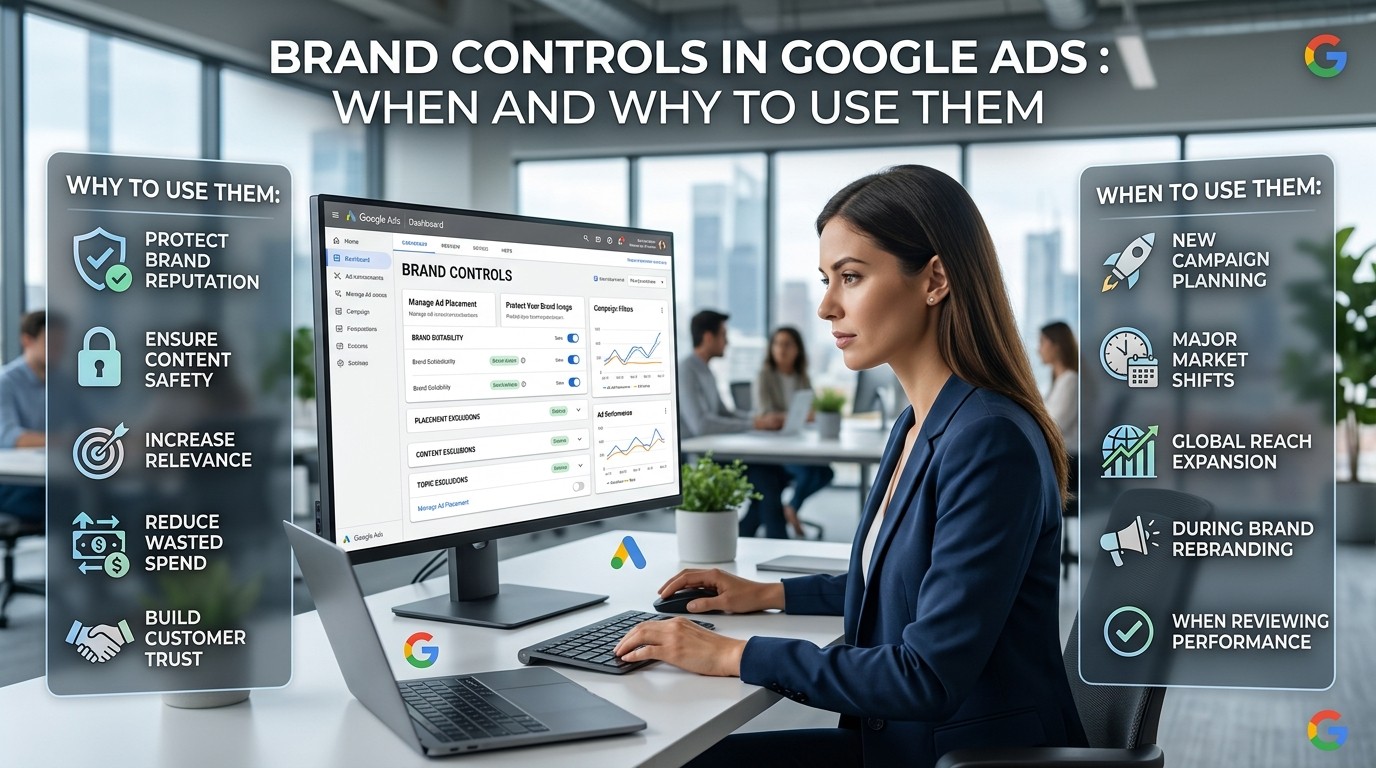
Brand controls help advertisers shape branded search traffic, protect campaign intent, reduce wasted overlap, improve budget efficiency, and create cleaner performance insights across modern Google Ads campaigns.
Paid search has evolved far beyond manually selecting keywords and writing a few advertisements. Modern Google Ads campaigns increasingly rely on automation, machine learning, broad matching, and increasingly sophisticated campaign controls. With that shift, advertisers need ways to tell the system where it should explore and where it should stop. This is where Brand Controls in Google Ads become strategically important.
Brand-related traffic is often different from generic search traffic. Someone searching for “running shoes” is exploring a category, while someone searching for a specific company name may already know exactly what they want. That difference can affect conversion probability, cost efficiency, incrementality, attribution, and budget allocation. Brand Controls in Google Ads provide advertisers with a way to manage those differences instead of allowing every campaign to compete equally for the same branded demand.
The modern challenge is not simply getting more traffic. The challenge is getting the right traffic into the right campaign at the right stage of the customer journey. Brand Controls in Google Ads can help establish those boundaries when an account has separate branded, generic, competitor, Shopping, or Performance Max objectives.
At the same time, more control is not automatically better. Google warns that brand settings can restrict traffic, which means unnecessary restrictions can reduce reach and potentially reduce conversions.
The smartest advertisers therefore treat Brand Controls in Google Ads as strategic guardrails rather than universal optimization switches.
This guide explains what brand inclusions and exclusions do, when to use each one, how they interact with Search and Performance Max, how they affect reporting and budget allocation, which mistakes can reduce performance, and how to build a practical decision framework around them.
What Are Brand Controls in Google Ads?
Brand Controls in Google Ads are campaign settings that allow advertisers to influence whether campaigns can serve on searches associated with specified brands.
Google currently provides two major types of brand settings: brand inclusions and brand exclusions. Brand inclusions can be used with Search campaigns, while brand exclusions can be used with Search and Performance Max campaigns.
A brand inclusion tells a Search campaign to serve only on queries associated with selected brands. This can be particularly useful when the advertiser wants to create a campaign dedicated to branded demand.
A brand exclusion does the opposite. It prevents campaigns from serving on searches associated with selected brands. This is particularly useful when an advertiser wants a campaign to focus more heavily on generic or incremental demand.
Brand Controls in Google Ads therefore create a mechanism for traffic steering.
Instead of asking only, “What keywords can this campaign target?” the advertiser can ask a more strategic question:
“What type of brand-related demand should this campaign own?”
That shift is important because modern advertising accounts often contain several campaigns that can potentially reach similar customers.
Why the Entity-Level Approach Matters
Traditional keyword management operates around words and phrases.
Brand controls operate around recognized brands.
Google explains that brand lists are intended to help advertisers manage brand-related queries, including variations and common misspellings.
This means Brand Controls in Google Ads can sometimes simplify a problem that would otherwise require a long list of individual keyword exclusions or additions.
For large companies with multiple products, subsidiaries, abbreviations, alternate spellings, and international brand variants, entity-level brand management can be significantly easier to maintain.
Why Brand Traffic Needs Different Treatment
Brand searches usually carry a different psychological signal from generic searches.
Consider these queries:
“best project management software”
“project management software for teams”
“Acme project management software”
“Acme login”
The last two queries contain stronger brand intent, but even they may represent different customer motivations.
One person may be evaluating the product for the first time.
Another may already be a customer.
Another may be looking for support.
Another may be comparing the brand with competitors.
Another may have heard the company name offline.
Brand Controls in Google Ads become useful because brand intent is not simply another keyword category. It can represent a different economic relationship with the customer.
The Psychology Behind Branded Searches

People generally experience less uncertainty when they already recognize a brand.
A known company name can provide:
Familiarity
Credibility
Reduced perceived risk
Expectation of a consistent experience
Existing awareness
Stronger purchase confidence
That is why brand traffic frequently performs differently from generic traffic.
A user searching for a known company may convert at a different rate from someone who discovers the company for the first time through a generic search.
Brand Controls in Google Ads help advertisers separate these types of demand when that separation improves strategic decision-making.
Existing Demand vs. Incremental Demand
This distinction is critical.
Existing demand refers to customers who are already aware of the company and are actively searching for it.
Incremental demand refers more broadly to demand that the advertising campaign helps capture or create beyond users who were already looking specifically for the brand.
For acquisition-focused campaigns, an advertiser may want to minimize spending on demand that would likely occur anyway.
That is one of the strongest strategic reasons to evaluate Brand Controls in Google Ads.
Brand Inclusions Explained
Brand inclusions are primarily useful when an advertiser wants a Search campaign focused on branded demand.
Instead of relying only on lists of brand keywords, a brand inclusion can define the branded territory that a campaign is allowed to enter.
Google states that brand inclusions can be used for Search campaigns and can work with broad match.
That creates an interesting combination:
The advertiser defines the brand boundary.
The system identifies relevant brand variations within that boundary.
This approach can be more scalable than manually maintaining every spelling and variation.
Brand Controls in Google Ads therefore provide a balance between control and automation.
When Brand Inclusions Make Sense
Brand inclusions may be useful for:
Dedicated brand-defense campaigns
Branded promotional campaigns
Brand-specific product campaigns
Separate brand measurement
Campaigns intentionally designed to capture existing brand demand
Search campaigns where the advertiser wants broader matching but only within a specific brand environment
For example, an established retailer could create a dedicated branded Search campaign using its own brand inclusion while allowing generic campaigns to focus on category demand.
Brand Exclusions Explained
Brand exclusions are designed to prevent campaign traffic from coming from selected brand searches.
For example, an advertiser may exclude its own brand from a generic acquisition campaign so that campaign performance reflects more non-brand demand.
Similarly, a Performance Max campaign might exclude an advertiser’s own brand when a dedicated brand campaign is already responsible for that traffic.
Google describes brand exclusions as a way to prevent ads from appearing on searches for selected brands and relevant variants.
Brand Controls in Google Ads become particularly useful in these cases because manually trying to account for every spelling or variation can be difficult.
When Brand Exclusions Make Sense
Consider exclusions when:
A generic campaign should focus on category demand.
A dedicated campaign already owns branded demand.
Performance Max is capturing too much existing brand traffic.
Competitor brand traffic is strategically undesirable.
Budget needs to shift toward incremental acquisition.
Campaign-level reporting is being distorted by large volumes of branded demand.
The Citation Secret is not relevant to paid search, but the underlying principle of controlling signal quality is similar: the objective is not maximum volume; it is useful, interpretable activity.
Brand Exclusions in Performance Max
Performance Max makes brand controls especially interesting because the campaign relies heavily on Google’s automation.
Performance Max can access multiple inventory surfaces, including Search and Shopping.
When an advertiser wants Performance Max to focus more heavily on non-brand acquisition, Brand Controls in Google Ads can be used to exclude selected brands from relevant search behavior.
Google states that Performance Max brand exclusions can apply to Search and Shopping inventory, with additional Shopping configuration options depending on advertiser settings.
This provides advertisers with a practical way to shape automation.
Instead of trying to control every search manually, the advertiser can define broader boundaries around brand demand.
That is a core reason Brand Controls in Google Ads have become increasingly relevant as campaign automation has expanded.
Brand Controls and Campaign Architecture
The best use of Brand Controls in Google Ads begins with campaign architecture.
Before creating a restriction, determine what each campaign is supposed to do.
A clean account might contain:
Brand Search
Generic Search
Competitor Search
Performance Max
Shopping-focused campaigns
Each campaign should have a clear role.
The Brand Search campaign captures existing branded demand.
The Generic Search campaign captures broader category and problem-based demand.
The Competitor Search campaign handles deliberate competitor strategy.
Performance Max handles broader automated discovery.
When campaign roles are clearly defined, Brand Controls in Google Ads can reinforce the structure.
When campaign roles are unclear, brand restrictions can make the account harder to understand.
Brand Controls vs. Negative Keywords
Brand controls and negative keywords solve different problems.
Negative keywords are specific terms or concepts that advertisers want to block.
Brand controls focus on recognized brands.
For example, an advertiser might use negative keywords to exclude:
free
jobs
careers
support
manual
template
A brand exclusion, on the other hand, can be used to block traffic associated with a specific company or brand.
Google explains that brand lists can reduce the need to manually enter many variations and misspellings of a brand.
Brand Controls in Google Ads therefore complement negative keywords rather than replacing them.
A strong account can use both.
When to Use Brand Inclusions
There are several situations where Brand Controls in Google Ads are particularly useful through brand inclusions.
Dedicated Brand Search
If the business has meaningful branded demand, a dedicated campaign can isolate it.
This can make reporting easier and provide clearer visibility into how much demand comes from people who already know the company.
Brand Defense
Competitors may bid on searches containing an advertiser’s brand.
In such environments, a dedicated brand campaign can provide greater control over messaging and brand presence.
Brand Promotion
When a brand launches a promotion, seasonal offer, or limited-time event, keeping campaign traffic focused on brand-related searches can make the campaign structure cleaner.
Branded Broad Match
Google’s documentation indicates that brand inclusions can work with broad match.
This can help advertisers capture brand-related variations without manually identifying every phrase.
Brand Controls in Google Ads become especially useful here because they allow broader matching inside a defined brand boundary.
When to Use Brand Exclusions
Generic Acquisition
A campaign intended to find people who do not already know the brand may benefit from excluding own-brand searches.
Performance Max Separation
When a dedicated Brand Search campaign already manages brand traffic, excluding the brand from Performance Max may create clearer campaign ownership.
Competitor Restrictions
Some brands may not want their campaigns appearing alongside selected competitor searches.
Cleaner Measurement
If the advertiser wants a more accurate view of non-brand acquisition, removing branded traffic may improve analytical clarity.
Brand Controls in Google Ads should therefore be connected to a measurable objective each time an exclusion is introduced.
The Biggest Risk: Over-Restricting Traffic
The biggest mistake is assuming that more control always means better performance.
Google explicitly warns that brand settings can restrict traffic and that restrictions may reduce performance or conversion opportunities.
Suppose a campaign receives a few irrelevant branded searches.
An advertiser might react by excluding an entire brand category.
That could remove many valuable queries along with the unwanted ones.
Brand Controls in Google Ads should therefore be applied only when the expected benefit of restriction outweighs the value of the traffic being removed.
Use the Smallest Useful Restriction
A good principle is:
Restrict only what you understand.
Before excluding a brand, identify:
How much traffic it contributes
How many conversions it generates
What kind of users it represents
Which campaign should own that traffic
Whether the traffic is incremental
Whether the alternative campaign can capture it
This prevents accidental over-filtering.
The Economics of Brand Traffic
Brand traffic can have excellent performance metrics.
It may have:
Higher conversion rates
Lower acquisition costs
Higher click-through rates
Higher conversion values
Stronger customer familiarity
But high performance does not automatically mean the traffic should remain in every campaign.
A campaign can have a fantastic return from branded searches and still fail as an acquisition campaign if most conversions come from users who already intended to purchase.
This is where Brand Controls in Google Ads can improve the distinction between efficiency and incrementality.
Incrementality vs. Efficiency
Efficiency asks:
“How cheaply did we generate the conversion?”
Incrementality asks:
“How many conversions did advertising actually create or influence that would not otherwise have happened?”
Brand traffic can be highly efficient while producing lower incremental value.
That is why campaign structure matters.
A brand campaign can optimize for capturing valuable existing demand.
A generic campaign can optimize for acquiring new demand.
Brand Controls in Google Ads can help keep those economic roles separate.
Brand Controls and Search Terms Reports
Search query analysis remains one of the best ways to understand how brand traffic behaves.
Search Terms Reports can reveal:
Unexpected brand combinations
Misspellings
Brand-plus-service queries
Brand-plus-location queries
Competitor references
Customer terminology
Low-value intent
High-value emerging demand
Search-term analysis can therefore help advertisers decide whether a brand control is actually necessary.
For example, a marketer may assume that a campaign contains mostly branded demand, only to discover that branded searches account for a small percentage of total traffic.
In that situation, adding a broad exclusion may solve a small problem while creating a larger one.
Brand Controls in Google Ads should follow observed behavior rather than assumptions.
Brand Controls and AI Max
Google’s current Search direction makes brand management increasingly relevant.
Google documentation indicates that brand inclusions and exclusions have been incorporated into newer AI Max settings experiences, with brand settings becoming part of the broader system of campaign-level and ad-group-level controls.
This is important because advertisers are moving into a more automated environment.
Rather than manually defining every possible query, marketers increasingly define boundaries and strategic priorities while Google’s systems determine matching and optimization within those boundaries.
Brand Controls in Google Ads fit naturally into that model.
The advertiser decides where the campaign should or should not compete.
Automation handles more of the details.
Ad-Group-Level Brand Inclusions
Google also supports brand inclusion behavior at the ad-group level within applicable Search configurations. Google notes that an ad-group-level brand inclusion can override the campaign-level inclusion for that specific ad group.
This can be useful for sophisticated account structures.
However, excessive complexity creates operational risk.
If every ad group has a different brand rule, analysts may struggle to understand why campaigns behave differently.
Brand Controls in Google Ads should therefore be as simple as possible while still solving the underlying business problem.
Brand Lists
Google allows advertisers to create brand lists and apply them to appropriate campaigns.
Brand lists can create reusable logic.
For example:
Brand List A: Own brands
Brand List B: Subsidiary brands
Brand List C: Competitor brands
Brand List D: Restricted brands
This structure can help larger businesses maintain consistent policies across campaigns.
Brand Controls in Google Ads become more scalable when the advertiser treats brand lists as strategic assets rather than rebuilding brand rules repeatedly.
How Brand Lists Should Be Structured
A good brand list should have a clear purpose.
Avoid creating dozens of lists that differ by one minor variation unless there is a legitimate campaign requirement.
A practical naming system can make governance easier.
For example:
OWN_BRANDS_PRIMARY
OWN_BRANDS_SUBSIDIARIES
COMPETITORS_CORE
COMPETITORS_SECONDARY
EXCLUSIONS_GENERIC_ACQ
Such naming makes it easier for another marketer or agency team member to understand why the list exists.
Brand Controls in Google Ads are much easier to manage when their logic is transparent.
Brand Controls for Established Companies
Established businesses generally have stronger branded search volume.
That makes separation more valuable.
A large company may have:
High branded demand
Strong organic visibility
Multiple products
Multiple domains
Multiple campaigns
Several regions
Multiple subsidiaries
Competitor targeting
Performance Max
Shopping campaigns
The risk of traffic overlap grows as account complexity increases.
Brand Controls in Google Ads can help create clear boundaries between those moving parts.
A mature advertiser may decide that:
Brand Search owns the core brand.
Generic Search owns category demand.
Competitor campaigns own competitor traffic.
Performance Max excludes selected brands.
Shopping receives different treatment based on product economics.
This is not the only possible architecture, but it illustrates how controls can support strategic ownership.
Brand Controls for Small Businesses
Small businesses should usually avoid unnecessary complexity.
If a company receives only a handful of branded searches each month, creating elaborate brand lists may provide little value.
A new business may gain more from:
High-intent keywords
Effective landing pages
Location targeting
Conversion tracking
Strong ad messaging
Negative keyword management
Relevant offers
Once branded demand becomes meaningful, Brand Controls in Google Ads can be introduced where they provide measurable benefit.
For businesses that rely heavily on local demand, the paid-search ecosystem also intersects with broader trust signals. A complementary discipline such as Local SEO And Reputation Mastery can influence how users behave after discovering the business through search.
Brand Controls and Local Search
Local searches frequently combine a brand with location or service intent.
Examples include:
“ABC Dental”
“ABC Dental Dhaka”
“ABC Dental appointment”
“ABC Dental emergency”
“ABC Dental phone”
The user may already recognize the business but still require paid visibility at the exact moment of action.
This means an advertiser should not automatically assume that all branded local traffic is unnecessary.
Brand Controls in Google Ads should instead be evaluated using actual customer behavior.
For a business with strong local visibility and a well-optimized profile, some branded paid traffic might be less incremental.
For a business facing aggressive local competitors, the same traffic may be strategically valuable.
Brand Controls and Reputation
Not all brand searches indicate purchase intent.
People may search:
Brand reviews
Brand complaints
Brand pricing
Brand customer service
Brand return policy
Brand alternatives
Brand locations
These searches can occur before, during, or after the purchase.
That makes branded traffic more complicated than simply “existing customer demand.”
Brand Controls in Google Ads should therefore be analyzed alongside customer journey stages.
Brand Controls and Google Business Profiles

Local businesses often have multiple digital touchpoints.
A customer could discover a company through an ad, compare it with a map profile, inspect reviews, visit its website, and finally make a call.
Accurate local information helps support that journey.
A strong Google Business Profile can reinforce trust after a user clicks or engages with an ad. Consistent information, credible reviews, and useful business details may reduce uncertainty.
The phrase Google Business Profile Optimization therefore belongs within the broader local marketing ecosystem, even though it is not itself a Brand Control.
The strategic lesson is that paid search should not be isolated from the experience customers encounter after the click or impression.
Brand Controls and Google Ads Strategy
Brand controls should sit inside a broader paid-search framework.
A complete Google Ads Strategy may include:
Campaign architecture
Keyword segmentation
Brand management
Audience signals
Landing-page strategy
Conversion tracking
Creative testing
Bid strategy
Budget allocation
Search-term analysis
Performance measurement
Brand Controls in Google Ads should strengthen this system, not become a substitute for it.
A perfect brand exclusion cannot fix an irrelevant landing page.
A sophisticated brand inclusion cannot rescue poor conversion tracking.
A well-designed brand list cannot compensate for an offer customers do not want.
Controls work best when the rest of the account is healthy.
Brand Controls for Competitor Campaigns
Competitor campaigns deserve careful planning.
Suppose a company intentionally targets competitor brands.
That may be useful for:
Market conquest
Alternative positioning
Comparison messaging
Category education
High-intent switching opportunities
But those same competitor terms may be irrelevant to other campaigns.
Brand Controls in Google Ads can help keep competitor traffic inside a campaign specifically designed for it.
This can make messaging, budgets, and reporting more coherent.
However, advertisers should always consider applicable advertising policies, trademark considerations, and strategic risk before running competitor-focused campaigns.
Brand Controls and Budget Allocation
Budget is one of the strongest strategic reasons to consider brand restrictions.
Suppose an advertiser has a fixed monthly budget.
If generic and branded traffic compete inside one campaign, the system may allocate budget toward whichever traffic is likely to produce the strongest predicted outcome.
That could favor branded demand.
From a pure efficiency perspective, this may look excellent.
From an acquisition perspective, however, the advertiser may want more exposure to people who do not already know the brand.
Brand Controls in Google Ads can therefore be used to improve budget separation.
The question becomes:
“Do we want this campaign to maximize efficient conversions, or do we want it to maximize incremental acquisition?”
That distinction should drive the control.
Brand Controls and New-Customer Acquisition
For businesses focused on new-customer growth, branded exclusions can sometimes make campaign reporting more representative of acquisition activity.
Consider:
Campaign A generates 1,000 clicks and 100 conversions.
80 conversions come from people searching the brand.
20 conversions come from generic searches.
The campaign looks extremely efficient.
But if the objective is new-customer acquisition, the report tells a different story.
Brand Controls in Google Ads can help create cleaner boundaries so the advertiser can evaluate generic acquisition independently.
The goal is not necessarily to eliminate brand traffic everywhere.
The goal is to measure different demand types fairly.
Brand Controls and E-Commerce
E-commerce introduces additional complexity.
A product search can contain both product and brand intent.
For example:
“wireless headphones”
“Sony wireless headphones”
“Sony WH headphones”
The user may be comparing products, searching for a retailer, or demonstrating strong brand preference.
Shopping campaigns and Performance Max may therefore benefit from a nuanced brand strategy rather than blanket exclusions.
Brand Controls in Google Ads should be evaluated through product margins, new-customer economics, existing customer value, and the role of branded demand in total revenue.
An e-commerce business should not remove high-value branded Shopping traffic merely because it is branded.
Brand Controls for Lead Generation
Lead-generation accounts may benefit from clear separation between brand and non-brand demand.
A professional services firm may have substantial searches for its company name.
A branded campaign can handle those searches.
A non-brand campaign can target:
Service categories
Problems
Industry needs
Locations
Use cases
This makes it easier to determine whether paid advertising is discovering new prospects or capturing people who already know the business.
Brand Controls in Google Ads can help create that distinction at the campaign level.
Brand Controls and Customer Journey Stages
Brand searches can appear at every stage.
Awareness
A customer may have just heard the brand name.
Consideration
A customer may search reviews or compare alternatives.
Decision
A customer may search pricing or a specific product.
Purchase
A customer may search the exact store, location, or checkout path.
Retention
A customer may search support or account services.
This explains why blanket brand exclusions can be dangerous.
Not all branded queries are equal.
Brand Controls in Google Ads should be evaluated based on what the campaign is intended to accomplish, not simply on whether a brand appears in the query.
Brand Controls and Measurement
Good measurement should examine the traffic mix before and after a change.
Useful metrics include:
Brand impression share
Non-brand impression share
Branded conversion volume
Non-branded conversion volume
Conversion rate
Cost per acquisition
Conversion value
Return on ad spend
New-customer acquisition
Budget distribution
Search-term composition
Brand traffic percentage
Brand Controls in Google Ads become easier to evaluate when these metrics are established before implementation.
Without a baseline, advertisers may make decisions based on isolated numbers.
What to Measure After Applying a Brand Exclusion
After applying an exclusion, look for:
Did generic impressions increase?
Did generic clicks increase?
Did new-customer volume increase?
Did total conversions fall?
Did cost efficiency improve?
Did conversion value change?
Did Performance Max shift toward other traffic?
Did competitors gain visibility?
Did overall business revenue change?
These questions are more useful than simply asking whether campaign CPA improved.
Brand Controls in Google Ads should be assessed against the original strategic objective.
Common Mistakes With Brand Controls
Excluding the Own Brand Everywhere
This can remove valuable demand and reduce brand-defense capability.
Using Brand Controls Without Search-Term Analysis
Without understanding actual queries, advertisers may solve the wrong problem.
Creating Too Many Lists
Excessive complexity increases management risk.
Confusing Brand Traffic With Low-Quality Traffic
Brand traffic can be extremely valuable.
Measuring Only CPA
Efficiency does not automatically equal incrementality.
Ignoring Competitive Pressure
A brand may need paid protection even when organic visibility is strong.
Applying Controls Without a Baseline
Without historical context, performance changes are difficult to interpret.
Forgetting About Campaign Ownership
If excluded traffic has nowhere else to go, the advertiser may simply lose demand.
Brand Controls in Google Ads should therefore be implemented only after ownership and measurement are understood.
A Practical Decision Framework
Use these questions before activating a brand control.
Question 1: What Is the Campaign’s Job?
If the answer is unclear, do not add restrictions yet.
Question 2: How Much Brand Traffic Does It Receive?
Measure actual volume.
Question 3: What Value Does That Traffic Produce?
Review conversion and revenue contribution.
Question 4: Is Another Campaign Better Positioned to Own It?
If yes, a control may improve structure.
Question 5: Is the Goal Efficiency or Incrementality?
This is often the deciding question.
Question 6: What Happens If the Traffic Disappears?
Always identify the likely consequence.
Brand Controls in Google Ads should be introduced only when the answers create a compelling business case.
A Simple Brand Control Decision Table
| Situation | Possible Approach |
|---|---|
| Dedicated brand campaign | Consider brand inclusion |
| Generic acquisition campaign | Consider own-brand exclusion |
| Performance Max harvesting own-brand demand | Consider brand exclusion |
| Competitor campaign | Use deliberate competitor targeting where appropriate |
| Very low brand volume | Often avoid unnecessary restrictions |
| Strong organic brand presence | Test incremental value before deciding |
| Heavy competitor pressure | Preserve important brand coverage |
| Clear campaign ownership | Controls can improve separation |
| Unclear account structure | Fix architecture first |
The table is a decision aid, not a rigid rule.
A/B and Experiment-Based Thinking
Advertisers should test important changes whenever practical.
Before changing Brand Controls in Google Ads, document:
Current brand traffic
Current conversion volume
Current acquisition efficiency
Expected effect
Primary success metric
Secondary metrics
Evaluation window
Then compare results.
The goal is not to prove that a brand control is good.
The goal is to determine whether the control improves the campaign’s actual objective.
A 30-Day Optimization Plan
Week 1: Diagnose
Review campaign architecture.
Analyze search terms.
Measure branded traffic.
Identify overlap between campaigns.
Week 2: Design
Determine campaign ownership.
Create or refine brand lists.
Choose inclusion or exclusion rules.
Document the expected outcome.
Week 3: Implement
Apply the selected Brand Controls in Google Ads.
Confirm that exclusions and inclusions do not conflict.
Check that relevant destination campaigns remain active.
Week 4: Evaluate
Review traffic composition.
Compare conversion performance.
Assess new-customer behavior.
Review budget allocation.
Inspect search terms again.
Decide whether the control should remain, change, or be removed.
Agency Governance for Brand Controls
Agencies managing multiple accounts should document brand-control policies.
A governance framework can specify:
When brand inclusions are appropriate
When exclusions are appropriate
How own-brand lists are created
How competitor lists are maintained
Who approves changes
What metrics determine success
How frequently controls are reviewed
This reduces inconsistent decisions between account managers.
Brand Controls in Google Ads become more scalable when the agency treats them as an operational framework rather than a series of isolated account adjustments.
Brand Controls and Reporting Clarity
Brand controls can improve reporting when campaign boundaries become clearer.
Consider two reports:
Report A:
Campaign generated 1,000 conversions.
Report B:
Campaign generated 300 generic conversions after branded demand was separated into another campaign.
The second report may be more useful for strategic analysis even though the number is smaller.
Brand Controls in Google Ads can therefore improve the quality of reporting by making traffic ownership more visible.
The advertiser can distinguish:
Brand demand capture
Generic acquisition
Competitor acquisition
Automated discovery
This improves executive decision-making.
Brand Controls and Revenue Attribution
Revenue attribution becomes more complex when multiple campaigns can capture the same brand demand.
A customer might:
See a generic ad
Visit the website
Return through a branded search
Click a brand ad
Convert
The branded campaign receives direct attribution, but that does not necessarily mean it created all of the demand.
This is another reason brand controls should not be evaluated through last-click metrics alone.
Brand Controls in Google Ads can improve campaign separation, but advertisers should still interpret attribution carefully.
Brand Controls and Organic Search
Paid brand traffic and organic brand visibility frequently overlap.
A company may already rank strongly for its own name.
When that happens, advertisers should evaluate the incremental role of paid brand coverage.
The question is not:
“Do we rank organically?”
It is:
“What additional business value does paid brand coverage produce?”
Competitor pressure, ad messaging, SERP ownership, promotions, reputation, and conversion behavior can all influence the answer.
Brand Controls in Google Ads can support controlled testing around that question.
Brand Controls and Local Reputation
For local businesses, brand demand can be tightly connected with reputation.
A customer may search the business name immediately before visiting a physical location.
They may review ratings, hours, directions, photographs, or recent customer experiences.
A strong local trust ecosystem can reduce uncertainty at that stage.
This means brand management should be connected with the rest of the customer journey rather than viewed only as campaign configuration.
A Robust Implementation Checklist
Before applying Brand Controls in Google Ads, confirm:
The campaign has a defined purpose.
Branded traffic volume is known.
Brand conversion value is known.
Search terms have been reviewed.
Campaign overlap is documented.
The relevant brand list is accurate.
The correct campaign owns the excluded traffic.
Reporting baselines have been captured.
Expected outcomes have been defined.
Post-change monitoring is scheduled.
The account team understands the reason for the control.
This checklist prevents technically correct settings from producing strategically poor results.
What Brand Controls Should Never Be Used For
Brand controls should not be used simply:
Because another advertiser recommended them
Because the account looks “cleaner” afterward
Because branded conversions look too easy
Because exclusions seem advanced
Because a competitor uses them
Because an account manager wants fewer search terms
The purpose of Brand Controls in Google Ads is to solve a business or measurement problem.
Without a clearly defined problem, the control may add risk without creating value.
How Brand Controls Fit Into the Modern Search Environment

Search advertising is becoming more automated.
Advertisers provide:
Goals
Budgets
Creative assets
Landing pages
Audience information
Business constraints
Brand rules
Google increasingly handles:
Matching
Prediction
Optimization
Query expansion
Placement selection
Creative combinations
Brand Controls in Google Ads are therefore best understood as strategic guardrails within an increasingly automated system.
They tell the platform something important about where the advertiser wants boundaries.
Final Strategic Perspective
The smartest advertisers do not choose between control and automation.
They combine them.
Automation can discover demand that humans would not predict.
Controls can define where that automation should and should not operate.
Brand Controls in Google Ads provide one way to establish those boundaries.
The strongest implementation starts with campaign architecture, customer intent, economic objectives, search-term analysis, and measurement.
An advertiser should understand:
Which campaign owns brand traffic
Which campaign owns generic traffic
Which campaign owns competitor demand
How much branded demand exists
How valuable that demand is
Whether it is incremental
What competitors are doing
What happens when traffic is restricted
That is the foundation of effective brand governance.
The ultimate goal is not to block as much branded traffic as possible.
The goal is to ensure that each type of demand reaches the campaign best equipped to convert it, measure it, and support the company’s larger growth strategy.
Frequently Asked Questions (FAQ)
What are Brand Controls in Google Ads?
Brand Controls in Google Ads are settings that help advertisers manage traffic associated with specific brands. They include brand inclusions for eligible Search campaigns and brand exclusions for Search and Performance Max campaigns.
What is a brand inclusion?
A brand inclusion restricts an eligible Search campaign so that it can serve on searches associated with selected brands. This can be useful for dedicated branded campaigns and certain controlled matching strategies.
What is a brand exclusion?
A brand exclusion prevents a campaign from serving on searches associated with selected brands. It can be useful when advertisers want generic or incremental campaigns to avoid specific branded demand.
Should I exclude my own brand from Performance Max?
Not automatically. The decision depends on whether Performance Max should own branded demand or whether that traffic should be managed by another campaign. Google identifies brand exclusions as one way to prevent Performance Max from appearing for specified brand searches.
Can Brand Controls in Google Ads reduce conversions?
Yes. Restrictions reduce eligible traffic, so they can also eliminate valuable searches. Google warns that brand settings may limit traffic and potentially reduce campaign performance.
Are brand controls the same as negative keywords?
No. Negative keywords target specific terms, while brand controls operate around recognized brands and can help manage brand variants and related queries. They can be used together.
Can brand inclusions work with broad match?
Yes. Google states that brand inclusions can work with broad match, helping capture relevant brand variations while maintaining the defined brand boundary.
Can brand inclusions be applied at ad-group level?
Yes, within eligible Search configurations. Google notes that ad-group-level brand inclusions can override the campaign-level inclusion for that ad group.
How should I decide whether to use Brand Controls in Google Ads?
Start with the campaign objective, then review branded traffic volume, conversion value, search terms, campaign overlap, and incrementality. Apply a restriction only when it solves a clearly defined problem.
What is the biggest mistake when using brand controls?
The biggest mistake is adding restrictions without understanding the traffic being removed. Brand Controls in Google Ads should be measured against business objectives rather than implemented simply to make an account appear more organized.




Leave a Reply